

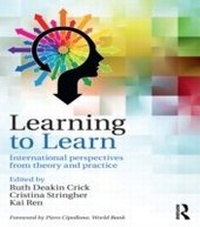
Learning to Learn
International perspectives from theory and practice
1st Edition
Published on 28. April 2014
356 pages
978-1-135-13562-1 (ISBN)
Description

Learning to Learn provides a much needed overview and international guide to the field of learning to learn from a multidisciplinary lifelong and lifewide perspective. A wealth of research has been flourishing on this key educational goal in recent years. Internationally, it is considered to be one of the key competencies needed to compete in the global economy, but also a crucial factor for individual and social well-being. This book draws on leading international contributors to provide a cutting-edge overview of current thinking on learning to learn research, policy, and implementation in both formal and informal learning environments.
But what learning to learn is exactly, and what its constituting elements are, are much debated issues. These seem to be the crucial questions if assessment and development of this 'malleable side of intelligence' are to be accomplished. The approach of this volume is to consider a broad conception of learning to learn, not confined to only study strategies or metacognition, yet acknowledging the importance of such elements.
The book sets out to answer five main questions:
What is learning to learn?
What are its functions and how do we assess it?
What does it promise to the individual and society at large?
How is it conceived in national curricula internationally?
How can it be developed in a variety of contexts?
The text is organized into two parts: the first addresses the core question of the nature of learning to learn from a theoretical and policy viewpoint, and the second presents recent research carried out in several educational systems, with special attention to assessment and curriculum. It gives an account of pedagogical practices of learning to learn and its role in individual empowerment from childhood to adulthood.
Contributors also highlight the potential use of learning to learn as an organizing concept for lifelong learning, school improvement, and teacher training along with potential conflicts with existing incentive practices and policies.
This book is a vital starting point and guide for any advanced student or researcher looking to understand this important area of research.
But what learning to learn is exactly, and what its constituting elements are, are much debated issues. These seem to be the crucial questions if assessment and development of this 'malleable side of intelligence' are to be accomplished. The approach of this volume is to consider a broad conception of learning to learn, not confined to only study strategies or metacognition, yet acknowledging the importance of such elements.
The book sets out to answer five main questions:
What is learning to learn?
What are its functions and how do we assess it?
What does it promise to the individual and society at large?
How is it conceived in national curricula internationally?
How can it be developed in a variety of contexts?
The text is organized into two parts: the first addresses the core question of the nature of learning to learn from a theoretical and policy viewpoint, and the second presents recent research carried out in several educational systems, with special attention to assessment and curriculum. It gives an account of pedagogical practices of learning to learn and its role in individual empowerment from childhood to adulthood.
Contributors also highlight the potential use of learning to learn as an organizing concept for lifelong learning, school improvement, and teacher training along with potential conflicts with existing incentive practices and policies.
This book is a vital starting point and guide for any advanced student or researcher looking to understand this important area of research.
Reviews / Votes
"Learning to Learn can serve as something of a paradigm for excellence in education and learning. It can also function as a helpful text for reflecting on the meta-competencies required to be fully efficient in contemporary vocational contexts. ... Educators will benefit from reading this book ... This material represents an excellent source for advancing new research, while at the same time offering useful applications for educators' practices in their individual higher educational contexts." -Reflective Teaching"All in all, the book covers a wide compass and is certainly of interest for anyone who wishes to pursue the notions behind learning to learn and its connection with lifelong learning [...] It is a book that deserves to be read with interest by those who profess the business of learning." - John Cribbin, International Journal of Continuing Education and Lifelong Learning
"This book draws on leading international contributors to provide a cutting edge overview of current thinking on research, policy, and implementation in both formal and informal learning environments." -Martina Visentin, PHD, Dept. of Political Science, Law, and International Studies at University of Padova, Italy
More details
Language
English
Place of publication
London
United Kingdom
Publishing group
Taylor & Francis Ltd
Target group
College/higher education
Illustrations
37 Tables, black and white; 30 Line drawings, black and white; 1 Halftones, black and white; 31 Illustrations, black and white
File size
3,65 MB
ISBN-13
978-1-135-13562-1 (9781135135621)
Copyright in bibliographic data and cover images is held by Nielsen Book Services Limited or by the publishers or by their respective licensors: all rights reserved.
Schweitzer Classification
Other editions
Additional editions
Kai Ren | Ruth Deakin Crick | CRISTINA STRINGHER
Learning to Learn
International perspectives from theory and practice
Book
04/2014
Routledge
€254.40
Shipment within 15-20 days
Kai Ren | Ruth Deakin Crick | CRISTINA STRINGHER
Learning to Learn
International perspectives from theory and practice
Book
04/2014
Routledge
€70.60
Shipment within 15-20 days
Persons
Ruth Deakin Crick, MEd, PhD, is Reader in Systems Learning and Leadership in the Graduate School of Education at the University of Bristol. She is one of the originators of the Effective Lifelong Learning Inventory, a self-assessment tool for developing learning power. Her research focuses on the implications of complexity and systems thinking for pedagogy. She co-directs the Learning Emergence network.
Cristina Stringher, PhD, is a researcher at the Italian Institute for the Educational Evaluation of Instruction and Training (INVALSI), and a lecturer at Roma Tre University. She currently serves as a member in the Project Advisory Committee of IEA's Early Childhood Education Study. Her interests focus on theoretical and empirical research in learning to learn development, with its lifelong and lifewide applications.
Kai Ren is a post-doctoral researcher at the School of Education, China Shaanxi Normal University. He is also a member of the learning power research team at the Graduate School of Education, Bristol University. Kai's research focuses on learning to learn and how it relates to people's identities and stories.
Cristina Stringher, PhD, is a researcher at the Italian Institute for the Educational Evaluation of Instruction and Training (INVALSI), and a lecturer at Roma Tre University. She currently serves as a member in the Project Advisory Committee of IEA's Early Childhood Education Study. Her interests focus on theoretical and empirical research in learning to learn development, with its lifelong and lifewide applications.
Kai Ren is a post-doctoral researcher at the School of Education, China Shaanxi Normal University. He is also a member of the learning power research team at the Graduate School of Education, Bristol University. Kai's research focuses on learning to learn and how it relates to people's identities and stories.
Content
Introduction Part 1. Theory and policy Stringher, C., Hautamaeki, J./Kupiainen, S. Deakin Crick, R., Alberici, A., Di Rienzo, P., Demetriou, A., Ren, K. Part 2. Research and curriculum Hautamaeki, J., Evans, C., Hautamaeki, J./Kupiainen, S., Moreno, A., Stringher, C. Part 3. L2L in practice Rao, N., Kupiainen, S., Kloosterman, P., Stringher, C., Tornar, C., Sorensen, E. Conclusions
