

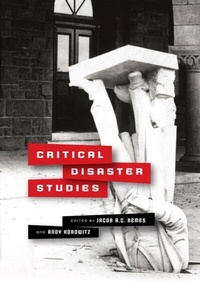
Critical Disaster Studies
1st Edition
Published on 20. August 2021
304 pages
978-0-8122-9972-4 (ISBN)
Description

This book announces the new, interdisciplinary field of critical disaster studies. Unlike most existing approaches to disaster, critical disaster studies begins with the idea that disasters are not objective facts, but rather are interpretive fictions-and they shape the way people see the world. By questioning the concept of disaster itself, critical disaster studies reveals the stakes of defining people or places as vulnerable, resilient, or at risk.
As social constructs, disaster, vulnerability, resilience, and risk shape and are shaped by contests over power. Managers and technocrats often herald the goals of disaster response and recovery as objective, quantifiable, or self-evident. In reality, the goals are subjective, and usually contested. Critical disaster studies attends to the ways powerful people often use claims of technocratic expertise to maintain power.
Moreover, rather than existing as isolated events, disasters take place over time. People commonly imagine disasters to be unexpected and sudden, making structural conditions appear contingent, widespread conditions appear local, and chronic conditions appear acute. By placing disasters in broader contexts, critical disaster studies peels away that veneer.
With chapters by scholars of five continents and seven disciplines, Critical Disaster Studies asks how disasters come to be known as disasters, how disasters are used as tools of governance and politics, and how people imagine and anticipate disasters. The volume will be of interest to scholars of disaster in any discipline and especially to those teaching the growing number of courses on disaster studies.
As social constructs, disaster, vulnerability, resilience, and risk shape and are shaped by contests over power. Managers and technocrats often herald the goals of disaster response and recovery as objective, quantifiable, or self-evident. In reality, the goals are subjective, and usually contested. Critical disaster studies attends to the ways powerful people often use claims of technocratic expertise to maintain power.
Moreover, rather than existing as isolated events, disasters take place over time. People commonly imagine disasters to be unexpected and sudden, making structural conditions appear contingent, widespread conditions appear local, and chronic conditions appear acute. By placing disasters in broader contexts, critical disaster studies peels away that veneer.
With chapters by scholars of five continents and seven disciplines, Critical Disaster Studies asks how disasters come to be known as disasters, how disasters are used as tools of governance and politics, and how people imagine and anticipate disasters. The volume will be of interest to scholars of disaster in any discipline and especially to those teaching the growing number of courses on disaster studies.
Reviews / Votes
"When speaking of disaster henceforth, we cannot escape the ensuing political questions this volume interrogates." (Los Angeles Review of Books) "In a world marked by calamity, this timely volume widens the lens of our understanding by emphasizing the importance of deeply contextualized approaches to the study of disaster. The end result is a vibrant reimagination of the field and a captivating introduction to critical disaster studies." (Lori Peek, University of Colorado Boulder) "This is a vital, iconoclastic volume that turns much conventional thinking about disaster studies on its head. The contributions are lively, geographically varied, and conceptually suggestive. An exciting and invaluable book." (Rob Nixon, Princeton University) "An urgent, timely, and vitally important volume that deserves a wide readership. As the crisis precipitated by the Covid-19 pandemic has made all too clear, this volume's unifying themes-vulnerability, risk, resilience, and disaster-are concepts that every one of us ought to understand, grapple with, and critique." (Julia Irwin, University of South Florida)More details
Series
Language
English
Place of publication
Pennsylvania
United States
Target group
Professional and scholarly
College/higher education
File size
3,55 MB
ISBN-13
978-0-8122-9972-4 (9780812299724)
Copyright in bibliographic data and cover images is held by Nielsen Book Services Limited or by the publishers or by their respective licensors: all rights reserved.
Schweitzer Classification
Other editions
Additional editions
Jacob A.C. Remes | Andy Horowitz
Critical Disaster Studies
Book
08/2021
University of Pennsylvania Press
€33.00
Shipment within 10-20 days
Persons
Andy Horowitz is Assistant Professor of History and the Paul and Debra Gibbons Professor in the School of Liberal Arts at Tulane University. Jacob A. C. Remes is Clinical Associate Professor of History at the Gallatin School of Individualized Study, New York University.
Content
Introduction. Introducing Critical Disaster Studies
Andy Horowitz and Jacob A. C. Remes
Part I. Knowing Disaster
Chapter 1. The Voyage of the Paragon: Disaster as Method
Scott Gabriel Knowles and Zachary Loeb
Chapter 2. Acts of God, Man, and System: Knowledge, Technology, and the Construction of Disaster
Ryan Hagen
Chapter 3. When Does a Crisis Begin? Race, Gender, and the Subprime Noncrisis of the Late 1990s
Dara Z. Strolovitch
Part II. Governing Disaster
Chapter 4. Concrete Kleptocracy and Haiti's Culture of Building: Toward a New Temporality of Disaster
Claire Antone Payton
Chapter 5. Risk Technopolitics in Freetown Slums: Why Community-Based Disaster Management Is No Silver Bullet
Aaron Clark-Ginsberg
Chapter 6. Spaces at Risk: Urban Politics and Slum Relocation in Chennai, India
Pranathi Diwakar
Chapter 7. Plan B: The Collapse of Public-Private Risk Sharing in the US National Flood Insurance Program
Rebecca Elliott
Part III. Imagining Disaster
Chapter 8. Mediating Disaster, or A History of the Novel
Susan Scott Parrish
Chapter 9. The Tokai Earthquake and Changing Lexicons of Risk
Kerry Smith
Chapter 10. Translating Disaster Knowledge from Japan to Chile: A Proposal for Incompleteness
Chika Watanabe
Afterword. "Acts of Men": Disasters Neglected, Preventable, and Moral
Kenneth Hewitt
Notes
Bibliography
Index
List of Contributors
Acknowledgments
Andy Horowitz and Jacob A. C. Remes
Part I. Knowing Disaster
Chapter 1. The Voyage of the Paragon: Disaster as Method
Scott Gabriel Knowles and Zachary Loeb
Chapter 2. Acts of God, Man, and System: Knowledge, Technology, and the Construction of Disaster
Ryan Hagen
Chapter 3. When Does a Crisis Begin? Race, Gender, and the Subprime Noncrisis of the Late 1990s
Dara Z. Strolovitch
Part II. Governing Disaster
Chapter 4. Concrete Kleptocracy and Haiti's Culture of Building: Toward a New Temporality of Disaster
Claire Antone Payton
Chapter 5. Risk Technopolitics in Freetown Slums: Why Community-Based Disaster Management Is No Silver Bullet
Aaron Clark-Ginsberg
Chapter 6. Spaces at Risk: Urban Politics and Slum Relocation in Chennai, India
Pranathi Diwakar
Chapter 7. Plan B: The Collapse of Public-Private Risk Sharing in the US National Flood Insurance Program
Rebecca Elliott
Part III. Imagining Disaster
Chapter 8. Mediating Disaster, or A History of the Novel
Susan Scott Parrish
Chapter 9. The Tokai Earthquake and Changing Lexicons of Risk
Kerry Smith
Chapter 10. Translating Disaster Knowledge from Japan to Chile: A Proposal for Incompleteness
Chika Watanabe
Afterword. "Acts of Men": Disasters Neglected, Preventable, and Moral
Kenneth Hewitt
Notes
Bibliography
Index
List of Contributors
Acknowledgments
