

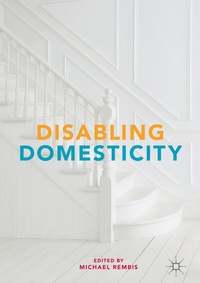
Disabling Domesticity
Published on 20. December 2016
XIX, 355 pages
978-1-137-48769-8 (ISBN)
Description

Bringing together a range of authors from the multidisciplinary field of disability studies, this book uses disability and the experiences of disabled people living in the United States and Canada to explore and analyze dynamic sites of human interaction in both historical and contemporary contexts to provide readers with new ways of envisioning home, care, and family. Contributors to Disabling Domesticity focus on the varied domestic sites where intimate - and interdependent - human relations are formed and maintained. Analyzing domesticity through the lens of disability forces readers to think in new ways about family and household forms, care work, an ethic of care, reproductive labor, gendered and generational conflicts and cooperation, ageing, dependence, and local and global economies and political systems, in part by bringing the notion of interdependence, which undergirds all of the chapters in this book, into the foreground.
Reviews / Votes
"This superb collection of essays brings readers to the threshold of multiple sites of disability oppression and resistance and promises to destabilize our taken for granted relations to family, home, and community while nurturing new possibilities of belonging. Throughout Disabling Domesticity, readers will experience a pedagogy of relationality where we are invited to reconsider what sort of lives with disability we have created together." (Tanya Titchkosky, Professor of Social Justice Education, OISE of the University of Toronto, Canada, and the author of "The Question of Access: Disability, Space, Meaning and Reading and Writing Disability Differently: The Texured Life of Embodiment and Disability, Self and Society") <"This important book shifts disability studies in a needed direction: it examines the understudied and often maligned "private" domestic spaces and interactions. Most significant, Disabling Domesticity shows why the disability rights movement needs to re-think the primacy of "independence" and to recognize and value interdependence. Filled with illuminating and intimate accounts and critical analysis." (Leslie J. Reagan, Professor of History, Medicine, Law, Gender, and Women's Studies University of Illinois-Urbana-Champaign, USA, and the author of "Dangerous Pregnancies: Mothers, Disabilities, and Abortion in America") "This book accomplishes all that an anthology should and more, bringing together diverse voices and perspectives to offer fresh insights with each chapter. The fascinating range of topics and fields, each delivering compelling arguments, together form a unique and important pathway to reformulating our ideas of family, home, and domesticity in light of disability studies. The kitchen table, the American dream home, and motherhood are among the icons that emerge with new meaning and potential as we see the power of disability theory to deconstruct and re-imagine our social world."(Allison C. Carey, Professor of Sociology and Disability Studies at Shippensburg University, USA, and the author of "On the Margins of Citizenship: Intellectual Disability and Civil Rights in 20th Century America") "From the design of thresholds to the shape of kinship, the essays in this volume bring critical disability studies to bodies, ideas, and spaces marked 'private.' 'The home' has never been a comfortable place for bodyminds disabled by narrowly normative standards and narrowly built doors - and the binary public/private has put us in our place for far too long. These essays energetically analyze the workings of that logic, and work to envision futures built along different lines."(Christina Crosby, Professor of English and Feminist, Gender, and Sexuality Studies, Wesleyan University, USA, and the author of "A Body, Undone: Living on After Great Pain")More details
Series
Edition
1st ed.
Language
English
Place of publication
New York
United States
Publishing group
Palgrave Macmillan US
Target group
Professional and scholarly
Product notice
Reflowable
Illustrations
XIX, 355 p. 3 illus. in color.
File size
3,34 MB
ISBN-13
978-1-137-48769-8 (9781137487698)
DOI
10.1057/978-1-137-48769-8
Schweitzer Classification
Other editions
Additional editions
Michael Rembis
Disabling Domesticity
Book
12/2016
Palgrave MacMillan
€123.04
Shipment within 10-20 days
Person
Michael Rembis is Director of the Center for Disability Studies and Associate Professor of History at the University at Buffalo (SUNY), USA. He has authored or edited many books, articles, and book chapters, including:
Defining Deviance: Sex, Science, and Delinquent Girls, 1890-1960
(2011);
Disability Histories
co-edited with Susan Burch (2014); and
The Oxford Handbook of Disability History
co-edited with Kim Nielsen and Catherine Kudlick (forthcoming).
Content
Introduction .- From "Blind Susan" to Incidents in the Life of a Blind Girl: How Mary L. Day Disabled Domesticity .- Crossing the Threshold: Disability and Modernist Housing .- The Largest Occupational Group of All the Disabled: Homemakers with Disabilities and Vocational Rehabilitation in Postwar America .- Rethinking the American Dream Home: The Disability Rights Movement and the Cultural Politics of Accessible Housing in the United States .- A Feminist Technoscientific Approach to Disability and Caregiving in the Family .- Inevitable Intersections: Care, Work, and Citizenship .- Reclaiming the Sexual Rights of LGBTQ People with Attendant Care Dependent Mobility Impairments .- "Everybody Has Different Levels of Why They Are Here": Deconstructing Domestication in the Nursing Home Setting .- Contesting the Neoliberal Affects of Disabled Parenting: Towards a Relational Emergence of Disability .- The Mad Woman in the Garden: DecolonizingDomesticity in Shani Mootoo's Cereus Blooms at Night .- Gatekeepers of Normalcy: The Disablement of Families in the Master Narratives of Psychology .- Postfeminist Motherhood?: Reading a Differential Deployment of Identity in American Women's HIV Narratives .- Melting Down the Family Unit: A Neuroqueer Critique of Table-Readiness.
