

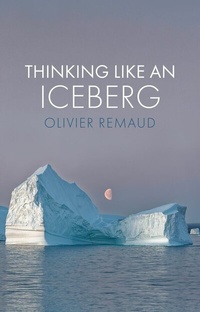
Thinking Like an Iceberg
Description

When we imagine the polar regions, we see a largely lifeless world covered in snow and ice where icebergs drift listlessly through frozen waters, like solitary wanderers of the oceans floating aimlessly in total silence. But nothing could be further from the truth.
This book takes us into the fascinating world of icebergs and glaciers to discover what they are really like. Through a series of historical vignettes recalling some of the most tragic and most exhilarating encounters between human beings and these gigantic pieces of matter, and through vivid descriptions of their cycles of birth and death, Olivier Remaud shows that these entities are teeming with many forms of life and that there is a deep continuity between iceberg life and human life, a complex web of reciprocal interconnections that can lead from the deadliest to the most vital. And precisely because there is this continuity, icebergs and glaciers tell us something important about life itself – namely, that it thrives in the most unexpected of places, even where there seems to be no life at all.
At a time when we are increasingly aware that the melting of ice sheets, glaciers and sea ice is one of the many disastrous consequences of global warming, this beautiful meditation is a poignant reminder of the interconnectedness of all life and the fragility of the Earth’s ecosystems.
Olivier Remaud is Professor of Philosophy at the Ecole des Hautes Etudes en Sciences Sociales (EHESS), Paris.
More details
Other editions
Additional editions
Persons
Content
The issue
Prologue: They are coming!
Chapter 1: Through the looking glass
Chapter 2: The eye of the glacier
Chapter 3. Unexpected lives
Chapter 4: Social snow
Chapter 5: A less lonely world
Chapter 6: Thinking like an iceberg
Epilogue: Return to the ocean
Notes
2
The Eye of the Glacier
The night was becoming increasingly opaque. With headlamps adjusted to foreheads, we progressed in single file along the steep mountainside. The path was still well marked, the lights reassuring. The valley had disappeared below. In front of us, immense proportions. The higher we climbed, the smaller we became.
We had left just before dusk. We had been walking for a few hours and our field of vision was narrowing. I was dependent on the shaking cone of light in front of me. All around our procession, creatures that hide during the day were awakening. The owls began to hoot. Perhaps they were looking for dead wood to build their nests in a trunk that a woodpecker had abandoned. Perhaps they were males singing nuptial songs. They brushed past us in silence. Without doubt they were watching us with their big hypnotic eyes, like revolving headlights.
Beyond the tree line, the path became lined with small piles of pebbles and rocks. We were entering the moraines. We had to attach our ropes to avoid any unnecessary risk.
So other, so close
As far as I can remember, the hut appeared a little before 2 o'clock in the morning. It was discreetly perched on a rocky promontory with no more available space. We checked out the terrace. It was quite welcoming, despite the bitter cold. As the sky was starry, we decided to have a rest outside. An hour of sleep, no more. We had to get back on the trail before the snow melted further up. All around the hut, ice had replaced the moraine. Once the crampons had been attached and the harnesses put on, our company set off again, rope taut and with a heavy step. A long silence settled in. All we could hear was breathing. We had the summit of Mont Blanc du Tacul in our sights.
Suddenly, the view closed up. It was very dark around us. My headlamp flickered, as if the ice floor had started to shake, and the gradient sloped even more. One of the leather straps on my crampons was probably loose. My shoe slipped, my ankle twisted. I stumbled and lost my balance. Below me, lights flashed: my ice axe disappeared into the darkness of the valley. My right leg had hit the rock. My knee was bruised. I, for one, would miss out on the summit.
Many years later, we are driving along the bed of an ancient glacier, now a stony dirt road. Our friend Þorvarður Árnason is concentrating. The mud fills the wheels of his jeep, and the uneven terrain throws us in all directions. A fine drizzle has been falling since the morning. High walls surround us, as if in a valley floor. Then we abandon the vehicle and start the walk that should lead us to the foot of the glacier. Not far away, we can hear the rustle of a waterfall. We cross a field of boulders piled up on top of each other. Not a tree in sight. There are only rocks of varying sizes.
We see it at the foot of a hill. The ice is surrounded by a belt of clayey silt. We descend to a sort of stony clearing and enter a cave at the bottom. The sun is weak but its rays pierce the damp curtain. They illuminate the transparent ceiling. Frozen shapes appear: air bubbles, filaments of dust, sprays of grass and leaves, fragments of flint. Everything is crystallised. The smooth walls of the cave are in shades of blue. We caress the silhouettes. The hand does not stay long. At the bottom, a current sprays onto the rock. The torrent roars. Above, the glacier creaks. It perspires as well. Drops fall to the ground.
We crawl on all fours so as not to touch the ice stalactites. I learn that they are yesterday's and that they will not last the night. Dusk arrives. We exit again. The place looks like a lunar outpost. It is completely different and asks nothing of us. We say goodbye to Breiðamerkurjökull, as if to an old acquaintance.
From the tangle of seracs to the cave of a formerly coastal glacier, the memory of my aborted mountain trek reflected back on our hike that day. In heights of the Alps I had already had the feeling that the ice had moved under my feet and that I had awakened a being that was languishing in its sleep. As if we had entered a place where we were making too much noise and its owner had watched us with a frown. In the southeast of Iceland, I again had the impression that an eye was watching us, that a spirit was spying on our movements, listening to our conversations and enjoying our silences. I was as fascinated as young Unn in Tarjei Vesaas's Ice Palace when she guesses that she is not alone in the crevices of a great waterfall that has been transformed by the ice into a marvellous mansion.
Several memories came back to me. They were white impressions: the fine, crunchy snow in the woods of my childhood in Touraine, a landscape of well-powdered fir trees in the Black Forest, the sound of dripping under a bridge of frost at the bottom of a valley in the Queyras, a blinding light during the brief stop of a train in a high-altitude station between Oslo and Bergen.
These winter memories had already resurfaced. This time they made me even more perplexed by the modern need to place a mirror between oneself and nature. I had been intrigued for some time by the endurance of so many travellers who stumbled, like innocent insects, on their reflections, believing themselves protected by their utopias as much as by their fears. In Iceland, I understood that some of them had felt scrutinised.
They lacked the words to translate this experience. They were trying to solve an enigma that was not just one of a sublime spectacle. It was that of a different life that had to be appreciated for itself. They wanted to see those who were watching them and who were not always pleased. Since they lacked the appropriate language, their best guess was that the mirror was one-way.
Way up above
A drop of liquid falls from the sky in the shape of a snowflake.
The writer Eugène Rambert reminds us that snowflakes can travel great distances, from the Atlantic Ocean to the peaks of the Alps and back to the sea via the Danube, the Rhone, the Po or even the Rhine. Its wandering lasts from a few hours to half a century. It all depends on the winds. Then it reaches the ground. Its needles become rounder and eventually disappear. The flake becomes an ice crystal. It merges with other flakes that do the same. A névé is formed. The crystals agglomerate again and become a glacier. In this way the snow piles up into compact ice on the slopes of the Bossons glacier in the Chamonix Valley. Then the crystals melt and the flake returns to its original condition as a drop of water: 'Describing a glacier means telling the story of this journey.'1
The snowflake's adventure is experienced differently in the mountains. The winter months were for a long time a period of anxiety and withdrawal. They were dreaded because it was a time of blizzards, snowdrifts and travel that was frustrated, sometimes made impossible. Bells warning of storms helped those who had lost the trail to reach the village.2
Snow was associated with the disasters caused by glaciers breaking out of their beds. No prayer or procession of monks could stop them wreaking havoc - 'surging', as the Anglo-Saxon glaciologists say. The internal water pockets, which form during the summer melt, gave way and flooded first the pastures and then the habitations below. Blocks of ice shot up into the air and fell in pieces on the houses. Lakes with small icebergs floating in them appeared. Entire valleys were blocked by serac avalanches. Ice avalanches are part of the history of the Alps. Memories of monumental ice break-ups were a feature of fireside chats many years later. The fear of such events made mountain people stick together. The villagers protected themselves together from the wrath of the hanging behemoths. Together they rebuilt their walls and streets.
The glaciers 'up there' evoke a distant world. Sometimes we avoid it. Sometimes it meets us. Crossing snow-covered mountain pastures is never without risk. When Élisée Reclus became interested in this natural environment, winter travel still required residents to take great precautions. Most vehicles were not able to withstand winter's fury. Sledges replaced carts and mules to cross the passes. They offered privileged views of the relief and veins of the landscape:
It is by travelling in this way by sledge over the mountain passes that one can learn to get to know the great snows well. The light frame glides noiselessly; you no longer feel the impact of the iron on the solid ground, and you feel as if you were travelling in space, carried away like a spirit. Sometimes one skirts the curve of a ravine, sometimes the projection of a promontory; one passes from the bottom of chasms to the edge of precipices and, in all these varied forms which one views one after the other, the mountain maintains its uniform whiteness. If the sun shines on the surface of the snow, innumerable diamonds shine; if the sky is grey and low, the elements seem to merge. Clouds, snowy mounds - all look the same. It is like floating in infinite space, no longer belonging to the earth.3
Travelling by sled was a way of incorporating the countryside, of living at its pace by following its contours. Close to the snow, one understood its varieties, circumvented its traps, and moved with the ease of a bird in flight or a high-country sprite. It was on the way back down that the mountain would test you most rudely, especially during the touring season. The sled often got out of control...
