

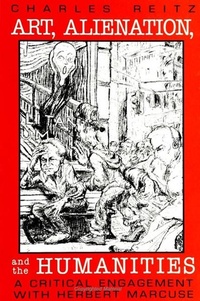
Art, Alienation, and the Humanities
A Critical Engagement with Herbert Marcuse
1st Edition
Published on 10. February 2000
352 pages
978-0-7914-9315-1 (ISBN)
Description

Illustrates how Marcuse's theory sheds new light on current debates in both education and society involving issues of multiculturalism, postmodernism, civic education, the "culture wars," critical thinking, and critical literacy.
Winner of the 2002 American Educational Studies Association's Critics' Choice Award
By examining the aesthetic, social, and educational philosophy of Herbert Marcuse, the author documents and demonstrates the structure and movement of Marcuse's thought on art, alienation, and the humanities. Reitz's work stresses the centrality of Marcuse's argument that the arts and humanities may act as disalienating educational forces.
Charles Reitz is Professor of Philosophy and Coordinator of Service Learning at Kansas City Kansas Community College.
Winner of the 2002 American Educational Studies Association's Critics' Choice Award
By examining the aesthetic, social, and educational philosophy of Herbert Marcuse, the author documents and demonstrates the structure and movement of Marcuse's thought on art, alienation, and the humanities. Reitz's work stresses the centrality of Marcuse's argument that the arts and humanities may act as disalienating educational forces.
Charles Reitz is Professor of Philosophy and Coordinator of Service Learning at Kansas City Kansas Community College.
More details
Other editions
Additional editions
Book
02/2000
State University of New York Press
€109.91
Article exhausted; check different version
Book
02/2000
State University of New York Press
€36.00
Shipment within 10-20 days
Person
Charles Reitz is Professor of Philosophy and Coordinator of Service Learning at Kansas City Kansas Community College.
Content
Acknowledgments
Author's Note
1. Recalling Marcuse: Art, Alienation, and the Humanities
2. Literary Art and Bildung: Marcuse's Early Works
Der deutsche Kunstlerroman: The German Artist Novel
The Artist's Education from Alienation to Maturity
Marcuse and Dilthey
3. The Emergent Critical Theory of Alienation: The Laws of Beauty versus the Law of the Thing
Alienation as Verdinglichung: Cornerstone of Critical Theory
4. The Emergent Critical Theory of Art: Marcuse's Middle Period
Art and The Actualization of Utopia
5. Marcuse's Aesthetic Ontology
The "Aesthetic Dimension" in Eros and Civilization
The Rationality of Art and the Denial of Things
6. Imagination, Death, and Educational Reminiscence
7. Alienation and Art in the One-Dimensional Society
Art and the Potential for Protest
8. Art Against Alienation: Aesthetic Education and Political Praxis
The Great Refusal and Lebensphilosophie
Education and Social Change
9. Art as Alienation: Marcuse's "Turn" and Return
10. The Future-Liberating the Critical in Critical Theory
The Irony of the Beautiful Soul of Herbert Marcuse
The Dialectics of Liberation and Learning
A Concluding Backward Glance
Appendix: Charter 2000: A Comprehensive Political Platform
Notes
Glossary
Bibliography
Name Index
Subject Index
