

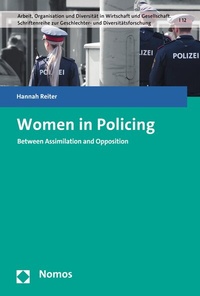
Women in Policing
Between Assimilation and Opposition
1st Edition
Published on 26. January 2022
229 pages
978-3-7489-3028-0 (ISBN)
Description

Basierend auf umfangreichen Interviewdaten wird begründet, dass die Polizei der untersuchten Länder (Österreich, England & Wales) aus stark verfestigten Strukturen besteht, die geschlechtsspezifische Trennlinien und die hegemoniale Position der Männlichkeit perpetuieren. Um einen umfassend inklusiven Arbeitsort zu schaffen, muss die Polizei anders gedacht werden, anstelle einer simplen Erhöhung des Frauenanteils in einem männlich-konzipierten Arbeitsumfeld. Gleichstellungsmaßnahmen erweisen sich lediglich als Symptombekämpfung, anstatt Ursachen zu adressieren. Der von rechtlichen Maßnahmen bestärkte strukturelle Wandel scheint zu stagniert, während ein weitergehender diskursiver sowie kultureller Wandel vernachlässigt wird.
More details
Other editions
Additional editions
Book
01/2022
1st Edition
Nomos
€49.00
Shipment within 7-9 days
Content
- Cover
- 1. Introduction
- 2. Context of the Study and Theoretical Approach
- 2.1 Police as Research Subject
- 2.2 Police in England and Wales & Police in Austria
- 2.3 Women in the Police
- 2.4 A Short Remark on Gender
- 2.5 Police Culture and Masculinity
- 2.6 Equality Law(s) & Equal Opportunity Policies
- 2.6.1 Why Equality Policies
- 2.6.2 Equality Policies in the Police
- 2.7 Background of the Study
- 3. Methodology
- 3.1 Research Question
- 3.2 Research Design
- 3.3 Method - Semi-structured Interviews
- 3.4 Method - Participatory Observation
- 3.5 Method - Grounded Theory
- 3.6 Ethical Issues
- 4. Method and Field Research
- 4.1 Access and Sample
- 4.2 Research Process
- 4.3 Data Analysis
- 4.4 Reflection on the Research Process
- 5. Findings
- 5.1 Motivational Factors for Joining the Police
- 5.1.1 Doing Something Meaningful
- 5.1.2 Career Plan vs. Spontaneous Application
- 5.1.3 The Importance of Previous Experiences
- 5.1.4 Nature of the Job
- 5.1.5 Career Opportunities
- 5.1.6 Exposure to Police
- 5.1.7 Interim Findings
- 5.2 Recruitment, Application and (Further) Training
- 5.2.1 Recruitment and Application
- 5.2.2 Training
- 5.2.3 Policing as a Career
- 5.2.4 Special Issues
- 5.2.5 Interim Findings
- 5.3 Police Work
- 5.3.1 The Variety of Police Work
- 5.3.2 What Constitutes ("Good") Policing?
- 5.3.3 Dealing with the Job
- 5.3.4 Structural Issues
- 5.3.5 Interim Findings
- 5.4 Internal Dynamics
- 5.4.1 The Acceptance of Female Officers in the "Boys' Club"
- 5.4.2 Perceived Gender Differences in Policing
- 5.4.3 Getting Along and Getting Ahead
- 5.4.4 Incidents of Sexism and Misogyny
- 5.4.5 Internal Developments
- 5.4.6 Interim Findings
- 5.5 External Dynamics
- 5.5.1 Communicating with the Public - Between Respect and De-escalation Strategies
- 5.5.1.1 The Issue of Respect and Prejudice
- 5.5.1.2 De-escalation Strategies
- 5.5.1.3 Dealing with Sexism
- 5.5.2 Witness Questioning and Protection
- 5.5.4 Interim Findings
- 5.6 Gender Dynamics
- 5.6.1 Women's Issues in a Male Environment
- 5.6.2 Equal Pay - Equal Workload?
- 5.6.2.1 Part-Time Work
- 5.6.2.2 Care Work
- 5.6.3 Equal Opportunities Policies and Related Schemes
- 5.6.3.1 Equality, Equity, Diversity
- 5.6.3.2 The Reception within the Police Force
- 5.6.3.3 Self-Perception
- 5.6.3.4 Women's Networks and Equality Commissioners
- 5.6.3.5 Perceived Gendered Difficulties
- 5.6.4 Improvements and Changes in Police Culture
- 5.6.5 Interim Findings
- 5.7 Intersectional Aspects
- 5.7.1 Diversity and Inclusivity
- 5.7.2 Networks and Visibility
- 5.7.3 Interim Findings
- 6. Conclusion
- References
- Online Sources
- Legal Sources
- Literature
