

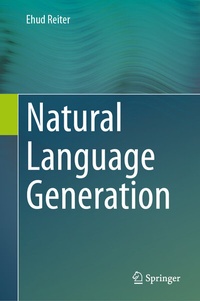
Natural Language Generation
Description

In late 2022, the prominence of Natural Language Generation (NLG) surged with the advent of advanced language models like ChatGPT. While these developments have captivated both academic and commercial sectors, the focus has predominantly been on the latest innovations, often overlooking the rich history and foundational work in NLG. This book aims to provide a comprehensive overview of NLG, encompassing not only language models but also alternative approaches, user requirements, evaluation methods, safety and testing protocols, and practical applications. Drawing on decades of NLG research, the book is designed to be a valuable resource for both researchers and developers, offering insights that remain relevant far beyond the current technological landscape.
Natural Language Generation focuses on data-to-text but also looks at other types of NLG including text summarization. The book takes a holistic approach to NLG, looking at requirements (what users are looking for), design, data issues, testing, evaluation, safety and ethical issues as well as technology. The holistic approach is unique to this book and is very valuable for people building real-world NLG systems, and for academics and researchers who are interested in applied NLG.
The author, who previously co-authored a seminal NLG book in 2000, emphasizes high-level concepts and methodologies, ensuring the material's longevity and utility. The book is structured to balance technical depth with practical relevance, including chapters on rule-based and neural NLG approaches, user requirements, rigorous evaluation techniques, and safety considerations. Real-world applications, particularly in journalism, business intelligence, summarization, and medicine, are explored to illustrate NLG's potential and scalability. With personal anecdotes and examples from the author's experiences, this book provides a unique and engaging perspective on the evolving field of NLG, making it an indispensable guide for those looking to harness the power of language generation technologies.
More details
Other editions
Additional editions
Person
Ehud Reiter is a Professor of Computing Science at the University of Aberdeen and had been Chief Scientist of Arria NLG (which he cofounded). In both roles he works on Natural Language Generation. He has been working on NLG since getting his PhD in NLG in 1990 (from Harvard), and is one of the most published and cited authors in the field. He has over 200 academic papers and 8 patents. He was chair of the Association for Computation Linguistics Special Interest Group in Generation (SIGGEN) from 2019-2022, and was awarded a Test of Time award for his NLG work in 2022.
Content
1. Introduction to NLG.- 2. Rule-based NLG.- 3. Machine Learning and Neural NLG.- 4. Requirements.- 5. Evaluation.- 6. Safety, testing, and maintenance.- 7. Applications.- Index.
