

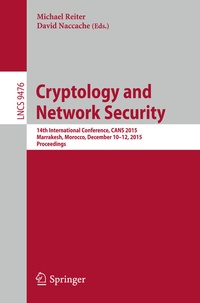
Cryptology and Network Security
14th International Conference, CANS 2015, Marrakesh, Morocco, December 10-12, 2015, Proceedings
Published on 19. November 2015
X, 257 pages
978-3-319-26823-1 (ISBN)
Description

This book constitutes the refereed proceedings of the 14th International Conference on Cryptology and Network Security, CANS 2015, held in Marrakesh, Morocco, in December 2015.
The 12 full papers presented together with 6 short papers were carefully reviewed and selected from numerous submissions. The papers cover topics of interest such as internet of things and privacy; password-based authentication; attacks and malicious code; security modeling and verification; secure multi-party computation; and cryptography and VPNs.
More details
Series
Edition
1st ed. 2015
Language
English
Place of publication
Cham
Switzerland
Publishing group
Springer International Publishing
Product notice
Reflowable
Illustrations
X, 257 p. 41 illus. in color.
File size
16,20 MB
ISBN-13
978-3-319-26823-1 (9783319268231)
DOI
10.1007/978-3-319-26823-1
Schweitzer Classification
Other editions
Additional editions
Michael Reiter | David Naccache
Cryptology and Network Security
14th International Conference, CANS 2015, Marrakesh, Morocco, December 10-12, 2015, Proceedings
Book
11/2015
Springer
€51.36
Shipment within 10-15 days
Content
- Intro
- Preface
- Organization
- Contents
- Internet of Things and Privacy
- PUDA -- Privacy and Unforgeability for Data Aggregation
- 1 Introduction
- 2 Problem Statement
- 2.1 PUDA Model
- 2.2 Security Model
- 3 Idea of our PUDA Protocol
- 4 PUDA Instantiation
- 4.1 Shi-Chan-Rieffel-Chow-Song Scheme
- 4.2 PUDA Scheme
- 5 Analysis
- 5.1 Aggregator Obliviousness
- 5.2 Aggregate Unforgeability
- 5.3 Performance Evaluation
- 6 Related Work
- 7 Concluding Remarks
- A Security Evidence for the LEOM Assumption
- B Aggregate Unforgeability
- References
- A Security Framework for Internet of Things
- 1 Introduction
- 2 Related Work
- 3 Background
- 3.1 Organization-Based Access Control Model (OrBAC)
- 3.2 Main Architectures for IoT Access Control
- 4 SmartOrBAC
- 4.1 SmartOrBAC Abstraction Layers
- 4.2 Enhancing OrBAC for Context Awareness
- 4.3 Scenario
- 5 Implementation
- 6 Conclusion
- References
- Privacy-Aware Authentication in the Internet of Things
- 1 Introduction
- 2 Internet Security Protocols
- 3 RFID Privacy Models
- 4 IPsec-Conform Authentication
- 4.1 IPsec Conformance of Existing Protocols
- 4.2 Possible Realizations
- 4.3 IPsec-Conform Privacy-Aware Authentication
- 5 Conclusion
- References
- Password-Based Authentication
- Security of Linear Secret-Sharing Schemes Against Mass Surveillance
- 1 Introduction
- 2 Preliminaries
- 2.1 Secret Sharing
- 2.2 Linear Secret Sharing
- 3 Subverting Secret-Sharing
- 3.1 Definitions
- 3.2 Share-Fixing
- 3.3 Shares Replacement Attack
- 4 Subversion Resilient Secret Sharing
- 4.1 Multi-input Secret Sharing
- 4.2 Definitions
- 4.3 Subversion Resilient Multi-input LSSS
- References
- Secure Set-Based Policy Checking and Its Application to Password Registration
- 1 Introduction
- 2 Related Work
- 3 Preliminaries
- 3.1 Policies and Linear Secret Sharing
- 3.2 Oblivious Bloom Intersection
- 4 Secure Set-Based Policy Checking (SPC)
- 4.1 SPC Instantiation
- 4.2 Security
- 5 A New Password Registration Protocol
- 5.1 Passwords and Password Policies
- 5.2 The Password Registration Protocol
- 5.3 Security Analysis
- 5.4 Password-Authenticated Key Exchange for Our Protocol
- 6 Implementation and Evaluation
- 7 SPC Applications
- 8 Conclusion and Future Work
- References
- SEPM: Efficient Partial Keyword Search on Encrypted Data
- 1 Introduction
- 1.1 Background
- 1.2 Key Techniques
- 1.3 Our Contributions
- 2 Preliminaries
- 2.1 Notations
- 2.2 Dual Pairing Vector Spaces (DPVS)
- 2.3 Decisional Linear (DLIN) Assumption
- 3 Inner-Product Encryption with Trapdoor Conversion
- 3.1 Syntax of IPE-TC
- 3.2 Security Definition
- 4 Proposed IPE-TC Scheme
- 5 Overview of SEPM Using IPE-TC
- A Preliminaries Lemmas
- References
- Attacks and Malicious Code
- Bad Sounds Good Sounds: Attacking and Defending Tap-Based Rhythmic Passwords Using Acoustic Signals
- 1 Introduction
- 2 Background
- 2.1 System Model
- 2.2 Threat Model and Attack Phases
- 3 Attack Overview and Scenarios
- 3.1 Automated Attacks
- 3.2 Human Attacks
- 4 Attack Design and Implementation
- 4.1 Automated Attack
- 4.2 Human Attack
- 5 Attack Experiments and Evaluation
- 5.1 Automated Attack
- 5.2 Human Attack
- 6 Defense: Masking the Audio Channel
- 6.1 Background
- 6.2 Our Defense Model
- 6.3 Defense Experiments
- 7 Discussion and Future Work
- 8 Conclusion
- References
- iDeFEND: Intrusion Detection Framework for Encrypted Network Data
- 1 Introduction
- 2 Framework Design
- 3 Function Identification Using the Detector
- 4 Information Extraction Using the Collector
- 5 Packet Injection and Interception
- 6 Implementation
- 7 Related Work
- 8 Conclusion
- References
- On the Weaknesses of PBKDF2
- 1 Introduction
- 2 PBKDF 2
- 3 HMAC
- 4 Weaknesses
- 4.1 Precomputing a Message Block
- 4.2 Useless XOR Operations
- 4.3 Precomputing a Word-Expansion
- 5 Discussion and Conclusions
- References
- Security Modeling and Verification
- Verifiable Random Functions from (Leveled) Multilinear Maps
- 1 Introduction
- 2 Preliminaries
- 2.1 Verifiable Random Function
- 2.2 Assumption
- 3 VRF Construction from the (n, K)-MMDDHE Assumption
- 4 Proof of Security
- 5 Conclusions
- A Appendix
- A.1 Proof of Lemma 1
- A.2 Proof of Lemma 2
- A.3 Proof of Lemma 3
- References
- A Formal Environment for MANET Organization and Security
- 1 Introduction
- 2 A Reputation-Based Trust Management Scheme
- 3 MCA Formal Specification and Validation
- 3.1 Preliminaries
- 3.2 Formal Specification
- 3.3 Soundness and Completeness Validation
- 4 TMCA and Delegation Process Specification and Validation
- 4.1 Formal Specification
- 4.2 Soundness and Completeness Validation
- 5 Conclusion
- References
- Analysis and Implementation of an Efficient Ring-LPN Based Commitment Scheme
- 1 Introduction
- 2 Preliminaries
- 3 Ring-LPN Based Commitment Scheme
- 4 Recommended Parameter Choices
- 5 Efficiency Issues and Implementation
- References
- Secure Multi-party Computation
- Practical Password-Based Authentication Protocol for Secret Sharing Based Multiparty Computation
- 1 Introduction
- 1.1 Requirements for SS-Based MPC's Authentication
- 1.2 Our Contribution
- 1.3 Related Works
- 1.4 Protocol Overview
- 2 Preliminaries and Models
- 2.1 Communication Model
- 2.2 Shamir's Secret Sharing
- 2.3 Password-Based Authentication Protocol for SS-Based MPC
- 3 Our Basic Protocol
- 3.1 General Architecture
- 3.2 Details of the Protocol
- 4 Optimization for Practical Network Model and Experiment
- 4.1 Network Model
- 4.2 Optimization for Gateway Network Model
- 4.3 Experimental Results
- 5 Conclusion
- A Other Methods to Generate Random and Zero Shares
- References
- Bandwidth-Optimized Secure Two-Party Computation of Minima
- 1 Introduction
- 2 Background
- 2.1 Related Work
- 3 Analysis of Efficient Secure Argmin Protocols
- 3.1 Garbled Circuits (GC)
- 3.2 Goldreich-Micali-Wigderson (GMW)
- 3.3 Homomorphic Encryption (HE)
- 4 Bandwidth-Optimized Min and Argmin
- 4.1 Security Discussion
- 5 Evaluation
- 5.1 Quantitative Communication Overhead Analysis
- 5.2 Performance Evaluation
- 6 Conclusion
- A Min and Argmin with Shared Inputs
- References
- Outsourcing Secure Two-Party Computation as a Black Box
- 1 Introduction
- 2 Related Work
- 3 Protocol
- 3.1 Setting
- 3.2 Protocol Description
- 4 Performance Evaluation
- 4.1 System Design
- 4.2 Execution Time
- 4.3 Communication Cost
- References
- Cryptography and VPNs
- What Users Should Know About Full Disk Encryption Based on LUKS
- 1 Introduction
- 2 Password Management
- 2.1 PBKDF2: A Key Derivation Function
- 3 Linux Unified Key Setup
- 3.1 Master Key Recovery
- 4 Analysis of a LUKS Implementation
- 4.1 Iteration Counts: Where and How
- 4.2 Iteration Counts and Hash Functions
- 4.3 Iteration Counts and Power Management
- 4.4 Testing
- 5 Discussion and Conclusions
- References
- Q-OpenVPN: A New Extension of OpenVPN Based on a Quantum Scheme for Authentication and Key Distribution
- 1 Introduction
- 2 OpenVPN
- 3 Related Works and Motivation
- 4 Quantum Authentication and Key Distribution Protocol
- 5 The Quantum Version of OpenVPN: Q-OpenVPN
- 6 Security Analysis
- 6.1 Eavesdropping Capabilities
- 6.2 Analysis of MQA Model Using PRISM Model Checker
- 6.3 Expression of Pdet and Property Verification
- 7 Conclusion
- References
- An LTE-Based VPN for Enhancing QoS and Authentication in Smallcell Enterprise Networks
- 1 Introduction
- 2 Proposed VPN Architecture
- 3 Proposed Authentication Mechanism
- 3.1 Initial User Authentication
- 3.2 Local User Authentication
- 4 Smart Aggregation Mechanism
- 5 Performance Evaluation
- 6 Conclusion
- References
- Author Index
