

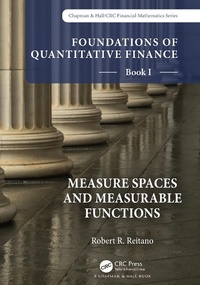
Foundations of Quantitative Finance, Book I: Measure Spaces and Measurable Functions
Book 1
1st Edition
Published on 31. October 2022
318 pages
978-1-000-59686-1 (ISBN)
Description

This is the first in a set of 10 books written for professionals in quantitative finance. These books fill the gap between informal mathematical developments found in introductory materials, and more advanced treatments that summarize without formally developing the important foundational results professionals need.
Book I in the Foundations in Quantitative Finance Series develops topics in measure spaces and measurable functions and lays the foundation for subsequent volumes. Lebesgue and then Borel measure theory are developed on ?, motivating the general extension theory of measure spaces that follows. This general theory is applied to finite product measure spaces, Borel measures on ?n, and infinite dimensional product probability spaces.
The overriding goal of these books is a complete and detailed development of the many mathematical theories and results one finds in popular resources in finance and quantitative finance. Each book is dedicated to a specific area of mathematics or probability theory, with applications to finance that are relevant to the needs of professionals. Practitioners, academic researchers, and students will find these books valuable to their career development.
All ten volumes are extensively self-referenced. The reader can enter the collection at any point or topic of interest, and then work backward to identify and fill in needed details. This approach also works for a course or self-study on a given volume, with earlier books used for reference.
Advanced quantitative finance books typically develop materials with an eye to comprehensiveness in the given subject matter, yet not with an eye toward efficiently curating and developing the theories needed for applications in quantitative finance. This book and series of volumes fill this need.
Book I in the Foundations in Quantitative Finance Series develops topics in measure spaces and measurable functions and lays the foundation for subsequent volumes. Lebesgue and then Borel measure theory are developed on ?, motivating the general extension theory of measure spaces that follows. This general theory is applied to finite product measure spaces, Borel measures on ?n, and infinite dimensional product probability spaces.
The overriding goal of these books is a complete and detailed development of the many mathematical theories and results one finds in popular resources in finance and quantitative finance. Each book is dedicated to a specific area of mathematics or probability theory, with applications to finance that are relevant to the needs of professionals. Practitioners, academic researchers, and students will find these books valuable to their career development.
All ten volumes are extensively self-referenced. The reader can enter the collection at any point or topic of interest, and then work backward to identify and fill in needed details. This approach also works for a course or self-study on a given volume, with earlier books used for reference.
Advanced quantitative finance books typically develop materials with an eye to comprehensiveness in the given subject matter, yet not with an eye toward efficiently curating and developing the theories needed for applications in quantitative finance. This book and series of volumes fill this need.
More details
Series
Edition
1. Auflage
Language
English
Place of publication
London
United Kingdom
Publishing group
Taylor & Francis Ltd
Target group
Professional and scholarly
ISBN-13
978-1-000-59686-1 (9781000596861)
Copyright in bibliographic data and cover images is held by Nielsen Book Services Limited or by the publishers or by their respective licensors: all rights reserved.
Schweitzer Classification
Other editions
Additional editions
Robert R. Reitano
Foundations of Quantitative Finance, Book I: Measure Spaces and Measurable Functions
Measure Spaces and Measurable Functions
Book
10/2022
1st Edition
Chapman & Hall/CRC
€109.10
Shipment within 10-20 days
Robert R. Reitano
Foundations of Quantitative Finance, Book I: Measure Spaces and Measurable Functions
Measure Spaces and Measurable Functions
Book
10/2022
1st Edition
Chapman & Hall/CRC
€270.90
Shipment within 10-20 days
Person
Robert R. Reitano is Professor of the Practice in Finance at the Brandeis International Business School where he specializes in risk management and quantitative finance, and where he previously served as MSF Program Director, and Senior Academic Director. He has a Ph.D. in Mathematics from MIT, is a Fellow of the Society of Actuaries, and a Chartered Enterprise Risk Analyst. He has taught as Visiting Professor at Wuhan University of Technology School of Economics, Reykjavik University School of Business, and as Adjunct Professor in Boston University's Masters Degree program in Mathematical Finance. Dr. Reitano consults in investment strategy and asset/liability risk management, was Chief Investment Officer of Controlled Risk Insurance Company (CRICO), and previously had a 29-year career at John Hancock/Manulife in investment strategy and asset/liability management, advancing to Executive Vice President & Chief Investment Strategist. His research papers have appeared in a number of journals and have won an Annual Prize of the Society of Actuaries and two F.M. Redington Prizes awarded biennially by the Investment Section of the Society of the Actuaries. Dr. Reitano has served as Vice-Chair of the Board of Directors of the Professional Risk Managers International Association (PRMIA) and on the Executive Committee of the PRMIA Board, and is currently a member of the PRMIA Boston Steering Committee, the Financial Research Committee of the Society of Actuaries, and other not-for-profit boards and investment committees.
Content
Preface
Introduction
1 The Notion of Measure 0
1.1 The Riemann Integral
1.2 The Lebesgue Integral
2 Lebesgue Measure on R 13
2.1 Sigma Algebras and Borel Sets
2.2 Definition of a Lebesgue Measure
2.3 There is No Lebesgue Measure on _(P(R)
2.4 Lebesgue Measurable Sets: ML(R) $ _(P(R))
2.5 Calculating Lebesgue Measures
2.6 Approximating Lebesgue Measurable Sets
2.7 Properties of Lebesgue Measure
2.7.1 Regularity
2.7.2 Continuity
2.8 Discussion on B(R) &ML(R)
3 Measurable Functions 55
3.1 Extended Real-Valued Functions
3.2 Equivalent Definitions of Measurability
3.3 Examples of Measurable Functions
3.4 Properties of Measurable Functions
3.4.1 Elementary Function Combinations
3.4.2 Function Sequences
Function Sequence Behaviors
Function Sequence Measurability Properties
3.5 Approximating Lebesgue Measurable Functions
3.6 Distribution Functions of Measurable Functions
4 Littlewood.s Three Principles
4.1 Measurable Sets
4.2 Convergent Sequences of Measurable Functions
4.3 Measurable Functions
5 Borel Measures on R
5.1 Functions Induced by Borel Measures
5.2 Borel Measures from Distribution Functions
5.3 Consistency of Borel Measure Constructions
5.4 Approximating Borel Measurable Sets
5.5 Properties of Borel Measures
5.6 Differentiable F-Length and Lebesgue Measure
6 Generating Measures by Extension
6.1 Recap of Lebesgue and Borel Constructions
6.2 Extension Theorems
6.3 Summary - Construction of Measure Spaces
6.4 Approaches to Countable Additivity
6.5 Completion of a Measure Space
7 Finite Products of Measure Spaces
7.1 Product Space Semi-Algebras
7.2 Properties of the Semi-Algebra
7.3 Measure on the Algebra A
7.4 Extension to a Measure on the Product Space
7.5 Well-Definedness of _-Finite Product Measure Spaces
7.6 Products of Lebesgue and Borel Measure Spaces
8 Borel Measures on Rn
8.1 Rectangle Collections that Generate B(Rn)
8.2 Borel Measures and Induced Functions
8.3 Properties of General Borel Measures on Rn
9 Infinite Products of Probability Spaces
9.1 A Naive Attempt at a First Step
9.2 A Semi-Algebra A0
9.3 Finite Additivity of _A on A for Probability Spaces
9.4 Free Countable Additivity on Finite Probability Spaces
9.5 Countable Additivity on A+ in Probability Spaces on R
9.6 Extension to a Probability Measure on RN
9.7 Probability of General Rectangles
References
Introduction
1 The Notion of Measure 0
1.1 The Riemann Integral
1.2 The Lebesgue Integral
2 Lebesgue Measure on R 13
2.1 Sigma Algebras and Borel Sets
2.2 Definition of a Lebesgue Measure
2.3 There is No Lebesgue Measure on _(P(R)
2.4 Lebesgue Measurable Sets: ML(R) $ _(P(R))
2.5 Calculating Lebesgue Measures
2.6 Approximating Lebesgue Measurable Sets
2.7 Properties of Lebesgue Measure
2.7.1 Regularity
2.7.2 Continuity
2.8 Discussion on B(R) &ML(R)
3 Measurable Functions 55
3.1 Extended Real-Valued Functions
3.2 Equivalent Definitions of Measurability
3.3 Examples of Measurable Functions
3.4 Properties of Measurable Functions
3.4.1 Elementary Function Combinations
3.4.2 Function Sequences
Function Sequence Behaviors
Function Sequence Measurability Properties
3.5 Approximating Lebesgue Measurable Functions
3.6 Distribution Functions of Measurable Functions
4 Littlewood.s Three Principles
4.1 Measurable Sets
4.2 Convergent Sequences of Measurable Functions
4.3 Measurable Functions
5 Borel Measures on R
5.1 Functions Induced by Borel Measures
5.2 Borel Measures from Distribution Functions
5.3 Consistency of Borel Measure Constructions
5.4 Approximating Borel Measurable Sets
5.5 Properties of Borel Measures
5.6 Differentiable F-Length and Lebesgue Measure
6 Generating Measures by Extension
6.1 Recap of Lebesgue and Borel Constructions
6.2 Extension Theorems
6.3 Summary - Construction of Measure Spaces
6.4 Approaches to Countable Additivity
6.5 Completion of a Measure Space
7 Finite Products of Measure Spaces
7.1 Product Space Semi-Algebras
7.2 Properties of the Semi-Algebra
7.3 Measure on the Algebra A
7.4 Extension to a Measure on the Product Space
7.5 Well-Definedness of _-Finite Product Measure Spaces
7.6 Products of Lebesgue and Borel Measure Spaces
8 Borel Measures on Rn
8.1 Rectangle Collections that Generate B(Rn)
8.2 Borel Measures and Induced Functions
8.3 Properties of General Borel Measures on Rn
9 Infinite Products of Probability Spaces
9.1 A Naive Attempt at a First Step
9.2 A Semi-Algebra A0
9.3 Finite Additivity of _A on A for Probability Spaces
9.4 Free Countable Additivity on Finite Probability Spaces
9.5 Countable Additivity on A+ in Probability Spaces on R
9.6 Extension to a Probability Measure on RN
9.7 Probability of General Rectangles
References
