

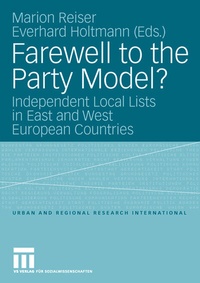
Farewell to the Party Model?
Independent Local Lists in East and West European Countries
1st Edition
Published on 14. May 2008
VI, 290 pages
978-3-531-90923-3 (ISBN)
Description

Marion Reiser, Everhard Holtmann Local independent lists as political actors are a common phenomenon on the local level in many European countries - in established Western democracies as well as in the 'new' democracies in Central and Eastern Europe. In some West European countries, these non-partisan groups have been an established and stable element in the local political system for decades. Ty- cally, they understand themselves as protectors of a harmonious factual political style. In their opinion, good local politics is not compatible with party politics so they consequently perceive themselves as non-parties. During the last two d- ades, presence and success of local lists have steadily increased in these co- tries. Furthermore, during the last years local lists emerged also in countries which had been formerly fully party-politicised on the local level. Explanations offered for these developments are often based on the observation of a general decline of trust in established parties and politicians. Hence, it has been argued that the disenchantment with political parties is a fertile ground for local lists. For the Central and East European countries, this argument can be - ployed only to a certain extent. Local lists established themselves in the early 1990's as important actors on the local level especially due to a lack of party organisation in the process of democratic consolidation.
More details
Other editions
Additional editions
Marion Reiser | Everhard Holtmann
Farewell to the Party Model?
Independent Local Lists in East and West European Countries
Book
04/2008
VS Verlag für Sozialwissenschaften
€53.49
Shipment within 10-15 days
Persons
Reiser, Marion, Dr., is Senior Research Fellow at the Institute of Political Science at the Martin-Luther-University of Halle-Wittenberg.
Holtmann, Everhard, Dr., is Professor of Political Science at the Martin-Luther-University of Halle-Wittenberg.
Holtmann, Everhard, Dr., is Professor of Political Science at the Martin-Luther-University of Halle-Wittenberg.
Content
Local Lists in Europe.- Local Lists in East and Central European Countries.- Local Lists in the Czech Republic.- Independent Local Lists in Croatia: In Search for a Composite Theoretical Frame.- Local and National Parties in Hungary.- Citizen Electoral Alliances in Estonia: Citizen Democracy versus Cartel Parties.- Non-party Lists in Local Election in Poland.- A bridging case?.- Independent Local Lists in East and West Germany.- Local Lists in West European Countries.- Local Political Parties in the Netherlands: Anomaly or Prototype?.- All Politics is Local, Partisan or National? Local Lists in Belgium.- Local Parties in Sweden.- Independent Lists in Norwegian Local Politics.- Independents and Citizen's Groups in Portuguese Municipalities.- Multi-Party Politics in England: Small Parties, Independents, and Political Associations in English Local Politics.- Conclusion.- Conclusion: Independent Local Lists in East and West European Countries.
Local Lists in Europe (p. 11)
Everhard Holtmann
1. Introduction
The phenomenon of independent local lists (Ill's) has not yet been a subject of international comparative research. Of course, there are manifold reasons for this lack of scientific attendance, but among the most serious are the absence of internationally agreed on definitions, a common conceptual framework, and above all, a first international oversight. The latter will be the ambitious project of this book, while the forthcoming paragraphs will deal with questions of a comprehensive definition and sketches of a possible conceptual framework.
The starting point is: how can we deal with the obvious heterogeneity of independent local lists regarding case studies of different European countries? Is there a definition that fits all cases? While keeping in mind national distinctions we must ask what influences the presence and success of independent local lists and how we can comprise these features in a comprehensive conceptual framework for comparative research.
2. The question of definition
To begin, we should deal with the question of definition. Local lists in European countries can be characterised by two criteria:
1. Ill's are focussed on a local jurisdiction. Independent lists are solely locally organised. Nevertheless, in the local arena Ill's are often confronted with local parties sections. Regarding this local co-existence of parties and nonparty formations, we need a further distinctive mark for Ill's and that means:
2. A typical non-partisan local list is focussed - and limited - on one single local jurisdiction, dealing here primarily (if not to say only) with problems and tasks of 'its' municipality or county. That means independent local lists practise a political self-restraint concerning supra-local politics. As local lists, they are 'localist'.
However, there are certain clandestine sub-species - even if they are formally local lists, which oscillate between covered party loyalty and partial detachment. In some articles presented in this book, Ill's run for example as "hidden local lists", or as "formally independent lists" sponsored by political parties (senior parties pushing local junior descendents), or as "revealed party-independent" lists (i.e. see the contribution of Copus et al. in this book).
3. Party systems as reference point for independent list's analysis
Now to the conceptual question which is of course much more complex. One basic assumption is: party systems normally act - or, at least, should do so from a normative point of view - like 'brokers' between state and civil society. Agreeing to this does not mean to accept the classification scheme of "Cartel Party" uncritically (see for this debate Katz/Mair 1995 and Koole 1996).
But in all modern political systems, parties are expected to perform this intermediate core function. Playing this role in the local fields of domestic politics, too, political parties here must bind together the societal system, where social conflicts emerge, and the political system is charged with managing these conflicts in terms and modes of politics. So both spheres are held in a specific interrelation by means of party politics.
Everhard Holtmann
1. Introduction
The phenomenon of independent local lists (Ill's) has not yet been a subject of international comparative research. Of course, there are manifold reasons for this lack of scientific attendance, but among the most serious are the absence of internationally agreed on definitions, a common conceptual framework, and above all, a first international oversight. The latter will be the ambitious project of this book, while the forthcoming paragraphs will deal with questions of a comprehensive definition and sketches of a possible conceptual framework.
The starting point is: how can we deal with the obvious heterogeneity of independent local lists regarding case studies of different European countries? Is there a definition that fits all cases? While keeping in mind national distinctions we must ask what influences the presence and success of independent local lists and how we can comprise these features in a comprehensive conceptual framework for comparative research.
2. The question of definition
To begin, we should deal with the question of definition. Local lists in European countries can be characterised by two criteria:
1. Ill's are focussed on a local jurisdiction. Independent lists are solely locally organised. Nevertheless, in the local arena Ill's are often confronted with local parties sections. Regarding this local co-existence of parties and nonparty formations, we need a further distinctive mark for Ill's and that means:
2. A typical non-partisan local list is focussed - and limited - on one single local jurisdiction, dealing here primarily (if not to say only) with problems and tasks of 'its' municipality or county. That means independent local lists practise a political self-restraint concerning supra-local politics. As local lists, they are 'localist'.
However, there are certain clandestine sub-species - even if they are formally local lists, which oscillate between covered party loyalty and partial detachment. In some articles presented in this book, Ill's run for example as "hidden local lists", or as "formally independent lists" sponsored by political parties (senior parties pushing local junior descendents), or as "revealed party-independent" lists (i.e. see the contribution of Copus et al. in this book).
3. Party systems as reference point for independent list's analysis
Now to the conceptual question which is of course much more complex. One basic assumption is: party systems normally act - or, at least, should do so from a normative point of view - like 'brokers' between state and civil society. Agreeing to this does not mean to accept the classification scheme of "Cartel Party" uncritically (see for this debate Katz/Mair 1995 and Koole 1996).
But in all modern political systems, parties are expected to perform this intermediate core function. Playing this role in the local fields of domestic politics, too, political parties here must bind together the societal system, where social conflicts emerge, and the political system is charged with managing these conflicts in terms and modes of politics. So both spheres are held in a specific interrelation by means of party politics.
