

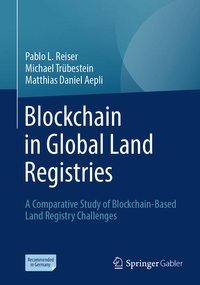
Blockchain in Global Land Registries
Description

This book explores the theory-practice gap in applying blockchain to land registries by examining four case studies (Sweden, Georgia, Ghana, and India) where blockchain-based land registry initiatives have been implemented or piloted. Through comparative analysis, it identifies recurring legal, institutional, and infrastructural barriers that have hindered progress, as well as enabling conditions that have supported partial success. Designed for scholars, policymakers, and practitioners in land governance, legal reform, and digital transformation, this study contributes to the growing literature on blockchain in public administration. It moves beyond theoretical promises to assess how and under what conditions blockchain can meaningfully support land administration reform in diverse global contexts.
Land registries are foundational institutions, intended to ensure legal certainty, facilitate property transactions, and reduce disputes. Yet in many jurisdictions, they remain plagued by inefficiency, opacity, and limited public trust. While blockchain technology has been widely proposed as a remedy - offering transparency, immutability, and decentralization - empirical evidence on its actual impact remains scarce.
More details
Other editions
Additional editions
Persons
Pablo L. Reiser MScRE studied real estate at Lucerne University (HSLU) and banking and finance at Lingnan University. With positions in Zurich, Singapore and Tokyo, he brings an international perspective to real estate transactions and digital innovations in land registry.
Prof. Dr. Michael Trübestein FRICS is professor of real estate management and investments as well as Head of the Master of Science in Real Estate (MScRE)-program at Lucerne University (HSLU). Furthermore, he was elected president of the RICS in Switzerland in 2019.
Dr. Matthias Daniel Aepli is lecturer at Lucerne University (HSLU), entrepreneur in the real estate sector and author of various publications in the area of real estate management, investment strategies, asset management, corporate financial management and risk management.
Content
Introduction.- Research Question.- Literature Review.- Methodology.- Data / Information Source.- Analysis.- Conclusion.- Recommendations.- Critical Reflection.- Appendix.
