

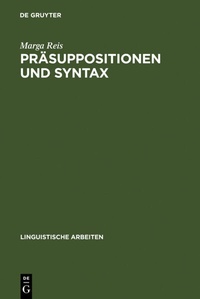
Präsuppositionen und Syntax
1st Edition
Published on 1. October 2010
VII, 238 pages
978-3-11-134484-3 (ISBN)
Description

Keine ausführliche Beschreibung für "Präsuppositionen und Syntax" verfügbar.
More details
Other editions
Additional editions
Marga Reis
Präsuppositionen und Syntax
Book
01/1977
1st Edition
De Gruyter
€119.95
Shipment within 7-9 days
Marga Reis
Präsuppositionen und Syntax
Book
01/1977
1st Edition
De Gruyter
€169.95
Article exhausted; check different version
Content
- Intro
- VORWORT
- VORBEMERKUNG
- 1. ZUM PRÄSUPPOSITIONSBEGRIFF
- 1.1 Zur philosophischen Präsuppositionsproblematik
- 1.2 Zur Äquivalenz der Präsuppositionsbegriffe
- 1.3 Zur Präzisierung eines linguistisch relevanten Präsuppositionsbegriffs
- 1.3.1 Präsuppositionen und Kontext
- 1.3.1.1 l-semantische vs. k-pragmatische Präsuppositionen
- 1.3.1.2 Sprachliche Präsuppositions-Garanten
- 1.3.2 Präsupposition, Negation, Illokution
- 1.3.2.1 Präsupposition und Sprachstruktur
- 1.3.2.2 Präsupposition und Negation
- 1.3.2.3 Präsupposition und Illokution
- 1.3.3 Linguistisch relevante Präsuppositionstypen
- 1.3.3.1 Die Partikeln
- 1.3.3.2 Konjunktionen
- 1.3.3.3 Grammatische Kategorien
- 1.3.3.4 Syntaktisch subordinierte Sätze
- 1.3.3.5 Asymmetrische Koordinationen
- 1.3.3.6 Implikative Verben
- 1.3.3.7 Selektionsbeschränkungen und Topic/Fokus-Erscheinungen
- 1.3.4 Zur Problematik eines propositionsbezüglichen Präsuppositionsbegriffs
- 1.4 Zum alternativen Präsuppositionsbegriff: Die essentiell-pragmatische Position
- 2. L-SEMANTISCHE VS. K-PRAGMATISCHE PRASUPPOSITIONEN oder: GIBT ES SPRACHLICHE PRASUPPOSITIONS-GARANEN?
- 2.1 Vorbemerkung
- 2.2 Allgemein nichtpräsuppositionale Kontexte
- 2.2.1 Zitat-Kontexte
- 2.2.2 Präsuppositionsproteste
- 2.2.3 'Filter'-Kontexte
- 2.2.4 Exkurs: Zur semantischen Festlegung von 'Filter'-Kontexten (Zu Hausser 1976)
- 2.2.5 'Weltschaffende' Kontexte
- 2.3 Termbildende Ausdrücke und Kontext
- 2.3.1 Gebrauch in Existentialsätzen
- 2.3.2 Generische und gesetzesähnliche Kontexte
- Zukunftserwartungen
- 2.3.3 Prädikativer Gebrauch
- 2.3.4 Artikelformen und numerische Präsuppositionen
- 2.3.5 Zum Status einiger Quantoren als Präsuppositions-Garanten
- 2.3.6 Ein erstes Fazit
- 2.4 Faktive Prädikate und Kontext
- 2.4.1 Dt. wissen/engl. know als Präsuppositions-Garant
- 2.4.2 Exkurs: Zum Problem nur einzelsprachlicher Präsuppositions-Garanten. Am Beispiel dt. wissen vs. engl. know
- 2.4.3 Nichtkognitive Faktive als Präsuppösitions-Garanten
- 2.5 Ergebnis
- 3. PRÄSUPPOSITIONEN UND GRAMMATIK
- 3.1 Präsuppositionen und Lexikon
- 3.1.1 Engl. accuse:criticize, dt. beschuldigen:tadeln
- 3.1.2 Engl. some:any
- 3.1.3 Starke vs. schwache Negation
- 3.1.4 Implikative Konstruktionen
- 3.1.5 glauben:wissen
- 3.2 Präsuppositionen und Syntax: Zur syntaktischen Relevanz faktiver Präsuppositionen
- 3.2.1 'Fact' -Argumente
- 3.2.2 Faktivität und die Substantivierung von Verben mit Satzkomplementen
- 3.2.3 Nachbemerkung: Zum Verhältnis von Emotivität und Faktivität
- 3.2.4 Zusammenfassung und Ergebnis
- 3.3 Präsuppositionen und Syntax: Zur Einordnung von Topic/Fokus-Erscheinungen
- 3.3.1 Topic/Fokus-Erscheinungen und ihre syntaktische Relevanz
- 3.3.2 Zur Gleichsetzung von 'Topic/Fokus' und 'Präsupposition/Assertion'
- 3.3.3 Argumente gegen die Gleichsetzung von 'Topic/Fokus' und 'Präsupposition/Assertion'
- 3.3.4 Ergebnis
- SCHLUSSBEMERKUNG
- LITERATUR
