

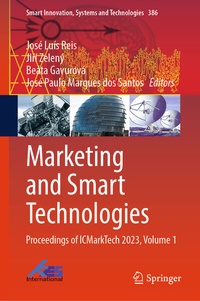
Marketing and Smart Technologies
Description

This book includes selected papers presented at the International Conference on Marketing and Technologies (ICMarkTech 2023), held at Faculty of Economics and Management (FEM), Czech University of Life Sciences Prague (CZU), in partnership with University College Prague (UCP), in Prague, Czech Republic, between 30 November and 2 December 2023. It covers up-to-date cutting-edge research on artificial intelligence applied in marketing, virtual and augmented reality in marketing, business intelligence databases and marketing, data mining and big data, marketing data science, web marketing, e-commerce and v-commerce, social media and networking, geomarketing and IoT, marketing automation and inbound marketing, machine learning applied to marketing, customer data management and CRM, and neuromarketing technologies.
More details
Other editions
Additional editions
Persons
José Luís Reis completed Ph.D. in Technologies and Information Systems from the University of Minho and is Professor with the title of Specialist in Management and Administration by IPAM Porto. He is Professor at University of Maia-ISMAI and ISCAP.IPP, and Integrated Researcher in LIACC-Laboratory of Artificial Intelligence and Informatics at the University of Porto. He carries out activities in the area of training and information systems and technologies in various organizations, coordinating various national and international projects in the area of information management, applied marketing and strategic regional planning. He is Author of scientific papers and articles in the fields of marketing automation, artificial intelligence, augmented and virtual reality, information systems modeling, multimedia, gamification, and data mining. He is Author and Co-author of several books, namely "Personalization in Marketing - Technologies and Information Systems", "Marketing in agri-food -fundamentals and case studies", "Gamification Model for SMEs", "Marketing and Smart Technologies", and "Information Systems - Diagnostics and Prospectives".
Jirí Zelený completed Ph.D. in agricultural economics and Master of Science (Department of Hotel Management) from the Institute of Hospitality Management in Prague and is Assistant Professor at University College Prague, Deputy Head of Study Program and Department (Department of Hotel Management and Travel and Tourism Studies), Assistant Professor of Media Sociology and Psychology subject (Department of Social Sciences) at Prague School of Creative Communication, and Project Specialist via Erasmus+ (Faculty of Economics and Management, Dept. of Humanities) at Czech University of Life Sciences Prague. He received Award of the Minister of Agriculture of the Czech Republic for Outstanding Doctoral Thesis with Contribution to Practice in the Field of Agriculture, Editorial Board Membership of the Potravinárstvo Slovak Journal ofFood Science: Nitra, SK; participates and participated in several, namely "Sustainability in the preparation and consumption of food and beverages, its social and cultural context", "Culinary Heritage of the Czech Lands: Memory, Presentation and Education", and "Sustainable Agriculture and Rural Development (SARUD)".
Beáta Gavurová, Ph.D., M.B.A., Center for Applied Economic Research, Faculty of Management and Economics, Tomas Bata University, in Zlin. Her research interests include the development of the models and methods for performance management and measurement, process optimization, process management, strategic and performance benchmarking, innovation management and informatization, and the standardization processes in the various sectors. She participates in the preparation of the strategic documents and the action plans in the ministries, such as National Strategy for Regional Development of the Slovak Republic, Agenda 2030, Agenda 2050, Strategy for Sustainable Tourismin the Slovak Republic until 2030, Strategy for Transport Development in the Slovak Republic, Debarrierization Strategy of the Slovak Republic, and the others. She participates in the creation of the European Commission policies in the areas of research and innovation, education, employment and social affairs, transport, and regional policy actively. She has authored and co-authored more than 450 publications, including 15 scientific monographs, 10 textbooks. She has also coauthored the intellectual property-utility model.
José Paulo Marques dos Santos is Associate Professor at the Dept. of Business Studies, University of Maia, and Researcher at the Unit of Experimental Biology, Faculty of Medicine, and at LIACC-Artificial Intelligence and Computer Science Lab, both in the University of Porto, Portugal. Paulo is Visiting Professor at the Universidade Europeia, Portugal. He also collaborates in Socius/CSG-Research Centre in Economic and Organizational Sociology (University of Lisbon). Paulo completed his Ph.D. in Management (variant on Marketing) in 2011 at ISEG-Lisbon School of Economics and Management, University of Lisbon, and the 5-year bachelor's degree in chemical engineering, in 1989, at the University of Coimbra, Portugal. His research interests lie in the area of consumer neuroscience, focusing on brand perception and brand meaning, ranging from neuroscientific techniques, like fMRI, EEG, and tDCS/tACS, to qualitative approaches like Grounded Theory, and passing by Semiotics. Modeling neural data with artificial neural networks and other AI methods is also a matter of study. Paulo has been publishing in neuroscience and branding academic journals like Frontiers in Neuroscience, Journal of Product and Brand Management, and Journal of Brand Management. He has been participating in the World Neuromarketing Forum (NMSBA) scientific committee and is one of the founders of the ICMarkTech-International Conference on Marketing and Technologies.
Content
- Intro
- Contents
- About the Editors
- Part I Artificial Intelligence Applied in Marketing
- 1 Social Media Presence Impacts AI Influencer's Endorsement: An Empirical Evidence
- 1.1 Introduction
- 1.2 Literature Review and Hypotheses Development
- 1.2.1 Social Media Presence
- 1.2.2 Fantasy
- 1.3 Pilot Study
- 1.3.1 Methodology
- 1.3.2 Analysis and Results
- 1.3.3 Discussion
- 1.4 Main Study
- 1.4.1 Methodology
- 1.4.2 Analysis and Results
- 1.4.3 Discussion
- 1.5 Limitations and Future Research Directions
- References
- 2 GSP Internet Users Based on Their Navigation Preferences: Second Round-Law Sentences
- 2.1 Introduction
- 2.2 Data Mining Applied to Educational Environments
- 2.3 Description of the Problem
- 2.3.1 GSP Algorithm
- 2.3.2 GSP_M Algorithm
- 2.4 Experimentation
- 2.5 Conclusion
- References
- 3 Artificial Intelligence in the Development of Eco-innovations
- 3.1 Introduction
- 3.2 Theoretical Background
- 3.2.1 AI in Product Innovation Development
- 3.2.2 AI in the Development of Eco-innovations
- 3.3 Research Design
- 3.3.1 Data and Scope
- 3.3.2 Bibliometric Analysis
- 3.4 Results
- 3.5 Discussion and Conclusion
- References
- 4 The Authenticity of ChatGPT's Responses in the Tourism and Hospitality Sector: An Explorative Study on Human Perception of Artificial Intelligence
- 4.1 Introduction
- 4.2 Literature Review
- 4.2.1 Usage of AI in the Hospitality Sector
- 4.2.2 Usage of ChatGPT in the Tourism and Hospitality Businesses
- 4.2.3 Usage of ChatGPT and Perspectives of Customers/Tourists
- 4.3 Research Methodology
- 4.3.1 Generated Textual Content by ChatGPT
- 4.3.2 Agents Employed in Semi-standardized Interviews and Explored Topics
- 4.4 Results
- 4.4.1 Ideal Types of Interviewed Agents
- 4.5 Discussion and Final Remarks
- References
- 5 Artificial Neural Networks and Discrete Choice Models: Comparing and Contrasting
- 5.1 Introduction
- 5.2 Literature Review
- 5.2.1 Artificial Neural Networks
- 5.2.2 Discrete Choice Models
- 5.2.3 ANNs Versus DCM
- 5.3 Methodology
- 5.4 Results and Findings
- 5.5 Concluding Remarks
- References
- 6 Usage of Artificial Intelligence for Advertising Creation for Social Media Marketing: ChatGPT Combined with Pictory and DALL·E
- 6.1 Introduction
- 6.2 Literature Review
- 6.3 Methodology
- 6.4 Discussion
- 6.5 Results: Real-World Case Studies
- 6.5.1 Case Study 1: Successful Social Media Marketing Campaigns Utilizing AI-Generated Advertising
- 6.5.2 Case Study 2: Challenges Faced and Lessons Learned from Implementing AI in Ad Creation from Smartly.io and Dagmar (Finnish Companies)
- 6.6 The Near Future of the Use of AI for Advertising Creation for Social Media Marketing
- 6.7 Conclusion
- References
- 7 Retail Chatbots' Main Themes and Research over Time: A Bibliometric and Content Analysis
- 7.1 Introduction
- 7.2 Literature Review
- 7.2.1 Retail Chatbots' Advantages for Retailers and Consumers
- 7.2.2 Retail Chatbots' Disadvantages for Retailers and Consumers
- 7.2.3 Main Concerns with Chatbots
- 7.3 Research Questions and Methodology
- 7.3.1 Research Questions
- 7.3.2 Methodology
- 7.4 Results
- 7.4.1 Citation Analysis: Documents with the Greatest Significance and Influence
- 7.4.2 Evolution of Published Research About Retail Chatbots
- 7.4.3 Retail Chatbots' Researched Themes and Trends
- 7.5 Final Considerations
- References
- 8 Gastronomic Consumers' Attitudes Toward AI-Generated Food Images: Exploring Different Perceptions Based on Generational Segmentation
- 8.1 Introduction
- 8.2 Literature Review
- 8.3 Research Methodology
- 8.4 Results
- 8.5 Discussion and Final Remarks
- References
- 9 Negative Impacts of Human-AI Interaction in Brands: A Data Mining Exploratory Approach
- 9.1 Introduction
- 9.2 Literature Review
- 9.2.1 Artificial Intelligence
- 9.2.2 Negativity in Consumer/Brand Relationship
- 9.3 Methodology
- 9.3.1 Objective and Research Question
- 9.3.2 Netnography Approach and Web Scrapping
- 9.4 Results and Discussion
- 9.5 Conclusions
- References
- 10 What Factors Determine the Consumer Acceptance of AI-Based Services? The Case of Lithuanian Consumers
- 10.1 Introduction
- 10.2 Theoretical Background and Hypothesis
- 10.2.1 Social-Emotional Factors and the Consumer Acceptance of AI-Based Services
- 10.2.2 Functional Factors and the Consumer Acceptance of AI-Based Services
- 10.2.3 Relational Factors and the Consumer Acceptance of AI-Based Services
- 10.2.4 Consumer Acceptance and Usage of AI-Based Services
- 10.3 Methodology
- 10.4 Results and Discussion
- 10.4.1 Results of Correlation Analysis
- 10.4.2 Results of Hypothesis Testing
- 10.5 Conclusions
- Appendix 1: Results of Linear Regression: Beta Coefficients
- References
- 11 "Ready for Your Insurance Quote?" the Impact of Chatbot Empathy on Emotions and User Experience
- 11.1 Introduction
- 11.2 Literature Review
- 11.2.1 Anthropomorphism and Empathy in Chatbots
- 11.2.2 The Positive Effects of Anthropomorphization and Empathy on Emotions and User Experience
- 11.2.3 The Negative Effects of Anthropomorphization and Empathy on Emotions and the User Experience
- 11.3 Research Methodology
- 11.3.1 Research Design
- 11.3.2 Participant Recruitment
- 11.3.3 Procedure and Data Collection for Retrospective Post-test Interviews
- 11.3.4 Data Analysis
- 11.4 Results
- 11.4.1 How Do Users Experience Interacting with an Empathetic Chatbot?
- 11.4.2 Synthesis of Results
- 11.5 Research Contributions
- 11.5.1 Theoretical Implications
- 11.5.2 Managerial Implications
- 11.6 Limitations and Avenues for Future Research
- References
- 12 Wine Consumers' Attitudes Toward AI-Generated Images of Wine Regions: Exploring Relationship Between Preferences and Imaginative Conceptions
- 12.1 Introduction
- 12.2 Research Methodology and Conduction
- 12.3 Results
- 12.4 Discussion and Final Remarks
- References
- Part II Customer Data Management and CRM
- 13 Measuring Leadership Through CELID-S: A Contemporary Perspective
- 13.1 Introduction
- 13.2 Literature Review
- 13.3 Methodology
- 13.3.1 Data Collection Techniques
- 13.4 Data Analysis
- 13.4.1 Analysis of Results
- 13.4.2 Reliability or Trustworthiness Analysis
- 13.4.3 Relationship Between Leadership Styles
- 13.4.4 Work Satisfaction
- 13.4.5 Relationship Between Leadership and Satisfaction
- 13.5 Conclusions
- References
- Part III Data Mining and Big Data-Marketing Data Science
- 14 Analyzing the Framework Conditions for Digital Entrepreneurship. An Empirical Evaluation of Country Performance
- 14.1 Introduction
- 14.2 Literature Review
- 14.3 Research Methodology
- 14.4 Results and Discussions
- 14.5 Conclusions
- References
- 15 Profiling Online and Physical Supermarket Customers Using Factor and Clustering Methods
- 15.1 Introduction
- 15.2 Related Work
- 15.2.1 Profiling Supermarket Customers Through Transactions and Questionnaires
- 15.2.2 Profiling Supermarket Customers Based on Purchased Products Characteristics
- 15.3 Methods
- 15.3.1 Overview of Analysis Process
- 15.3.2 Data Collection and Preparation
- 15.3.3 Factor and Cluster Analysis
- 15.4 Analysis Results
- 15.4.1 MCA Results
- 15.4.2 HCPC Results
- 15.5 Discussion
- 15.6 Conclusion
- References
- 16 Data-Driven Insights: Analysing Variables in Black Soldier Fly Larvae's Transformation of Organic Waste
- 16.1 Introduction
- 16.2 Materials and Methods
- 16.2.1 Organic Waste Sampling
- 16.2.2 Organic Waste Pretreatment
- 16.2.3 Organic Waste Characterisation
- 16.2.4 Experiment Design
- 16.2.5 Bromatological Characteristics of the Larvae
- 16.2.6 Manure Characterisation
- 16.3 Results
- 16.3.1 Waste Characterisation
- 16.3.2 Biotransformation
- 16.4 Discussion
- 16.5 Conclusions
- References
- 17 Big Data in Journalism in Ecuador
- 17.1 Introduction
- 17.2 Methodology
- 17.3 Results
- 17.4 Conclusions
- References
- Part IV Digital Marketing and Branding
- 18 Destination Brands Experienced Through Digital Platforms: A Semiotic Approach for the Interpretation of a Case Study
- 18.1 Introduction
- 18.2 Theoretical Background
- 18.2.1 Marketing and Branding of Places
- 18.2.2 Tourism Marketing and Destination Brands
- 18.2.3 New Technologies in Tourism Digital Platforms
- 18.3 Research Methodology
- 18.3.1 Analysis Framework: Semiotic Structures and Interactional Regimes
- 18.3.2 Analysis Protocol
- 18.4 Application in Case
- 18.4.1 Case Presentation
- 18.4.2 Case Study
- 18.5 Conclusion
- References
- 19 Resilience and Transformation: Examining Marketing Strategies and Consumer Behavior in a COVID-19 World Connected by Social Media
- 19.1 Introduction
- 19.2 Consumer Behavior During the COVID-19 Period
- 19.3 Marketing in the Time of COVID-19
- 19.4 Online Social Networks in the Time of COVID-19
- 19.5 Final Considerations
- References
- 20 Key Pillars in Storytelling to Generate Emotional Branding
- 20.1 Introduction
- 20.1.1 Key Pillars of Emotional Branding
- 20.2 Methodology
- 20.3 Results and Discussion
- 20.3.1 Emotions that Awaken in the Storytelling of the Amaras Spot for General Emotional
- 20.3.2 Key Pillars in Storytelling of the Amarás Spot to Generate Emotional Branding
- 20.4 Conclusions
- References
- 21 Emotions in Advertising and Their Connection to Consumers
- 21.1 Introduction
- 21.1.1 Emotional Advertising
- 21.1.2 Consumer Persuasion
- 21.2 Method
- 21.3 Results and Discussion
- 21.3.1 Telling a Story Through an Advertising Spot
- 21.3.2 The Influence of a Brand in the Purchase Decision of the Consumer
- 21.3.3 Emotions Generated by the Campaign "Este 2022, Unidos Nada Nos Podrá Vencer"
- 21.4 Conclusions
- References
- 22 The Influence of Social Media Marketing Activity on Purchase Intention in the Beer Sector: Case of SuperBock's Instagram
- 22.1 Introduction
- 22.2 Literature Review
- 22.2.1 Social Media Marketing Activity
- 22.3 Conceptual Model
- 22.3.1 Research Hypotheses
- 22.4 Methodology
- 22.5 Results and Discussion
- 22.5.1 Presentation of Results
- 22.5.2 Discussion of Results
- 22.6 Conclusion
- References
- Part V Gamification Technologies to Marketing
- 23 Phygital Brand Experience: Merging Physical and Digital Formats to Enhance Customer Engagement
- 23.1 Introduction
- 23.2 Theoretical Framework
- 23.2.1 Brand Experience
- 23.2.2 Brand Experience Formats: Physical and Digital Experiences
- 23.2.3 Phygital Brand Experience
- 23.2.4 Gamification
- 23.2.5 Branded Content
- 23.2.6 Customer Engagement
- 23.3 Methodology
- 23.4 Case Study
- 23.5 Analysis
- 23.6 Discussion and Conclusions
- References
- 24 The Impact of Card Games on Enhancing Financial Education and Daily Life Skills for Older Adults
- 24.1 Introduction
- 24.2 Background
- 24.3 Method
- 24.3.1 Participants
- 24.3.2 Materials and Resources
- 24.3.3 Procedure
- 24.4 Results and Discussion
- 24.5 Conclusions
- References
- Part VI Machine Learning Applied to Marketing
- 25 Automated Consulting Services-Perspectives of Customers, Consultants and Companies
- 25.1 Introduction
- 25.2 Literature Review
- 25.2.1 Consulting
- 25.2.2 Artificial Intelligence
- 25.2.3 Automated Consulting and Acceptance
- 25.3 Methodology
- 25.4 Findings and Observations
- 25.5 Discussion
- 25.6 Implications
- 25.7 Study Limitations and Future Research
- 25.8 Conclusion
- References
- 26 Undergraduate Candidate Experience and Engagement: Insights from a Case Using CRISP-DM and Machine Learning
- 26.1 Introduction
- 26.2 Literature Review
- 26.2.1 Digital Marketing for Higher Education Institutions
- 26.2.2 Customer-Centric Experiences and Web Analytics
- 26.2.3 Data Mining Techniques and Data Quality Concepts
- 26.3 Methodology
- 26.4 Results
- 26.4.1 Business Understanding
- 26.4.2 Data Understanding
- 26.4.3 Data Preparation
- 26.4.4 Modeling
- 26.4.5 Evaluation
- 26.5 Conclusion
- References
- 27 Using Linguistic Features to Predict Social Media Engagement: Proposing an Approach Based on Machine Learning and Natural Language Processing
- 27.1 Introduction
- 27.2 Related Work
- 27.3 Methodology
- 27.3.1 Data
- 27.3.2 Models
- 27.4 Experimental Results
- 27.5 Conclusion and Future Work
- References
- 28 Using Extended Reality and Machine Learning in Digital Marketing Focusing Tourism
- 28.1 Introduction
- 28.2 Extended Reality and Machine Learning in Digital Marketing of Touristic Destination
- 28.2.1 Extended Reality Overview
- 28.2.2 Machine Learning Overview
- 28.2.3 Digital Marketing Overview
- 28.3 Proposed Conceptual Model
- 28.4 Conclusion and Final Remarks
- References
- 29 Modular Prototype of Artificial Vision for the Detection of Fatigue and Anti-drowsiness in Drivers of Land Vehicles
- 29.1 Introduction
- 29.2 Literature Review
- 29.3 Materials and Methods
- 29.3.1 Conceptual Design of the Device
- 29.3.2 Electronic Device Design
- 29.3.3 Printed Circuit Board (PCB) Design
- 29.3.4 Case Design for the Device
- 29.3.5 Dataset for Computer Vision Algorithm
- 29.4 Results
- 29.4.1 Hardware
- 29.4.2 Implementation of the PCB for the GPRS-GSM Module and the LED Module.
- 29.4.3 Circuit Assembly for Testing
- 29.4.4 Software
- 29.4.5 3D Printing of the Case and Device Assembly
- 29.4.6 Device Reliability Testing
- 29.5 Conclusions
- References
- 30 The Impact of Digital Transformation on Innovation in European Companies: A New Generation of AI Predictive Model Test Against Predictive Machine Learning Algos
- 30.1 Introduction
- 30.2 Literature Review
- 30.3 Methodology and Methods
- 30.4 Prediction Analysis with RapidMiner
- 30.5 Results Analysis and Model's Comparison
- 30.6 Conclusion
- References
- Part VII Mataverse and NFT applied to Marketing
- 31 Brand Management and Metaverse: A Data Mining Exploratory Approach
- 31.1 Introduction
- 31.2 Literature Review
- 31.2.1 Brand Equity
- 31.2.2 Brand Digitalization and Future of Brands
- 31.2.3 Metaverse
- 31.2.4 Metaverse and Brand Equity
- 31.2.5 Relationship Between Consumers and Brand Equity in Metaverse
- 31.3 Methodology
- 31.3.1 Objective and Research Question
- 31.3.2 Netnography Approach and Web Scrapping
- 31.3.3 Models
- 31.3.4 Evaluation Metrics
- 31.4 Results and Discussion
- 31.5 Conclusions
- 31.5.1 Limitations and Future Research
- References
- 32 Metaverse for Sustainable Marketing Toward Circular Economy
- 32.1 Introduction
- 32.2 What the Metaverse Is
- 32.2.1 Brief History
- 32.2.2 Definitions
- 32.2.3 Implications of the Metaverse
- 32.3 Metaverse for Sustainable Marketing in Circular Economy
- 32.3.1 Metaverse for Sustainable Marketing
- 32.3.2 Metaverse as an Accelerate Enabler for Circular Economy
- 32.4 Conclusion
- References
- 33 How Can Businesses, Low-Tech Businesses in Particular, Benefit from the Metaverse? A Delphi Perspective from Academics
- 33.1 Introduction
- 33.2 Method
- 33.2.1 The Delphi Method
- 33.2.2 The Panel of Experts
- 33.2.3 Data Analysis
- 33.3 Findings
- 33.3.1 Theme 1: Definition of Metaverse
- 33.3.2 Theme 2: Metaverse Marketplace
- 33.3.3 Theme 3: Beneficiaries of the Metaverse
- 33.3.4 Theme 4: Industrial Metaverse
- 33.3.5 Theme 5. Low-Tech Businesses
- 33.3.6 Theme 6: Metaverse: Future, Present, or Past?
- 33.3.7 Theme 7. Technological and Other Requirements of Metaverse
- 33.3.8 Theme 8. Meta's Controversies
- 33.3.9 Theme 9. Other Platforms
- 33.3.10 Theme 10. Extra Comments
- 33.4 Discussion and Conclusions
- References
- Part VIII Mobile Marketing and Wearable Technologies
- 34 Too Good to Go: Acceptance Factors of an Application to Combat Food Waste
- 34.1 Introduction
- 34.2 Literature Review
- 34.2.1 Food Waste
- 34.2.2 TGTG Application
- 34.2.3 Technology Adoption
- 34.3 Methodology
- 34.4 Analysis and Discussion of Results
- 34.5 Conclusion
- References
- Part IX Neuromarketing Technologies
- 35 Technological Innovations Applied to Neuromarketing: Systematic Review
- 35.1 Introduction
- 35.2 Method
- 35.3 Results
- 35.4 Conclusions
- References
- 36 Psychological Factors that Influence Decision Making at the Time of Purchase
- 36.1 Introduction
- 36.2 Psychological Factors
- 36.2.1 Following the Stereotypes Promoted by Fashion
- 36.2.2 The Role of the Frontal Lobe at the Time of Purchase
- 36.2.3 The Relationship Between Anxiety and Shopping
- 36.2.4 Color Psychology and Purchasing Intention
- 36.2.5 Personality Traits and Shopping Behavior
- 36.3 Conclusions
- References
- 37 Eye-Tracking and Pictograms: Improving Communication and Accessibility for Senior Adults
- 37.1 Introduction
- 37.1.1 Related Studies
- 37.2 Method
- 37.3 Results
- 37.4 Conclusions
- References
- 38 The Impact of Advertising on Self-medication: Considerations for Project Management and Leadership in the Health and Wellness Industry
- 38.1 Introduction
- 38.2 Background
- 38.3 Method
- 38.3.1 Participants
- 38.3.2 Instruments
- 38.3.3 Procedure
- 38.4 Results
- 38.5 Conclusions
- References
- 39 Visual and Textual Elements of Board Game Packaging, What Do Children Prefer?-An Eyetracking Study
- 39.1 Introduction
- 39.2 Literature Review
- 39.2.1 Children as Consumers
- 39.2.2 Brand Awareness and Toy Packaging
- 39.2.3 Visual and Textual Attributes
- 39.3 Method
- 39.4 Results
- 39.5 Discussion
- 39.6 Conclusion
- References
- Part X Social Media and Networking
- 40 The Three Congruence Perspectives and the Effects of Social Media Influencers on Consumer Behavior: A Belgium-Croatia Comparison
- 40.1 Introduction
- 40.1.1 Research Context
- 40.1.2 Expected Scientific and Practical Contribution
- 40.2 Conceptual Background
- 40.2.1 Social Media Influencers and Consumer Behavior
- 40.2.2 Cross-Country Comparison: Croatia and Belgium
- 40.3 Methodology
- 40.3.1 Research Technique and Instrument
- 40.3.2 Sample
- 40.3.3 Data Analysis
- 40.4 Results and Discussion
- 40.4.1 What Makes a Good Match and Why is It Important?
- 40.4.2 Based on What Characteristics of Social Media Influencers, Brands, and Followers is the Assessment of Congruence Made?
- 40.4.3 What Effect Do Social Media Influencers Have on Consumer Behavior?
- 40.4.4 Cross-Country Comparison: Croatia and Belgium
- 40.5 Conclusion and Limitations
- References
- 41 Sustainability Communication of Fashion Brands on Social Media: Language Abstraction and Digital Customer Engagement
- 41.1 Introduction
- 41.2 Literature Review
- 41.2.1 Sustainable Fashion Communication
- 41.2.2 Linguistic Category Model and Language Abstraction
- 41.3 Methodology
- 41.3.1 Sample
- 41.3.2 Coding Process
- 41.4 Data Analysis and Results
- 41.4.1 LCM Categorization and Overall Language Abstraction Level
- 41.4.2 Sustainability Dimension Categorization and Dimensional Language Abstraction Level Differences
- 41.4.3 Digital Customer Engagement
- 41.5 Discussion and Conclusion
- 41.6 Limitations and Future Research
- References
- 42 Uses and Gratifications of Consuming 'Yo soy Betty, la fea' from a Female Perspective
- 42.1 Introduction
- 42.2 Methodology
- 42.3 Results and Discussion
- 42.3.1 Cognitive Need
- 42.3.2 Affective Need
- 42.3.3 Social Integration Need
- 42.3.4 Recreational Need
- 42.3.5 Personal Integration Need
- 42.4 Conclusions
- References
- Part XI Technologies Applied to Tourism Marketing
- 43 Experiencing a City Through Instagram: What Do Tourists Engage with?
- 43.1 Introduction
- 43.2 Theoretical Background
- 43.2.1 City Marketing
- 43.2.2 Destination Brand
- 43.2.3 Instagram and User-Generated Content
- 43.3 Methodology
- 43.4 Results and Discussion
- 43.4.1 Idanha-a-Nova
- 43.4.2 Óbidos
- 43.4.3 Amarante
- 43.4.4 Barcelos
- 43.4.5 Braga
- 43.4.6 Caldas da Rainha
- 43.4.7 Leiria
- 43.4.8 Covilhã
- 43.4.9 Santa Maria da Feira
- 43.5 Conclusions and Implications
- 43.5.1 Theoretical Implications
- 43.5.2 Managerial Implications
- 43.5.3 Limitations and Future Research
- References
- 44 Educating for Legacy: History on Vinho Verde's Brands Websites as Marketing Destination Image?
- 44.1 Introduction
- 44.2 Literature Review
- 44.3 Materials and Methods
- 44.3.1 Sample
- 44.3.2 Historical Concepts on Websites Discourse
- 44.3.3 Let the Bottle Speak!
- 44.4 Results Discussion
- References
- 45 Ranking Luxury Hotels in Lisbon Using the 2T-AEC-TOPSIS Model
- 45.1 Introduction
- 45.2 Theoretical Framework
- 45.2.1 The 2-Tuple Linguistic Model
- 45.2.2 The Integrated AHP-Entropy-CRITIC Method
- 45.2.3 The TOPSIS Method and Its Improvement
- 45.3 Case Study: Applying the Proposed Model to Rank Luxury Hotels in Lisbon
- 45.3.1 Data Collection
- 45.3.2 Data Cleaning
- 45.3.3 Data Transformation
- 45.3.4 Calculation of Weights for Each Hotel Aspect
- 45.3.5 Hotel Rankings and Recommendations
- 45.4 Conclusions and Future Work
- References
- 46 Technologies Applied to Tourism Marketing: A 10 Years Systematic Literature Review
- 46.1 Introduction
- 46.2 Methodology
- 46.3 Results
- 46.4 Discussion
- 46.5 Conclusion
- References
- 47 Discrepancies Between Michelin Guide Awards and Google Restaurant Reviews: A Case Study of the Capital City of Prague
- 47.1 Introduction
- 47.2 Literature Review
- 47.3 Research Methodology
- 47.4 Results
- 47.5 Discussion and Final Remarks
- References
- 48 Which Are the Factors That Limit the Tourism Experience in Portuguese Thermal Hotels? An Exploration Using UGC
- 48.1 Introduction
- 48.2 Theoretical Context
- 48.2.1 The Thermal Tourism Experience
- 48.2.2 Thermal Tourism in Portugal
- 48.3 Methodology
- 48.4 Results
- 48.5 Conclusions
- References
- 49 Digital Marketing as a Tool to Promote Rural Tourism Ventures: The Case of Casa da Lagoa
- 49.1 Introduction
- 49.2 Literature Review
- 49.2.1 Rural Tourism
- 49.2.2 Digital Marketing
- 49.2.3 Social Media
- 49.3 Methodology
- 49.4 Case Study: Casa da Lagoa
- 49.4.1 Digital Presence of Casa da Lagoa
- 49.5 Conclusions
- References
- 50 eWOM of Spain's Tourism Destination in the Rural Context from a Sustainable and Technological Perspective
- 50.1 Introduction
- 50.2 Literature Review
- 50.2.1 Impact of Tourism and Its Rural Context
- 50.2.2 eWOM in Tourism: A Sustainable and Technological Approach
- 50.3 Objective and Research Questions
- 50.4 Research Methodology
- 50.5 Results
- 50.5.1 Tourists' Perceptions of Rural Tourist Attractions
- 50.5.2 Evolution of Sustainable and Technological eWOM
- 50.5.3 Sentiment and Emotion Analysis
- 50.6 Conclusion
- References
- 51 Hospitality Marketing Strategies in Urban Events
- 51.1 Introduction
- 51.2 Literature Review
- 51.3 Methodology
- 51.4 Results
- 51.4.1 Impact of Events
- 51.4.2 Conditions for Hosting Events
- 51.4.3 Marketing Preparation of Hotels for City Events
- 51.5 Conclusion
- References
- 52 Comparison of SMART Tourism Models of Selected European City Destinations
- 52.1 Introduction
- 52.2 Literature Review
- 52.2.1 Smart City Concept
- 52.2.2 Smart City Destination Model
- 52.3 Data and Methodology
- 52.3.1 Overview of the Data Used
- 52.3.2 Methodology
- 52.4 Results and Discussion
- 52.4.1 Tourism Data as the Base for Launching Smart Tourism Strategy
- 52.4.2 Analysis of the Smart Tourism Models and Strategies
- 52.4.3 Comparison of the SMART Tourism Business Models and Strategies
- 52.5 Conclusion
- References
- 53 e-Tourist in a Historical City-The Case of Brasov, Romania
- 53.1 Introduction
- 53.2 The Research Methodology
- 53.2.1 General Issues Regarding the Research Design
- 53.2.2 Brasov-One of the Most Important Touristic Destinations in Romania
- 53.3 Theoretical Issues Regarding Smart Tourism and STTs
- 53.4 Results and Discussions
- 53.5 Conclusions
- 53.5.1 Theoretical and Operational Implications
- 53.5.2 Research Limitations and Future Directions of Research
- References
- Part XII Virtual and Augmented Reality in Marketing
- 54 Augmented Reality and Brand Perception: A Review of Strategies and Impact on Consumer Behavior
- 54.1 Introduction
- 54.2 Method
- 54.3 Results
- 54.4 Discussion
- 54.4.1 Augmented Reality: Concept and Importance
- 54.4.2 Practical Applications of Augmented Reality
- 54.4.3 Augmented Reality and Brand Perception
- 54.5 Conclusion
- References
- 55 Which Factors Influence Word-of-Mouth for Tourism Video Ads?
- 55.1 Introduction
- 55.2 Literature Review
- 55.2.1 Word-of-Mouth
- 55.2.2 Destination Familiarity
- 55.2.3 Narrative Transportation and Structure
- 55.3 Methodology
- 55.4 Results
- 55.5 Conclusions
- References
- 56 Augmented Reality in Omnichannel Marketing: A Systematic Review in the Retail Sector
- 56.1 Introduction
- 56.2 Systematic Literature Review
- 56.2.1 AR Basics
- 56.2.2 Omnichannel Customer Experience and Journey
- 56.2.3 Metaverse Enabled by AR and Impact in Omnichannel, Customer and Retail
- 56.2.4 AR Impact on Customers Through Omnichannel Marketing
- 56.2.5 AR Implementation in Omnichannel Marketing Strategies in Retail
- 56.2.6 Strategies to Implement Omnichannel AR Marketing in Retail
- 56.2.7 Future Research
- 56.3 Discussion
- 56.4 Conclusions
- References
- 57 Spatial Computing and Augmented Reality-Challenges in E-Commerce
- 57.1 Introduction
- 57.1.1 Timeline
- 57.2 Methodology and Article Selection
- 57.3 Discussion of Results
- 57.3.1 Analysis of Articles Resulting from PRISMA
- 57.4 Discussion
- 57.5 Conclusions
- 57.5.1 Evolution of E-Commerce in Spatial Computing
- 57.5.2 Limitations
- 57.5.3 Future Research
- References
- 58 Exploring Virtual Reality in Omnichannel Marketing: A Systematic Review
- 58.1 Introduction
- 58.2 Metaverse and Virtual Reality Fundamentals in Marketing
- 58.2.1 Virtual Reality Definition
- 58.2.2 Uses for Virtual Reality in Marketing
- 58.2.3 Metaverse Definition
- 58.2.4 Omnichannel Marketing
- 58.2.5 Phygital Marketing
- 58.3 Systematic Literature Review
- 58.3.1 How VR Is Currently Being Used in Retailing
- 58.3.2 Examples of VR and Omnichannel Use in Retail
- 58.3.3 Marketing in the Metaverse
- 58.3.4 Non-fungible Tokens
- 58.3.5 Consumer Wellbeing and Trust
- 58.3.6 Policy Implications
- 58.3.7 Challenges for the Metaverse
- 58.4 Conclusions
- References
- Correction to: The Three Congruence Perspectives and the Effects of Social Media Influencers on Consumer Behavior: A Belgium-Croatia Comparison
- Correction to: Chapter 40 in: J. L. Reis et al. (eds.), Marketing and Smart Technologies, Smart Innovation, Systems and Technologies 386, https://doi.org/10.1007/978-981-97-1552-7_40
- Correction to: Phygital Brand Experience: Merging Physical and Digital Formats to Enhance Customer Engagement
- Correction to: Chapter 23 in: J. L. Reis et al. (eds.), Marketing and Smart Technologies, Smart Innovation, Systems and Technologies 386, https://doi.org/10.1007/978-981-97-1552-7_23
- Author Index
