

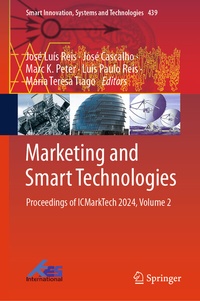
Marketing and Smart Technologies
Description

This book includes selected papers presented at the International Conference on Marketing and Technologies (ICMarkTech 2024), held at University of Azores, Ponta Delgada, Azores, Portugal, between December 5 and 7, 2024. It covers up-to-date cutting-edge research on artificial intelligence applied in marketing, virtual and augmented reality in marketing, business intelligence databases and marketing, data mining and big data, marketing data science, web marketing, e-commerce and v-commerce, social media and networking, geomarketing and IoT, marketing automation and inbound marketing, machine learning applied to marketing, customer data management and CRM, and neuromarketing technologies.
More details
Other editions
Additional editions
Persons
José Luís Reis holds Ph.D. in technologies and information systems from the University of Minho and Specialist in management and administration since 2011. He is Assistant Professor at the University of Maia, where he serves as Director of the Department of Business Administration and coordinates the master's program in digital transformation. Additionally, he is Invited Adjunct Teacher at the Polytechnic Institute of Porto's School of Accounting and Administration of Porto. He is Integrated Researcher at LIACC-Laboratory of Artificial Intelligence and Computer Science and Collaborating Member of the Center for Organizational and Social Studies of the Polytechnic of Porto (CEOS.PP). His work focuses on technologies and information systems, with a strong emphasis on computer science, information science, and economics and business. Throughout his professional career, he has collaborated with 58 co-authors on scientific papers. He is also Author and Co-Author of several books.
José Cascalho holds Ph.D. in computational science from the University of the Azores, his M.Sc. in informatics from the University of Lisbon, and his B.Sc. in electronic and computing engineering from the University of Lisbon. He is Associate Professor at the University of the Azores and Integrated Researcher in LIACC-Laboratory of Artificial Intelligence and Informatics of the University of Porto. His main research interests are the multiagent systems and intelligent robotics as subfields of artificial intelligence. In the area of education, in recent years, he has been responsible for teaching subjects linked to mathematics didactics, training primary school teachers and educators, and has carried out some research in using technology to support learning, through intelligent systems that use computational paradigms in area of agents. He has authored and coauthored more than 95 publications, published 6 articles in specialized journals. It has 4 book chapters and 4 books.
Marc K. Peter is Professor of digital business and Head of the Competence Center Digital Transformation at the FHNW School of Business in Olten, Switzerland. He received his doctorate from CSU Sydney, an executive M.B.A. from UAS Bern/Babson College/PKU Beijing, and master of marketing from the University of Basel. He is Fellow of both the British Computer Society and the Chartered Institute of Marketing. His research and teaching areas are digital transformation, digital business, digital marketing, and cybersecurity.
Luís Paulo Reis has B.Sc. (5 years-1993), M.Sc. (1995), and Ph.D. (2003) degrees in electrotechnical engineering (with specializations in computer science, industrial informatics, and artificial intelligence/robotics). He is Associate Professor at the University of Porto in Portugal and Director of LIACC-Artificial Intelligence and Computer Science Laboratory. He is IEEE Senior Member and he was President of the Portuguese Society for Robotics and Vice-President of the Portuguese Association for Artificial Intelligence. He is Vice-President of APPIA-Portuguese Association for Artificial Intelligence. He is also Co-Director of LIACD-First Degree in Artificial Intelligence and Data Science. He won more than 60 scientific awards including wining more than 15 RoboCup international competitions and best papers at conferences such as ICEIS, Robotica, IEEE ICARSC, and ICAART. He supervised 22 Ph.D. and 150 M.Sc. theses to completion and is supervising 15 Ph.D. theses. He evaluated more than 50 projects.
Maria Teresa Tiago is Associate Professor with the School of Business and Economics at the University of the Azores, and she collaborates as Guest Professor at the University NOVA-IMS. She holds a Ph.D. in economics and business sciences, specializing in management, from the University of the Azores, and she completed her aggregation in the field of service marketing. She also holds an M.B.A. and a master's degree in marketing from the Catholic University of Portugal and a bachelor's degree in business from the University of the Azores. Throughout her academic career, she has taught over 17 undergraduate and postgraduate courses, with a focus on management subjects. She also teaches courses in the fields of tourism. She is Integrated Member of the CEEAplA research center at the University of the Azores and Collaborating Member of Advance/CSG, ISEG - Technical University of Lisbon.
Content
Chapter 1: E-government business model based on blockchain: Examining citizens' readiness.- Chapter 2: Digital Transformation at Delta Cafés in Portugal: A case study.- Chapter 3: Cost-effective and operationally sustainable supply chain inventory planning: a mathematical programming approach.- Chapter 4: Business Intelligence and Operations Research in Supply Chain Management: A Systematic Review.- Chapter 5: Internal Connection Intensity as Logistic and Marketing Indicator of Museum Clusters Performance.- Chapter 6: Sustainable Supply Chain Strategies: A Review of EU Policies and Blockchain Implementations (2019-2024).- Chapter 7: Machine learning for cargo code prediction in port logistics.- Chapter 8: Integrating Artificial Intelligence and the Internet of Things for Environmental Monitoring in Seaports: A dynamic model for reducing CO2 emissions.- Chapter 9: Logistics 4.0 and Digital Supply Chain: A Systematic Review.- Chapter 10: Port-Centric Strategies for Optimizing Agro-Commodity Supply Chains: Insights from Soybean Flow Redesign.- etc.
