

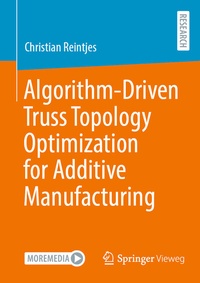
Algorithm-Driven Truss Topology Optimization for Additive Manufacturing
Description

Since Additive Manufacturing (AM) techniques allow the manufacture of complex-shaped structures the combination of lightweight construction, topology optimization, and AM is of significant interest. Besides the established continuum topology optimization methods, less attention is paid to algorithm-driven optimization based on linear optimization, which can also be used for topology optimization of truss-like structures.
To overcome this shortcoming, we combined linear optimization, Computer-Aided Design (CAD), numerical shape optimization, and numerical simulation into an algorithm-driven product design process for additively manufactured truss-like structures. With our Ansys SpaceClaim add-in construcTOR, which is capable of obtaining ready-for-machine-interpretation CAD data of truss-like structures out of raw mathematical optimization data, the high performance of (heuristic-based) optimization algorithms implemented in linear programming software is now available to the CAD community.
More details
Other editions
Additional editions
Person
Christian Reintjes received a master's degree in Industrial Engineering from University of Siegen in Germany. Following on from that, he worked as a research associate at the Institute of Technology Management where he worked towards his PhD in Mechanical Engineering. Currently, Christian works for SAP SE as an Expert in Digital Manufacturing and is based out of Walldorf.
