

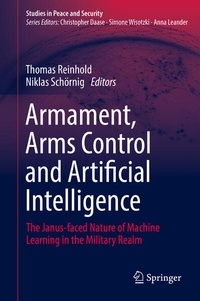
Armament, Arms Control and Artificial Intelligence
The Janus-faced Nature of Machine Learning in the Military Realm
1st Edition
Published on 8. October 2022
XVII, 226 pages
978-3-031-11043-6 (ISBN)
Description

Looking at a variety of armament sectors, the book examines how Artificial Intelligence (AI) impacts the fields of armament and arms control, how existing arms control measures will be affected by AI, and what new approaches based on AI have been or are currently developed.
The significant increase in computing power, the increasing reliance on software, and the advent of (narrow) AI and deep-learning algorithms all have the potential to lead to disruptive changes for military operations and warfare, rendering many classical arms control instruments less effective, or even useless. On the other hand, AI might lead to completely new arms control approaches, raising the effectiveness and reliability of new verification measures. To provide a common understanding, the book starts by presenting a general introduction to the state of the art in artificial intelligence and arms control, and how the two topics are interrelated. The second part of the book looks at examples from various fields of weapon technology, including weapons of mass destruction (WMD), conventional armament, and emerging technologies. The final section offers a cross-cutting perspective based on the examples presented in the second part.
This volume will appeal to students and scholars of international relations, as well as policy-makers and practitioners interested in a better understanding of peace and security studies in general, and armament and arms control in particular with a strong focus on AI.
The significant increase in computing power, the increasing reliance on software, and the advent of (narrow) AI and deep-learning algorithms all have the potential to lead to disruptive changes for military operations and warfare, rendering many classical arms control instruments less effective, or even useless. On the other hand, AI might lead to completely new arms control approaches, raising the effectiveness and reliability of new verification measures. To provide a common understanding, the book starts by presenting a general introduction to the state of the art in artificial intelligence and arms control, and how the two topics are interrelated. The second part of the book looks at examples from various fields of weapon technology, including weapons of mass destruction (WMD), conventional armament, and emerging technologies. The final section offers a cross-cutting perspective based on the examples presented in the second part.
This volume will appeal to students and scholars of international relations, as well as policy-makers and practitioners interested in a better understanding of peace and security studies in general, and armament and arms control in particular with a strong focus on AI.
More details
Series
Language
English
Place of publication
Cham
Switzerland
Publishing group
Springer International Publishing
Target group
Professional and scholarly
Product notice
Reflowable
Illustrations
XVII, 226 p. 1 illus.
File size
4,77 MB
ISBN-13
978-3-031-11043-6 (9783031110436)
DOI
10.1007/978-3-031-11043-6
Schweitzer Classification
Other editions
Additional editions
Thomas Reinhold | Niklas Schörnig
Armament, Arms Control and Artificial Intelligence
The Janus-faced Nature of Machine Learning in the Military Realm
Book
10/2022
Springer
€117.69
Shipment within 15-20 days
Persons
Thomas Reinhold
is a research assistant at the Chair of Science and Technology for Peace and Security (PEASEC) at TU Darmstadt. His research focuses on the increasing militarization of cyberspace and the influence of artificial intelligence on military developments, especially regarding questions of disarmament and arms control.
Niklas Schörnig is a senior researcher at the Peace Research Institute Frankfurt (PRIF) and head of the PRIF research group on Emerging Technology, Order and Stability (rETOS). His research focuses, inter alia, on current trends in warfare, military robotics, and arms control for emerging technologies. Schörnig holds a Ph.D. from Goethe University, Frankfurt am Main, Germany. In 2011/2012 he was a visiting professor for International Relations and Theories of Global World Order at Goethe University.
Niklas Schörnig is a senior researcher at the Peace Research Institute Frankfurt (PRIF) and head of the PRIF research group on Emerging Technology, Order and Stability (rETOS). His research focuses, inter alia, on current trends in warfare, military robotics, and arms control for emerging technologies. Schörnig holds a Ph.D. from Goethe University, Frankfurt am Main, Germany. In 2011/2012 he was a visiting professor for International Relations and Theories of Global World Order at Goethe University.
Content
Chapter 1. Introduction.- Chapter 2. Introduction Into Artificial Intelligence and Machine Learning.- Chapter 3. The Military Rationale for AI.- Chapter 4. Military AI Applications: A Cross-country Comparison of Emerging Capabilities.- Chapter 5. Artificial Intelligence as an Arms Control Tool: Opportunities and Challenges.- Chapter 6. Verifying the Prohibition of Chemical Weapons in a Digitalized World.- Chapter 7. AI and Biological Weapons.- Chapter 8. Doomsday Machines? Nukes, Nuclear Verification and Artificial Intelligence.- Chapter 9. AI, WMD and Arms Control III: The Case of Nuclear Testing.- Chapter 10. Artificial Intelligence in Conventional Arms Control and Military Confidence-building.- Chapter 11. Cyber Weapons and Artificial Intelligence - Impact, Influence and the Challenges for Arms Control.- Chapter 12. Armament, Arms Control and Artificial Intelligence: the Impact of Software, Machine Learning and Artificial Intelligence on Armament and Arms Control.- Chapter 13. No, Not That Verification: Challenges Posed by Testing, Evaluation, Validation and Verification of Artificial Intelligence in Weapon Systems.- Chapter 14. Applying Export Controls to AI: Current Coverage and Potential Future Controls.- Chapter 15. Arms Control for Artificial Intelligence.
