

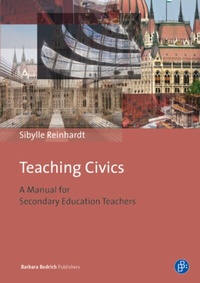
Teaching Civics
A Manual for Secondary Education Teachers
1st Edition
Published on 28. September 2015
244 pages
978-3-8474-0851-2 (ISBN)
Description

Around the world, teaching civics is our most practical tool for learning about democracy. In Germany, the art of civics education is constantly being reconsidered and revised, in part because of the country's history and the widespread awareness in German society of the dangers posed by education failing to do its job. The aim of this book is to provide educators with a varied and theoretically robust repertoire of professional strategies that are grounded in the social sciences.
Reviews / Votes
The book is very well written in an accessible style which is well served by the translation which presents a number of difficult concepts and materials in an engaging manner. Overall the book makes an important contribution at both a scholarly and practical level. Journal of Social Science Education 2/2016 Das Praxishandbuch von Sibylle Reinhardt ist inzwischen zu einem Klassiker der deutschsprachigen politischen Bildung geworden. In ihm sind über vierzig Jahre reflektierte Erfahrung als Lehrerin an Schule und Hochschule verdichtet. Im englischen Sprachraum kann dieser Klassiker nun erleichtert Verbreitung finden. Politisches Lernen 3-4/2015 Eine praktikabele Methode, Demokratie zu vermitteln, ist der (Schul-)Unterricht. Das eng-lischsprachige Buch stellt LehrerInnen eine Palette an Strategien und Methoden zur kriti-schen Selbstreflexion bereit, die ihren Ursprung in den Sozialwissenschaften haben. Damit sollen sie dazu ermächtigt werden, einfallsreich im Unterrichtsalltag zu agieren und konstruk-tiv mit den Herausforderungen des Unterrichtssettings umgehen zu können. GMK-Newsletter 10/2015More details
Other editions
Additional editions
Book
09/2015
1st Edition
Verlag Barbara Budrich
€29.90
No shipping information available
Person
Prof. em. Dr. Sibylle Reinhardt, Professor emeritus for Didactics of Civics at the Institute of Political Sciences, Martin-Luther-University, Halle
Content
- Cover
- Teaching Civics
- Table of Contents
- Preface to the English Edition
- Part I - Foundations
- 1 The Civics Teacher: Pro and Professional
- 1.1 The profession of teaching
- 1.2 Principles for teaching civics
- 2 Responsible Citizens: The Goals of Civic Education
- 2.1 Civic education as general education
- 2.2 Skills in civic education
- 2.3 Competencies
- 2.4 Standards
- 2.5 Cognitive structure and complexity
- 2.6 The Beutelsbach Consensus
- 2.7 May civics teachers express their political views in the classroom? Should they?
- 3 Youth and Politics
- 3.1 Developmental stages
- 3.2 Political socialization
- 3.3 Interest in politics
- 3.4 Understanding politics - Dealing with conflict
- 3.5 Trajectories of civic education and socialization
- 3.6 Misunderstanding as an essential part of civic learning
- 3.7 Implications: what does this mean for teachers?
- 3.8 Research on high school students' notions of political concepts
- 4 Learning Democracy
- 4.1 Democracy in school life
- 4.2 Democracy in the classroom
- 4.3 Intersubjective recognition at school
- 4.4 Democratic education
- Part II - Teaching Civics: Principles and Methods
- 5 The Conflict-Based Approach
- 5.1 What is a conflict?
- 5.2 Dealing with conflict
- 5.3 The method: conflict analysis
- Summary
- 6 The Problem-Based Approach
- 6.1 What is a problem?
- 6.2 Working on problems
- 6.3 The method: problem studies
- Summary
- 7 The Action-Based Approach
- 7.1 What is action?
- 7.2 Dimensions of action
- 7.3 Methods: projects, citizens' initiatives
- Summary
- 8 Case Teaching
- 8.1 What is a case?
- 8.2 Individual cases and universality
- 8.3 The methods: case analyses, case studies
- Summary
- 9 The Future-Based Approach
- 9.1 What is the future?
- 9.2 The future and sustainability
- 9.3 The methods: simulation games, future workshops, scenario planning
- Summary
- 10 Moral and Political Judgment
- 10.1 Morality and politics
- 10.2 Analyzing and judging
- 10.3 The methods: political decision making, the dilemma method
- Summary
- 11 The Genetic Method in Civic Education:Becoming an Active Citizen
- 11.1 What is genesis?
- 11.2 The role of the social sciences
- 11.3 The method: establishing a society
- Summary
- Afterword to Part II
- Overview: Principles for teaching civics
- Part III - Transitioning to the Upper Grades of High School and to College
- 12 Stages and Levels of Learning
- 12.1 Sequencing in teaching guidelines
- 12.2 Stages and levels
- 13 Introduction to Critical Thinking
- 13.1 Introducing high school students to the social sciences
- 13.2 The methods: reading original academic scholarship, self-reflectively implementing scholarly tools and techniques, classroom research projects
- Summary
- Part IV - Lesson Planning
- 14 Preparing for the Classroom
- 14.1 The normative dimension
- 14.2 Specialized knowledge
- 14.3 Everyday knowledge
- 14.4 Professional knowledge (traditional format? media? evaluation?)
- 15 The Lesson Plan or Outline
- 16 Touchstones for Lesson Planning
- Bibliography
- Index
