

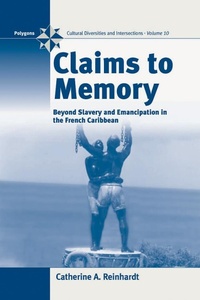
Claims to Memory
Beyond Slavery and Emancipation in the French Caribbean
1st Edition
Published on 1. December 2007
216 pages
978-1-78238-206-5 (ISBN)
Description

Why do the people of the French Caribbean still continue to be haunted by the memory of their slave past more than one hundred and fifty years after the abolition of slavery? What process led to the divorce of their collective memory of slavery and emancipation from France's portrayal of these historical phenomena? How are Martinicans and Guadeloupeans today transforming the silences of the past into historical and cultural manifestations rooted in the Caribbean? This book answers these questions by relating the 1998 controversy surrounding the 150th anniversary of France's abolition of slavery to the period of the slave regime spanning the late Enlightenment and the French Revolution. By comparing a diversity of documents-including letters by slaves, free people of color, and planters, as well as writings by the philosophes, royal decrees, and court cases-the author untangles the complex forces of the slave regime that have shaped collective memory. The current nationalization of the memory of slavery in France has turned these once peripheral claims into passionate political and cultural debates.
Reviews / Votes
"Reinhardt's astute, well -researched, and historically contextualized literary analyses yield much interesting commentary as well as some original insights." * American Historical Review"Claims to Memory is illuminating, thought-provoking, and even elegant. All students and scholars with an interest in France's islands in the Caribbean need to read it." * Island Studies Journal
"Claims to Memory is an engaging and in many ways unique book...that sets out to dismantle the delusions of republican France as the birthplace of liberty and slave emancipation... Reinhardt's book is a great challenge to francophone literary studies and a brilliant response to Glissant's call for a 'prophetic vision of the past.'" * H-France Review
"The complexities and controversies of commemorating slavery provide Claims to Memory with a fascinating subject matter... a valuable addition to debates on slavery commemoration that serves as a counterpoint to 'the overpowering narrative of the French abolitionist movement'." * Francophone Studies
"Reinhardt does not fail in her ambitions. Using the theoretical antecedent of rhizomatic memory and reading across the multiple sources this method entails, Reinhardt succeeds in challenging our simplification of historical narratives of abolition in the Caribbean, and our assumptions about the interrelationship between abolition and the Enlightenment... In her reading across genres and realms of memory, this text offers an excellent actualization of rhizome memory... [and] an historical account of slavery in the French Caribbean from a variety of sources ideal for scholars in the area of the history of slavery. Claims to Memory is also engaging reading for scholars in the more general areas of public memory and representation." * The Canadian Review of Sociology/Revue canadienne de sociologie
"What is distinctive about Catherine Reinhardt's book is the highly visible place that it gives to the decolonizing of memory in a larger theory of Caribbean postcolonial subjectivity. This makes it a vital contribution to the theory of the postcolonial subject." * Paget Henry, the Fanon Prize Committee, Caribbean Philosophical Association
More details
Series
Edition
1. Auflage
Language
English
Place of publication
Oxford
United Kingdom
Illustrations
Bibliography; Index; 34 Plates, unspecified
ISBN-13
978-1-78238-206-5 (9781782382065)
DOI
10.3167/9781845450793
Copyright in bibliographic data and cover images is held by Nielsen Book Services Limited or by the publishers or by their respective licensors: all rights reserved.
Schweitzer Classification
Other editions
Additional editions
Book
12/2007
1st Edition
Berghahn Books
€41.10
Shipment within 3-4 weeks
Book
04/2006
1st Edition
Berghahn Books
€149.30
Shipment within 3-4 weeks
Person
Catherine Reinhardt is a lecturer of French at Chapman University. She has given numerous talks and published articles on slavery in the French Caribbean and on French and Caribbean literature.
Content
List of Illustrations
Acknowledgments
Introduction: Memories of Slavery
Chapter 1. Realms of the Enlightenment
Chapter 2. Realms of the Maroon
Chapter 3. Realms of Freedom
Chapter 4. Realms of Assimilation
Chapter 5. Realms of Memory
Conclusion: Beyond Slavery
Postscript
Appendix
Bibliography
Index
Acknowledgments
Introduction: Memories of Slavery
Chapter 1. Realms of the Enlightenment
Chapter 2. Realms of the Maroon
Chapter 3. Realms of Freedom
Chapter 4. Realms of Assimilation
Chapter 5. Realms of Memory
Conclusion: Beyond Slavery
Postscript
Appendix
Bibliography
Index
