

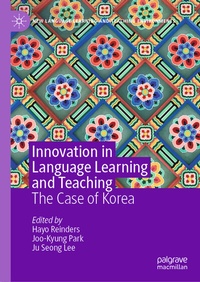
Innovation in Language Learning and Teaching
Description

This book brings together diverse experiences at all levels of language education in Korea, from government to public and private education to business and industry, to identify the origin of the processes of change and the factors influencing their success. The chapters are written by widely respected and well-known academics from the top institutions in Korea and abroad who together cover all aspects of innovation in language education in the region. Each chapter deals with a particular innovation or an innovation in a particular sector and is carefully structured to provide enough background information to understand its specific context, while drawing broader implications for educators in different contexts or countries. The overview and closing chapters set the scene and bring together all the experiences to offer suggestions for a successful integration of innovative practices in language education worldwide. As such, the book will be a rich resource for researchers, students, teachers and practitioners interested in understanding, implementing, or evaluating innovation in language teaching environments globally.
More details
Other editions
Additional editions
Persons
Hayo Reinders (www.innovationinteaching.org) is TESOL Professor and Director of Research at Anaheim University in the US and Professor of Applied Linguistics at KMUTT in Thailand.
Joo-Kyung Park is a former professor of TESOL at Honam University, South Korea and Immediate Past President of AsiaTEFL.
Ju Seong Lee is Acting Head and Associate Professor in the Department of English Language Education at the Education University of Hong Kong.
Content
1. A brief history of English language education in Korea (Joo-Kyung Park, Hayo Reinders, Ju Seong Lee).- 2. Innovation in elementary English education in Korea from the perspective of literacy education (Hae-Ri Kim).- 3. Integrating informal digital learning of English (IDLE) into Korean middle school contexts (Joohyun Bae).- 4. Artificial intelligence in enhancing Korean high school students' English skills (Rakhun Kim).- 5. An Innovative In-service English Teacher Education Program: Toward a Closer Coupling of Knowledge and Practice (Eun-kyoung Jang, Ahn S.-H. Gyemyong and Mun Woo Lee).- 6. The English for Peacebuilding Purposes writing courses at a Korean university (Jocelyn Wright).- 7. Exploring Localized Adaptations of Critical Literacy Practices in Korean EFL Contexts (Young-Mee Suh and Seonmin Huh).- 8. Integrating Content and Language in Higher Education (ICLHE) at a Korean science and engineering university (Eun Gyong Kim).- 9. A Case Study of an AI-Assisted CLIL Approach: A College English Course for Global Citizenship and Global Competence in an EFL Setting (Eunjou Oh).- 10. ChatGPT and Google Bard in Critical-PBLL: Korean University StudentPerspectives (Mi Kyong Kim).- 11. An Analysis of Flipped Learning Research Trends in Korean EFL Classrooms Using Big Data Techniques (Hye-Kyung Kim and Sumi Han).- 12. ESP Research in Korea: Current Status and Implications for Korean ELT (Jihyeon Jeon and Eun-young Kwon).- 13. Innovation in Korea: Lessons Learned (Ju Seong Lee, Hayo Reinders, Joo-Kyung Park).
