

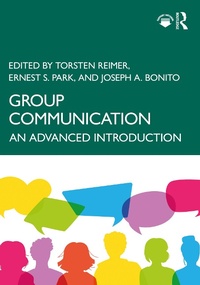
Group Communication
An Advanced Introduction
1st Edition
Published on 30. November 2023
488 pages
978-1-000-99797-2 (ISBN)
Description

In this comprehensive, advanced introduction to group communication, the field's leading experts summarize theory, methodological advancements, and current research in the field.
This book follows a coherent structure specifying clear objectives and evidence-based practical implications for the management of groups. Each chapter provides case study examples highlighting the role of communication for group functioning. The textbook takes a particular look at recent advancements in the research on virtual teams, the role of technology in group communication, and issues of diversity and inclusion, considering group communication in various situations including health and organizational contexts. It features theory-driven descriptions, an emphasis on empirical findings, and reflections on research methods.
The book is an integrative and coherent textbook for advanced undergraduate and graduate group communication classes and a useful reference for students, scholars, and group communication professionals across different disciplines including communication studies, psychology, life sciences, business administration, management, and engineering.
Online resources include a sample course syllabus, discussion questions, lecture slides, and a test-bank. They are available at www.routledge.com/9781032114712
This book follows a coherent structure specifying clear objectives and evidence-based practical implications for the management of groups. Each chapter provides case study examples highlighting the role of communication for group functioning. The textbook takes a particular look at recent advancements in the research on virtual teams, the role of technology in group communication, and issues of diversity and inclusion, considering group communication in various situations including health and organizational contexts. It features theory-driven descriptions, an emphasis on empirical findings, and reflections on research methods.
The book is an integrative and coherent textbook for advanced undergraduate and graduate group communication classes and a useful reference for students, scholars, and group communication professionals across different disciplines including communication studies, psychology, life sciences, business administration, management, and engineering.
Online resources include a sample course syllabus, discussion questions, lecture slides, and a test-bank. They are available at www.routledge.com/9781032114712
Reviews / Votes
"Group Communication is an exceptional text, organized and targeted for use in seminars. It includes an extraordinary collection of chapters that describe the theory, research and methods of group communication. The chapters are authored by known and renowned scholars who offer unique perspectives on the modern landscape of group communication."Verlin B. Hinsz, Ph. D., Dale Hogoboom Presidential Professor of Psychology, North Dakota State University, USA.
"Great textbooks motivate readers to dive headfirst into a sea of knowledge. Group Communication: An Advanced Introduction does so by treating students as peers with their professors. Readers will learn the complexity of member diversity, virtual teams, group research, so much more. Jump right in."
John Gastil, Ph.D., Distinguished Professor of Communication Arts and Sciences, Public Policy and Political Science, Penn State University, USA.
More details
Edition
1. Auflage
Language
English
Place of publication
London
United Kingdom
Publishing group
Taylor & Francis Ltd
Target group
College/higher education
Illustrations
9 Tables, black and white; 11 Line drawings, black and white; 11 Illustrations, black and white
ISBN-13
978-1-000-99797-2 (9781000997972)
Copyright in bibliographic data and cover images is held by Nielsen Book Services Limited or by the publishers or by their respective licensors: all rights reserved.
Schweitzer Classification
Other editions
Additional editions
Book
11/2023
1st Edition
Routledge
€94.00
Shipment within 10-20 days

Book
11/2023
1st Edition
Routledge
€205.20
Shipment within 10-20 days
Persons
Torsten Reimer is a Professor of Communication and Psychology and Director of the Communication and Cognition Lab at Purdue University, USA.
Ernest S. Park is a social psychologist and an Associate Professor at Grand Valley State University, USA.
Joseph A. Bonito is a Professor of Communication at the University of Arizona, USA.
Ernest S. Park is a social psychologist and an Associate Professor at Grand Valley State University, USA.
Joseph A. Bonito is a Professor of Communication at the University of Arizona, USA.
Content
1. Introduction: The Role of Communication in Group Scholarship Part I: Foundations of Group Communication 2. The Importance of Groups 3. Theories of Group Communication: Guidelines for their Application 4. Researching Small Discussion Groups 5. The Use of Technology in Groups Part II: Components and Processes of Group Communication 6. Characteristics of Successful Groups and Teams 7. Groups as Systems 8. Diversity in Groups 9. Leading Groups and Teams 10. Managing Conflict within Groups 11. Relational Communication in Groups 12. Language and Social Influence 13. Participation Involvement and Information Sharing 14. Transactive Memory and Learning 15. Group Decision Making 16. Creativity and Innovation in Groups 17. Social Networks and Groups Part III: Contexts of Group Communication 18. Groups in Organizations 19. Function of Groups within Society 20. Online Communities and Big Data 21. Groups in Health Contexts: Online Health Communities 22. Groups in Medicine 23. Communication in Sports Teams 24. Communication in Human-AI Teaming
