

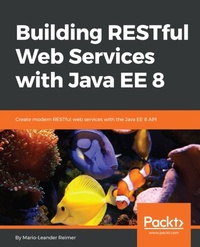
Building RESTful Web Services with Java EE 8
Create modern RESTful web services with the Java EE 8 API
Published on 23. September 2024
116 pages
978-1-78953-426-9 (ISBN)
Description

Learn the fundamentals of Java EE 8 APIs to build effective web services
Key Features
[*] Design modern and stylish web services with Java EE APIs
[*] Secure your web services with JSON Web Tokens
[*] Explore the advanced concepts of RESTful web services and the JAX-RS API
Book DescriptionJava Enterprise Edition is one of the leading application programming platforms for enterprise Java development. With Java EE 8 finally released and the first application servers now available, it is time to take a closer look at how to develop modern and lightweight web services with the latest API additions and improvements. Building RESTful Web Services with Java EE 8 is a comprehensive guide that will show you how to develop state-of-the-art RESTful web services with the latest Java EE 8 APIs. You will begin with an overview of Java EE 8 and the latest API additions and improvements. You will then delve into the details of implementing synchronous RESTful web services and clients with JAX-RS. Next up, you will learn about the specifics of data binding and content marshalling using the JSON-B 1.0 and JSON-P 1.1 APIs. This book also guides you in leveraging the power of asynchronous APIs on the server and client side, and you will learn to use server-sent events (SSEs) for push communication. The final section covers advanced web service topics such as validation, JWT security, and diagnosability. By the end of this book, you will have implemented several working web services and have a thorough understanding of the Java EE 8 APIs required for lightweight web service development.What you will learn
[*] Dive into the latest Java EE 8 APIs relevant for developing web services
[*] Use the new JSON-B APIs for easy data binding
[*] Understand how JSON-P API can be used for flexible processing
[*] Implement synchronous and asynchronous JAX-RS clients
[*] Use server-sent events to implement server-side code
[*] Secure Java EE 8 web services with JSON Web Tokens
Who this book is forIf you're a Java developer who wants to learn how to implement web services using the latest Java EE 8 APIs, this book is for you. Though no prior knowledge of Java EE 8 is required, experience with a previous Java EE version will be beneficial.
Key Features
[*] Design modern and stylish web services with Java EE APIs
[*] Secure your web services with JSON Web Tokens
[*] Explore the advanced concepts of RESTful web services and the JAX-RS API
Book DescriptionJava Enterprise Edition is one of the leading application programming platforms for enterprise Java development. With Java EE 8 finally released and the first application servers now available, it is time to take a closer look at how to develop modern and lightweight web services with the latest API additions and improvements. Building RESTful Web Services with Java EE 8 is a comprehensive guide that will show you how to develop state-of-the-art RESTful web services with the latest Java EE 8 APIs. You will begin with an overview of Java EE 8 and the latest API additions and improvements. You will then delve into the details of implementing synchronous RESTful web services and clients with JAX-RS. Next up, you will learn about the specifics of data binding and content marshalling using the JSON-B 1.0 and JSON-P 1.1 APIs. This book also guides you in leveraging the power of asynchronous APIs on the server and client side, and you will learn to use server-sent events (SSEs) for push communication. The final section covers advanced web service topics such as validation, JWT security, and diagnosability. By the end of this book, you will have implemented several working web services and have a thorough understanding of the Java EE 8 APIs required for lightweight web service development.What you will learn
[*] Dive into the latest Java EE 8 APIs relevant for developing web services
[*] Use the new JSON-B APIs for easy data binding
[*] Understand how JSON-P API can be used for flexible processing
[*] Implement synchronous and asynchronous JAX-RS clients
[*] Use server-sent events to implement server-side code
[*] Secure Java EE 8 web services with JSON Web Tokens
Who this book is forIf you're a Java developer who wants to learn how to implement web services using the latest Java EE 8 APIs, this book is for you. Though no prior knowledge of Java EE 8 is required, experience with a previous Java EE version will be beneficial.
More details
Edition
Digital original
Language
English
Place of publication
Birmingham
United Kingdom
Target group
Professional and scholarly
US School Grade: College Graduate Student
Edition type
Digital original
File size
7,18 MB
ISBN-13
978-1-78953-426-9 (9781789534269)
Copyright in bibliographic data and cover images is held by Nielsen Book Services Limited or by the publishers or by their respective licensors: all rights reserved.
Schweitzer Classification
Other editions
Additional editions
Mario-Leander Reimer
Building RESTful Web Services with Java EE 8
Create modern RESTful web services with the Java EE 8 API
Book
07/2018
Packt Publishing
€38.70
Shipment within 3-4 weeks
Person
Reimer Mario-Leander :
Mario-Leander Reimer is a chief software architect, a passionate developer, and a #CloudNativeNerd currently working for QAware GmbH. He is continuously looking for innovations in software engineering in order to combine and apply state-of-the-art technologies in real-world projects. He is a regular speaker at national and international conferences and he teaches cloud computing and software quality assurance as a part-time lecturer. Slidedecks: https://speakerdeck.com/lreimer/ GitHub: https://github.com/lreimer/ Twitter: https://twitter.com/LeanderReimer Linkedin: https://www.linkedin.com/in/mario-leander-reimer-b2b67aa0/
Mario-Leander Reimer is a chief software architect, a passionate developer, and a #CloudNativeNerd currently working for QAware GmbH. He is continuously looking for innovations in software engineering in order to combine and apply state-of-the-art technologies in real-world projects. He is a regular speaker at national and international conferences and he teaches cloud computing and software quality assurance as a part-time lecturer. Slidedecks: https://speakerdeck.com/lreimer/ GitHub: https://github.com/lreimer/ Twitter: https://twitter.com/LeanderReimer Linkedin: https://www.linkedin.com/in/mario-leander-reimer-b2b67aa0/
Content
Table of Contents
Getting started with java ee 8
Building synchronous web services and clients
Content marshalling with json-b and json-p
Building asynchronous web services
Using server-sent events (sse)
Advanced rest apis
Getting started with java ee 8
Building synchronous web services and clients
Content marshalling with json-b and json-p
Building asynchronous web services
Using server-sent events (sse)
Advanced rest apis
