

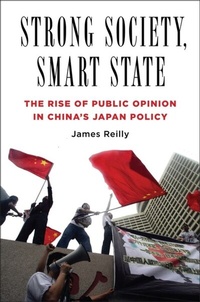
Strong Society, Smart State
The Rise of Public Opinion in China's Japan Policy
1st Edition
Published on 29. October 2015
352 pages
978-0-231-52808-5 (ISBN)
Description

The rise and influence of public opinion on Chinese foreign policy reveals a remarkable evolution in authoritarian responses to social turmoil. James Reilly shows how Chinese leaders have responded to popular demands for political participation with a sophisticated strategy of tolerance, responsiveness, persuasion, and repression-a successful approach that helps explain how and why the Communist Party continues to rule China.
Through a detailed examination of China's relations with Japan from 1980 to 2010, Reilly reveals the populist origins of a wave of anti-Japanese public mobilization that swept across China in the early 2000s. Popular protests, sensationalist media content, and emotional public opinion combined to impede diplomatic negotiations, interrupt economic cooperation, spur belligerent rhetoric, and reshape public debates. Facing a mounting domestic and diplomatic crisis, Chinese leaders responded with a remarkable reversal, curtailing protests and cooling public anger toward Japan.
Far from being a fragile state overwhelmed by popular nationalism, market forces, or information technology, China has emerged as a robust and flexible regime that has adapted to its new environment with remarkable speed and effectiveness. Reilly's study of public opinion's influence on foreign policy extends beyond democratic states. It reveals how persuasion and responsiveness sustain Communist Party rule in China and develops a method for examining similar dynamics in different authoritarian regimes. He draws upon public opinion surveys, interviews with Chinese activists, quantitative media analysis, and internal government documents to support his findings, joining theories in international relations, social movements, and public opinion.
Through a detailed examination of China's relations with Japan from 1980 to 2010, Reilly reveals the populist origins of a wave of anti-Japanese public mobilization that swept across China in the early 2000s. Popular protests, sensationalist media content, and emotional public opinion combined to impede diplomatic negotiations, interrupt economic cooperation, spur belligerent rhetoric, and reshape public debates. Facing a mounting domestic and diplomatic crisis, Chinese leaders responded with a remarkable reversal, curtailing protests and cooling public anger toward Japan.
Far from being a fragile state overwhelmed by popular nationalism, market forces, or information technology, China has emerged as a robust and flexible regime that has adapted to its new environment with remarkable speed and effectiveness. Reilly's study of public opinion's influence on foreign policy extends beyond democratic states. It reveals how persuasion and responsiveness sustain Communist Party rule in China and develops a method for examining similar dynamics in different authoritarian regimes. He draws upon public opinion surveys, interviews with Chinese activists, quantitative media analysis, and internal government documents to support his findings, joining theories in international relations, social movements, and public opinion.
All prices
More details
Other editions
Additional editions
Book
10/2011
Columbia University Press
€76.86
Shipment within 10-20 days
Person
James Reilly is lecturer in northeast Asian politics at the University of Sydney. He earned his Ph.D. from George Washington University and has been a postdoctoral research associate at the University of Oxford and a Fulbright Scholar at Renmin University in Beijing. His research focuses on Chinese foreign policy, East Asian politics, and international relations, and for eight years he worked with the American Friends Service Committee in China.
Content
List of Figures
List of Tables
Acknowledgments
Introduction
1. Public Opinion in Chinese Foreign Policy
2. Forgetting and Remembering the Past: China's Relations with Japan, 1949-1999
3. The Origins of Public Mobilization
4. Responding to Public Opinion
5. A Potent Populism
6. The Rebirth of the Propaganda State
Conclusion
Appendices
Notes
Bibliography
Index
List of Tables
Acknowledgments
Introduction
1. Public Opinion in Chinese Foreign Policy
2. Forgetting and Remembering the Past: China's Relations with Japan, 1949-1999
3. The Origins of Public Mobilization
4. Responding to Public Opinion
5. A Potent Populism
6. The Rebirth of the Propaganda State
Conclusion
Appendices
Notes
Bibliography
Index

