

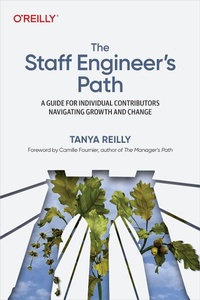
Staff Engineer's Path
Description

For years, companies have rewarded their most effective engineers with management positions. But treating management as the default path for an engineer with leadership ability doesn''t serve the industry well--or the engineer. The staff engineer''s path allows engineers to contribute at a high level as role models, driving big projects, determining technical strategy, and raising everyone''s skills.
This in-depth book shows you how to understand your role, manage your time, master strategic thinking, and set the standard for technical work. You''ll read about how to be a leader without direct authority, how to plan ahead to make the right technical decisions, and how to make everyone around you better, while still growing as an expert in your domain.
By exploring the three pillars of a staff engineer''s job, Tanya Reilly, a veteran of the staff engineer track, shows you how to:
- Take a broad, strategic view when thinking about your work
- Dive into practical tactics for making projects succeed
- Determine what "good engineering" means in your organization
More details
Other editions
Additional editions

Content
- Cover
- Copyright
- Table of Contents
- Foreword
- Introduction
- Two Paths
- The Pillars of Staff Engineering
- Part I: The Big Picture
- Part II: Execution
- Part III: Leveling Up
- O'Reilly Online Learning
- How to Contact Us
- Acknowledgments
- Part I. The Big Picture
- Chapter 1. What Would You Say You Do Here?
- What Even Is a Staff Engineer?
- Why Do We Need Engineers Who Can See the Big Picture?
- Why Do We Need Engineers Who Lead Projects That Cross Multiple Teams?
- Why Do We Need Engineers Who Are a Good Influence?
- Enough Philosophy. What's My Job?
- You're Not a Manager, but You Are a Leader
- You're in a "Technical" Role
- You Aim to Be Autonomous
- You Set Technical Direction
- You Communicate Often and Well
- Understanding Your Role
- Where in the Organization Do You Sit?
- What's Your Scope?
- What Shape Is Your Role?
- What's Your Primary Focus?
- Aligning on Scope, Shape, and Primary Focus
- Is That Your Job?
- To Recap
- Chapter 2. Three Maps
- Uh, Did Anyone Bring a Map?
- A Locator Map: You Are Here
- A Topographical Map: Learning the Terrain
- A Treasure Map: X Marks the Spot
- Clearing the Fog of War
- The Locator Map: Getting Perspective
- Seeing Bigger
- The Topographical Map: Navigating the Terrain
- Rough Terrain
- Understanding Your Organization
- What Points of Interest Are on Your Map?
- Keeping Your Topographic Map Up to Date
- If the Terrain Is Still Difficult to Navigate, Be a Bridge
- The Treasure Map: Remind Me Where We're Going?
- Chasing Shiny Things
- Taking a Longer View
- If the Treasure Map Is Still Unclear, It Might Be Time to Draw a New One
- Your Personal Journey
- To Recap
- Chapter 3. Creating the Big Picture
- The Scenario: SockMatcher Needs a Plan
- What's a Vision? What's a Strategy?
- What's a Technical Vision?
- What's a Technical Strategy?
- Do You Really Need Vision and Strategy Documents?
- The Approach
- Embrace the Boring Ideas
- Join an Expedition in Progress
- Get a Sponsor
- Choose Your Core Group
- Set Scope
- Make Sure It's Achievable
- Make It Official
- The Writing
- The Writing Loop
- Make Decisions
- Get Aligned and Stay Aligned
- Create the Final Draft
- The Launch
- Make It Official
- Keep It Fresh
- Case Study: SockMatcher
- Approach
- The Writing
- The Launch
- To Recap
- Part II. Execution
- Chapter 4. Finite Time
- Doing All the Things
- Time
- Finite Time
- How Busy Do You Like to Be?
- projectqueue.pop()?
- Resource Constraints
- Your Dashboard
- E + 2S + ...?
- Bin packing
- Choosing Projects
- Evaluating a Project
- What are you signing on for?
- Questions to Ask Yourself About Projects
- What If It's the Wrong Project?
- Examples
- Defend Your Time
- To Recap
- Chapter 5. Leading Big Projects
- The Life of a Project
- The Start of a Project
- If You're Feeling Overwhelmed.
- Building Context
- Giving Your Project Structure
- Driving the Project
- Exploring
- Clarifying
- Designing
- Coding
- Communicating
- Navigating
- To Recap
- Chapter 6. Why Have We Stopped?
- The Project Isn't Moving-Should It Be?
- You're Stuck in Traffic
- Blocked by Another Team
- Blocked by a Decision
- Blocked by a Single $%@$% Button Click
- Blocked by a Single Person
- Blocked by Unassigned Work
- Blocked by a Huge Crowd of People
- You're Lost
- You Don't Know Where You're All Going
- You Don't Know How to Get There
- You Don't Know Where You Stand
- You Have Arrived.Somewhere?
- But It's Code Complete!
- It's Done but Nobody Is Using It
- It's Built on a Shaky Foundation
- The Project Just Stops Here
- To Recap
- Part III. Leveling Up
- Chapter 7. You're a Role Model Now (Sorry)
- What Does It Mean to Do a Good Job?
- But I Don't Want to Be a Role Model!
- What Does It Mean to Do a Good Job as a Senior Engineer?
- Be Competent
- Know Things
- Be Self-Aware
- Have High Standards
- Be Responsible
- Take Ownership
- Take Charge
- Create Calm
- Remember the Goal
- Remember There's a Business
- Remember There's a User
- Remember There's a Team
- Look Ahead
- Anticipate What You'll Wish You'd Done
- Expect Failure
- Optimize for Maintenance, Not Creation
- Create Future Leaders
- To Recap
- Chapter 8. Good Influence at Scale
- Good Influence
- Scaling Your Good Influence
- Advice
- Individual Advice
- Scaling Your Advice to a Group
- Being a Catalyst
- Teaching
- Individual Teaching
- Scaling Your Teaching to a Group
- Being a Catalyst
- Guardrails
- Individual Guardrails
- Scaling Your Guardrails to a Group
- Being a Catalyst
- Opportunity
- Individual Opportunities
- Scaling Your Opportunities to a Group
- Being a Catalyst
- To Recap
- Chapter 9. What's Next?
- Your Career
- What's Important to You?
- Where Are You Going?
- What Do You Need to Invest In?
- Your Current Role
- Five Metrics to Keep an Eye On
- Can You Get What You Want from Your Role?
- Should You Change Jobs?
- Paths from Here
- Keep Doing What You're Doing
- Work Toward Promotion
- Work Less
- Change Teams
- Build a New Specialty
- Explore
- Take a Management Role
- Take on Reports for the First Time
- Find or Invent Your Own Niche
- Do the Same Job for a Different Employer
- Change Employers and Go Up a Level
- Change Employers and Go Down a Level
- Set Up Your Own Startup
- Go Independent
- Change Careers
- Prepare to Reset
- Your Choices Matter
- To Recap
- Index
- About the Author
