

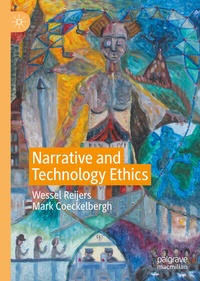
Narrative and Technology Ethics
Description

This book proposes that technologies, similar to texts, novels and movies, 'tell stories' and thereby configure our lifeworld in the Digital Age. The impact of technologies on our lived experience is ever increasing: innovations in robotics challenge the nature of work, emerging biotechnologies impact our sense of self, and blockchain-based smart contracts profoundly transform interpersonal relations. In their exploration of the significance of these technologies, Reijers and Coeckelbergh build on the philosophical hermeneutics of Paul Ricouer to construct a new, narrative approach to the philosophy and ethics of technology.
The authors take the reader on a journey: from a discussion of the philosophy of praxis, via a hermeneutic notion of technical practice that draws on MacIntyre, Heidegger and Ricoeur, through the virtue ethics of Vallor, and Ricoeur's ethical aim, to the eventual construction of a practice method which can guide ethics in research and innovation. In itscreation of a compelling hermeneutic ethics of technology, the book offers a concrete framework for practitioners to incorporate ethics in everyday technical practice.
Reviews / Votes
Narrative & Technology Ethics represents a major contribution to the contemporary philosophical debate on technology. While the field is currently dominated by the so-called empirical turn, the authors propose a narrative approach to technology. They introduce, among several innovative ideas, the notions of technical practice and technological employment, both inspired by the philosophy of Paul Ricoeur. Such an innovative framework turns out to be particularly effective when it comes to technology ethics. Narrative & Technology Ethics will be of great interest not only to scholars in philosophy of technology, Ricoeur studies, science and technology studies, media studies, and many other research fields. It will also represent a formidable instrument for practitioners, and stakeholders in general. The authors have indeed the great merit of translating the narrative ethics of technical practice into an elegant and easy-to-apply method for practicing ethics in research and innovation settings.- Alberto Romele, Associate Professor of Philosophy of Technology at the ETHICS Lab of Lille Catholic University, France.
More details
Other editions
Additional editions
Persons
Mark Coeckelbergh is a philosopher of technology. He is Professor of Philosophy of Media and Technology at the Department of Philosophy of the University of Vienna, Austria, and President of the Society for Philosophy and Technology.
