

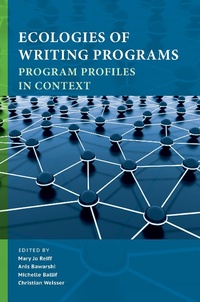
Ecologies of Writing Programs
Program Profiles in Context
Published on 15. April 2015
416 pages
978-1-60235-513-2 (ISBN)
Description

Ecologies of Writing Programs: Profiles of Writing Programs in Context features profiles of exemplary and innovative writing programs across varied institutions. Situated within an ecological framework, the book explores the dynamic inter-relationships as well as the complex rhetorical and material conditions that writing programs inhabit-conditions and relationships that are constantly in flux as writing program administrators negotiate constraint and innovation.
More details
Other editions
Additional editions
Mary Jo Reiff | Anis Bawarshi | Michelle Ballif
Ecologies of Writing Programs
Program Profiles in Context
Book
03/2015
Parlor Press
€40.20
Shipment within 3-4 weeks
Content
- Front cover
- Series page
- Title page
- Copyright page
- Contents
- Acknowledgments
- Writing Program Ecologies: An Introduction
- Mary Jo Reiff, Anis Bawarshi, Michelle Ballif, and Christian Weisser
- Part I. The Contested Ecologies of FYC Programs: Negotiating between Stability and Change
- 1 The Kairotic Moment: Pragmatic Revision of Basic Writing Instruction at Indiana University-Purdue University Fort Wayne
- Sara Webb-Sunderhaus and Stevens Amidon
- 2 Standardizing English 101 at Southern Illinois University Carbondale: Reflections on the Promise of Improved GTA Preparation and More Effective Writing Instruction
- Ronda Leathers Dively
- 3 Taking the High Road: Teaching for Transfer in an FYC Program
- Jenn Fishman and Mary Jo Reiff
- 4 Intractable Writing Program Problems, Kairos, and Writing-about-Writing: A Profile of the University of Central Florida's First-Year Composition Program
- Elizabeth Wardle
- Part II. Remapping Interdisciplinary Ecologies: WAC and WID Programs
- 5 The Writing Intensive Program at the University of Georgia
- Michelle Ballif
- 6 Back to the Future: First-Year Writing in the Binghamton University Writing Initiative, State University of New York
- Kelly Kinney and Kristi Murray Costello
- 7 Imagining a Writing and Rhetoric Program Based on Principles of Knowledge "Transfer": Dartmouth's Institute for Writing and Rhetoric
- Stephanie Boone, Sara Biggs Chaney, Josh Compton, Christiane Donahue, and Karen Gocsik
- Part III. Claiming Disciplinary Locations: The Undergraduate Major in Rhetoric and Composition
- 8 Diverse Lessons: Developing an Undergraduate Program in Rhetoric, Writing, and Culture at Texas A&M
- Stephanie L. Kerschbaum and M. Jimmie Killingsworth
- 9 Reflections on the Major in Writing and Rhetoric at Oakland University
- Lori Ostergaard, Greg A. Giberson, and Jim Nugent
- 10 The Case for a Major in Writing Studies: The University of Minnesota Duluth
- David Beard
- Part IV. Interconnected Sites of Agency: Situating Assessment within Institutional Ecologies
- 11 Self-Assessment as Programmatic Center: The First Year Writing Program and Its Assessment at California State University, Fresno
- Asao B. Inoue
- 12 Utilizing Strategic Assessment to Support FYC Curricular Revision at Murray State University
- Paul Walker and Elizabeth Myers
- Part V. Third Spaces: Creating Liminal Ecologies
- 13 A Collaborative Approach to Information Literacy: First-year Composition, Writing Center, and Library Partnerships at West Virginia University
- Laura Brady, Nathalie Singh-Corcoran,
- Jo Ann Dadisman, and Kelly Diamond
- 14 The Peer-Interactive Writing Center at the University of New Mexico
- Daniel Sanford
- 15 Writing the Transition to College: A Summer College Writing Experience at Elon University
- Jessie L. Moore, Kimberly B. Pyne, and Paula Patch
- Index
- About the Editors
- Back cover
