

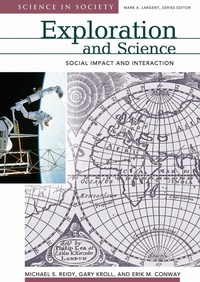
Exploration and Science
Social Impact and Interaction
Published on 27. December 2006
384 pages
978-1-57607-986-7 (ISBN)
Description

This comprehensive volume explores the intricate, mutually dependent relationship between science and exploration-how each has repeatedly built on the discoveries of the other and, in the process, opened new frontiers.
A simple question: Which came first, advances in navigation or successful voyages of discovery? A complicated answer: Both and neither. For more than four centuries, scientists and explorers have worked together-sometimes intentionally and sometimes not-in an ongoing, symbiotic partnership. When early explorers brought back exotic flora and fauna from newly discovered lands, scientists were able to challenge ancient authorities for the first time. As a result, scientists not only invented new navigational tools to encourage exploration, but also created a new approach to studying nature, in which observations were more important than reason and authority.
The story of the relationship between science and exploration, analyzed here for the first time, is nothing less than the history of modern science and the expanding human universe.
A simple question: Which came first, advances in navigation or successful voyages of discovery? A complicated answer: Both and neither. For more than four centuries, scientists and explorers have worked together-sometimes intentionally and sometimes not-in an ongoing, symbiotic partnership. When early explorers brought back exotic flora and fauna from newly discovered lands, scientists were able to challenge ancient authorities for the first time. As a result, scientists not only invented new navigational tools to encourage exploration, but also created a new approach to studying nature, in which observations were more important than reason and authority.
The story of the relationship between science and exploration, analyzed here for the first time, is nothing less than the history of modern science and the expanding human universe.
More details
Series
Language
English
Place of publication
New York
United States
Publishing group
Bloomsbury Publishing Plc
Illustrations
26 bw illus
File size
4,18 MB
ISBN-13
978-1-57607-986-7 (9781576079867)
Copyright in bibliographic data and cover images is held by Nielsen Book Services Limited or by the publishers or by their respective licensors: all rights reserved.
Schweitzer Classification
Other editions
Additional editions
Michael Sean Reidy | Gary Kroll | Erik M. Conway
Exploration and Science
Social Impact and Interaction
Book
12/2006
ABC-CLIO
€93.60
Shipment within 3-4 weeks
Persons
Michael S. Reidy, PhD, is assistant professor of history in the Department of History and Philosophy at Montana State University, Bozeman, MT, specializing in the history of geophysical sciences in the 19th century.
Gary Kroll, PhD, is assistant professor of history at State University of New York-Plattsburgh, Plattsburgh, NY, where he teaches courses on environmental history and the history of science.
Erik Conway, PhD, is a visiting historian at NASA's Langley Research Center, Hampton, VA. He received his degree from the University of Minnesota.
Gary Kroll, PhD, is assistant professor of history at State University of New York-Plattsburgh, Plattsburgh, NY, where he teaches courses on environmental history and the history of science.
Erik Conway, PhD, is a visiting historian at NASA's Langley Research Center, Hampton, VA. He received his degree from the University of Minnesota.
Content
- Cover
- Exploration and Science
- Contents
- Series Editor's Preface
- Preface
- 1 Navigating the Oceans
- When China Ruled the Waves
- Europe's Rebirth
- Portugal, Spain, and the Atlantic World
- The Scientific Revolution
- The Royal Society and English Science
- Edmund Halley, the Last Philosopher-Commander
- The Royal Academy and French Science
- Maupertuis and the Shape of Earth
- Determining Longitude
- Mapping the Moon's Motion
- The Mariner's Watch
- Conclusion
- Bibliographic Essay
- 2 Ordering Nature in the Age of Enlightenment
- The Stimulus to Natural History
- The Jardin du Roi and Royal Academy of Sciences
- The Rise of Natural History
- Linnaeus's "Apostles" and Economic Botany
- The Second Great Age of Discovery
- The Transit of Venus
- The Three Voyages of Captain James Cook
- In the Wake of Cook
- Conclusion
- Bibliographic Essay
- 3 Humboldt and the Rise of the Geophysical Sciences
- Alexander von Humboldt (1769-1859)
- Humboldt and British Imperialism
- Humboldtian Initiatives
- Tides
- Terrestrial Magnetism
- Meteorology
- The Search for the Northwest Passage
- The Study of the Ocean
- Conclusion
- Bibliographic Essay
- 4 Natural History in the Nineteenth Century
- Charles Darwin
- Joseph Dalton Hooker
- Alfred Russel Wallace
- Thomas Henry Huxley
- Conclusion
- Bibliographic Essay
- 5 Scientific Exploration of a Manifest America
- U.S. Coast Survey
- Corps of Discovery
- Army Corps of Topographical Engineers
- The Great Surveys
- The California Geological Survey and Environmental Reform
- A Long Conclusion: An End to Exploration?
- Bibliographic Essay
- 6 The Exploratory Tradition in the Ocean Sciences
- Military Exploration and the Bureaucratic Imperative
- Commercial Exploration
- Imperial Science and the Expeditionary Tradition
- Scandinavia, Oceanography, and Cod
- American Oceanography and the Military Imperative
- Environmental and Remote Ocean Exploration in the Late Twentieth Century
- Bibliographic Essay
- 7 Human Exploration under the Sea
- Personal Exploration: Helmets and Scuba
- Underwater Habitats
- Deep-Sea Submersibles
- Conclusion
- Bibliographic Essay
- 8 Human Exploration of the High Frontier
- Exploring the Atmosphere
- Getting Man into Space
- Shooting the Moon
- Exploration and Lunar Science
- Contraction of the High Frontier: The Retreat to Low Earth Orbit
- Conclusion
- Bibliographic Essay
- 9 Robotic Space Exploration
- The Golden Age of Robotic Exploration, 1960-1973
- Planetary Science
- A Decade of Retrenchment amid Exploration: The 1970s
- The Nadir: The 1980s and Robotic Exploration
- The Decade of "Faster, Better, Cheaper"
- Conclusion
- Bibliographic Essay
- Chronology of Significant Events
- Glossary
- Primary Source Documents
- Chapter 1
- Salomon's House
- Henry Oldenberg's Call for Observations on Sea Voyages
- Chapter 2
- Captain James Cook's Voyage to Tahiti
- The Royal Academy's Instructions to Jean-Francois Galaup, Comte de La Pérouse
- Operations Respecting Astronomy, Geography, Navigation, Physics, and the Different Branches of Natural History
- Chapter 3
- Alexander von Humboldt's Personal Narrative
- James Clark Ross and the Northern Magnetic Pole
- Chapter 4
- Charles Darwin's Landing on Chatham Island
- Alfred Russel Wallace's Account of Living in Dobbo
- Joseph Dalton Hooker's Account of Preparations and Negotiations for Entering the Tibetan Passes
- Chapter 5
- The Corps of Discovery and the Mandan Nation
- Dr. G. Suckley's Report on Pacific Salmon
- Chapter 6
- William Scoresby on Sea Color in the Arctic
- Henry Bigelow's Report on Oceanography
- Matthew Fontaine Maury on Determining Accurate Seafloor Depth
- Chapter XIII: The Depths of the Ocean
- Chapter 8
- John F. Kennedy's Special Message on Urgent National Needs
- Chapter 9
- James M. Beggs's Letter on Budget Cuts and the Jet Propulsion Laboratory
- Daniel S. Goldin's May 1992 Remarks to the Jet Propulsion Laboratory
- Daniel S. Goldin's March 2000 Remarks to the Jet Propulsion Laboratory
- Notes
- CHAPTER 1
- CHAPTER 2
- CHAPTER 3
- CHAPTER 4
- CHAPTER 5
- CHAPTER 6
- CHAPTER 7
- Bibliography
- Chapter 1
- Chapter 2
- Chapter 3
- Chapter 4
- Chapter 5
- Chapter 6
- Chapter 7
- Chapter 8
- Chapter 9
- Index
