

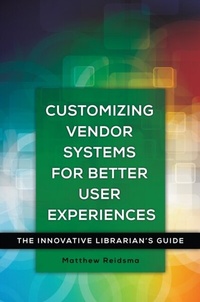
Customizing Vendor Systems for Better User Experiences
The Innovative Librarian's Guide
1st Edition
Published on 9. May 2016
178 pages
978-1-4408-4385-3 (ISBN)
Description

Discover how-with relatively straightforward scripts and minimal coding-to customize the user interfaces to third-party systems from your library's website for better communication with your users and to lead them to your library's services.
In order to provide access to online resources, libraries depend on third-party vendor software that comes with each product. While these systems do have value, they can also be confusing, awkward, frustrating, or even misleading for library users. Imagine how much better your patrons' user experience would be if the software were customized specifically to fit your library. This how-to guide shows library staff how to take a DIY approach to customize the web interface to vendor-hosted online systems, thereby resolving usability problems and providing the ability to respond quickly to problems or evolving needs.
The book begins with an explanation of how to test library vendor software for user experience, then goes on to present solutions to common usability problems through tutorials and case studies on using JavaScript or jQuery to change how a web browser displays that software. It also covers ongoing assessment methods to ensure that user needs have been satisfied. By using these tools, libraries can take some control of "black box" library software and customize it based on local needs.
In order to provide access to online resources, libraries depend on third-party vendor software that comes with each product. While these systems do have value, they can also be confusing, awkward, frustrating, or even misleading for library users. Imagine how much better your patrons' user experience would be if the software were customized specifically to fit your library. This how-to guide shows library staff how to take a DIY approach to customize the web interface to vendor-hosted online systems, thereby resolving usability problems and providing the ability to respond quickly to problems or evolving needs.
The book begins with an explanation of how to test library vendor software for user experience, then goes on to present solutions to common usability problems through tutorials and case studies on using JavaScript or jQuery to change how a web browser displays that software. It also covers ongoing assessment methods to ensure that user needs have been satisfied. By using these tools, libraries can take some control of "black box" library software and customize it based on local needs.
More details
Series
Edition
1. Auflage
Language
English
Place of publication
United States
Publishing group
Bloomsbury Publishing Plc
Target group
Interest Age: From 7 to 17 years
ISBN-13
978-1-4408-4385-3 (9781440843853)
Copyright in bibliographic data and cover images is held by Nielsen Book Services Limited or by the publishers or by their respective licensors: all rights reserved.
Schweitzer Classification
Other editions
Additional editions
Matthew Reidsma
Customizing Vendor Systems for Better User Experiences
The Innovative Librarian's Guide
Book
05/2016
Libraries Unlimited Inc
€64.30
Shipment within 10-20 days
Person
Matthew Reidsma is web services librarian at Grand Valley State University in Allendale, MI, and cofounder and editor-in-chief of Weave: Journal of Library User Experience.
Content
Acknowledgments
Chapter 1 Library Vendor Tools
Chapter 2 JavaScript and Vendor Tools
Chapter 3 Working with Developer Tools
Chapter 4 JavaScript Basics
Chapter 5 JavaScript Bookmarklets
Chapter 6 Advanced JavaScript
Chapter 7 JavaScript Examples
Chapter 8 jQuery Basics
Chapter 9 Advanced jQuery
Chapter 10 jQuery Examples
Chapter 11 Getting Data In and Out of Vendor Tools
Chapter 12 AJAX Examples
Chapter 13 Helper Scripts in PHP
Conclusion
Index
Chapter 1 Library Vendor Tools
Chapter 2 JavaScript and Vendor Tools
Chapter 3 Working with Developer Tools
Chapter 4 JavaScript Basics
Chapter 5 JavaScript Bookmarklets
Chapter 6 Advanced JavaScript
Chapter 7 JavaScript Examples
Chapter 8 jQuery Basics
Chapter 9 Advanced jQuery
Chapter 10 jQuery Examples
Chapter 11 Getting Data In and Out of Vendor Tools
Chapter 12 AJAX Examples
Chapter 13 Helper Scripts in PHP
Conclusion
Index
