

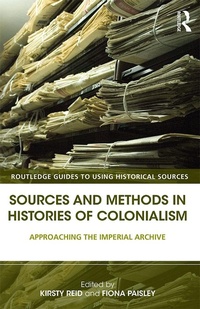
Sources and Methods in Histories of Colonialism
Approaching the Imperial Archive
Published on 27. March 2017
212 pages
978-1-351-98663-2 (ISBN)
Description

Sources and Methods in Histories of Colonialism provides an in-depth study of the relationships between archives, knowledge and power. Exploring a diverse range of examples and surveying the now substantial scholarly literatures on the functions and scope of the 'imperial archive', it facilitates a deeper understanding of the challenges of working with a range of specific source genres within imperial and colonial archives.
Covering the late eighteenth century to the present day and drawing on material from a range of modern empires including those established by Britain, France, the Netherlands, Spain and the United States, chapters discuss themes such as the emergence of photography as an archival tool, the use of oral history in histories of colonialism and the ways in which the state informs the archive and vice versa. This book considers the ways in which newer ways of thinking about the past have challenged more traditional views of 'the archive', provoking questions about what archives are and where their conceptual, geographical and chronological boundaries lie.
Examining a wide selection of source material including government papers, censuses, petitions and case files and providing both an overarching introduction to the subject and close analysis of specific case studies, this book will be essential reading for students of imperial and colonial history.
Covering the late eighteenth century to the present day and drawing on material from a range of modern empires including those established by Britain, France, the Netherlands, Spain and the United States, chapters discuss themes such as the emergence of photography as an archival tool, the use of oral history in histories of colonialism and the ways in which the state informs the archive and vice versa. This book considers the ways in which newer ways of thinking about the past have challenged more traditional views of 'the archive', provoking questions about what archives are and where their conceptual, geographical and chronological boundaries lie.
Examining a wide selection of source material including government papers, censuses, petitions and case files and providing both an overarching introduction to the subject and close analysis of specific case studies, this book will be essential reading for students of imperial and colonial history.
Reviews / Votes
"This wide-ranging collection explores the creation of colonial archives, their extent and limitations, and their use and misuse. It offers revealing case studies, as well as important theoretical and methodological insights for practitioners of the history of empire, from undergraduate students to senior scholars."Robert Aldrich, University of Sydney, Australia
"Kirsty Reid and Fiona Paisley's provocative collection explores the myriad links between colonial archives, knowledge, and power. These essays transform the archive from a source for history into a historical subject of its own, revealing the many ways archives shaped - and continue to shape - the contours of empire and its legacies. Sources and Methods in Histories of Colonialism should be required reading for anyone who studies the history of empire."
J. P. Daughton, Stanford University, USA "This wide-ranging collection explores the creation of colonial archives, their extent and limitations, and their use and misuse. It offers revealing case studies, as well as important theoretical and methodological insights for practitioners of the history of empire, from undergraduate students to senior scholars."
Robert Aldrich, University of Sydney, Australia
"Kirsty Reid and Fiona Paisley's provocative collection explores the myriad links between colonial archives, knowledge, and power. These essays transform the archive from a source for history into a historical subject of its own, revealing the many ways archives shaped - and continue to shape - the contours of empire and its legacies. Sources and Methods in Histories of Colonialism should be required reading for anyone who studies the history of empire."
J. P. Daughton, Stanford University, USA
"This book argues that decisions made by researchers surrounding appraisal and description of, and access to, archival materials via their scholarly products have a real-world impact on people and their identities. It serves as a timely reminder that archival decisions do as well."
Sarah R. Demb, Archival Issues
More details
Series
Language
English
Place of publication
London
United Kingdom
Publishing group
Taylor & Francis Ltd
Target group
College/higher education
Illustrations
18 s/w Abbildungen
18 Illustrations, black and white
File size
2,16 MB
ISBN-13
978-1-351-98663-2 (9781351986632)
Copyright in bibliographic data and cover images is held by Nielsen Book Services Limited or by the publishers or by their respective licensors: all rights reserved.
Schweitzer Classification
Other editions
Additional editions
Kirsty Reid | Fiona Paisley
Sources and Methods in Histories of Colonialism
Approaching the Imperial Archive
Book
03/2017
1st Edition
Routledge
€55.00
Shipment within 15-20 days
Kirsty Reid | Fiona Paisley
Sources and Methods in Histories of Colonialism
Approaching the Imperial Archive
Book
03/2017
1st Edition
Routledge
€215.77
Shipment within 15-20 days
Persons
Kirsty Reid was a senior lecturer in history at the University of Bristol, UK, for many years. In 2011 she moved home to the north of Scotland and became part of the team at the Centre for History at the University of the Highlands and Islands. She now lives and works in northern Scotland. Her research has primarily focused on convict transportation and unfree labour within the British Empire. She is the author of Gender, Crime and Empire: Convicts, Settlers and the State in Early Colonial Australia (Manchester, 2007) and co-editor with Fiona Paisley of Critical Perspectives on Colonialism: Writing the Empire from Below (London, 2014).
Fiona Paisley is a cultural historian at Griffith University, Australia. She works on progressive debates concerning the reform of settler colonialism in the first half of the twentieth century. Her recent books are The Lone Protestor: AM Fernando in Australia and Europe (Canberra, 2012) and Glamour in the Pacific: Cultural Internationalism and Race Politics in the Women's Pan-Pacific (Honolulu, 2009). Her current projects include a study of internationalism in the Pacific and Australian public opinion, and anti-slavery discourse and settler colonialism in interwar Australia.
Fiona Paisley is a cultural historian at Griffith University, Australia. She works on progressive debates concerning the reform of settler colonialism in the first half of the twentieth century. Her recent books are The Lone Protestor: AM Fernando in Australia and Europe (Canberra, 2012) and Glamour in the Pacific: Cultural Internationalism and Race Politics in the Women's Pan-Pacific (Honolulu, 2009). Her current projects include a study of internationalism in the Pacific and Australian public opinion, and anti-slavery discourse and settler colonialism in interwar Australia.
Content
List of figures
List of contributors
Introduction
Kirsty Reid and Fiona Paisley
PART I
1 - Democratising the photographic archive
Jane Lydon
2 - Archival detours: sourcing colonial history
Penny Edwards
3 - Decolonizing the archives: a transnational perspective
Victoria Haskins
PART II
4 - Archiving Algeria: power, violence and secrecy
Abdelmajid Hannoum
5 - Colonial knowledge and subaltern voices: the case of an official enquiry in mid-nineteenth-century Java
G. Roger Knight
6 - Making people countable: analyzing paper trails and the imperial census
Alexandra Widmer
PART III
7 - Institutional case files: insanity's archive
Catharine Coleborne
8 - Gender, geopolitics and gaps in the records: women glimpsed in the military archives
Vera Mackie
9 - Entanglement of oral sources and colonial records
Maria Nugent
10 - Living empire
Fiona Paisley
Index
List of contributors
Introduction
Kirsty Reid and Fiona Paisley
PART I
1 - Democratising the photographic archive
Jane Lydon
2 - Archival detours: sourcing colonial history
Penny Edwards
3 - Decolonizing the archives: a transnational perspective
Victoria Haskins
PART II
4 - Archiving Algeria: power, violence and secrecy
Abdelmajid Hannoum
5 - Colonial knowledge and subaltern voices: the case of an official enquiry in mid-nineteenth-century Java
G. Roger Knight
6 - Making people countable: analyzing paper trails and the imperial census
Alexandra Widmer
PART III
7 - Institutional case files: insanity's archive
Catharine Coleborne
8 - Gender, geopolitics and gaps in the records: women glimpsed in the military archives
Vera Mackie
9 - Entanglement of oral sources and colonial records
Maria Nugent
10 - Living empire
Fiona Paisley
Index
