

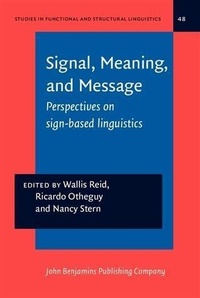
Signal, Meaning, and Message
Perspectives on sign-based linguistics
1st Edition
Published on 26. July 2002
XXII, 413 pages
978-90-272-8223-1 (ISBN)
Description

This is the second volume of papers on sign-based linguistics to emerge from Columbia School linguistics conferences. One set of articles offers semantic analyses of grammatical features of specific languages: English full-verb inversion; Serbo-Croatian deictic pronouns; English auxiliary do; Italian pronouns egli and lui; the Celtic-influenced use of on (e.g., 'he played a trick on me'); a monosemic analysis of the English verb break. A second set deals with general theoretical issues: a solution to the problem that noun class markers (e.g. Swahili) pose for sign-based linguistics; the appropriateness of statistical tests of significance in text-based analysis; the word or the morpheme as the locus of paradigmatic inflectional change; the radical consequences of Saussure's anti-nomenclaturism for syntactic analysis; the future of 'minimalist linguistics' in a maximalist world. A third set explains phonotactic patterning in terms of ease of articulation: aspirated and unaspirated stop consonants in Urdu; initial consonant clusters in more than two dozen languages. An introduction highlights the theoretical and analytical points of each article and their relation to the Columbia School framework. The collection is relevant to cognitive semanticists and functionalists as well as those working in the sign-based Jakobsonian and Guillaumist frameworks.
More details
Other editions
Additional editions
Wallis Reid | Ricardo Otheguy | Nancy Stern
Signal, Meaning, and Message
Perspectives on sign-based linguistics
Book
07/2002
John Benjamins Publishing Co
€137.80
Shipment within 10-15 days
Persons
Content
- Signal, Meaning, and Message Perspectives on sign-based linguistics
- Editorial page
- Title page
- Copyright page
- Table of contents
- List of Contributors
- Introduction: Sign-Based Linguistics
- 1. Meaning as Explanation
- 2. Integration with Cognitive Grammar
- 3. A New Object of Explanation
- 4. Non-Random Distribution of Forms
- 5. Phonology
- 6. The Future of Minimalist Linguistics in a Maximalist World
- References
- Part I. Theoretical and Methodological Issues
- (What) do noun class markers mean?
- 1. Introduction
- 2. Analyses of "noun class
- 3. Noun classification in Swahili
- 3.1 Definition of "noun class " in Swahili
- 3.2 Categorization of the lexicon
- 3.2.1 Parts of speech
- 3.3 Pairing of noun class prefixes with lexical stems
- 3.3.1 Productive NCM uses
- 3.3.2 Less productive NCM alternations
- 4. Overview of the noun classes
- 4.1 Theoretical orientation
- 4.2 The data
- 4.3 Notational conventions
- 4.4 Analysis
- 4.4.1 Class 3 (with prefix m-)
- 4.4.2 Class 7 (with prefix ki-)
- 4.4.3 Class 5 (with prefix ji- ~ 0)
- 5. Discussion
- Notes
- References
- Rethinking the Place of Statistics in Columbia School Analysis
- 1. Rejecting Chi-Square
- 2. Fate, Chance, Kinks, and Desperate Men
- 3. Where do we go from here?
- 4. The meaning of failure
- 5. This Is a Test. This Is Only a Test.
- 6. Conclusion
- Notes
- Sources of data cited
- References
- The Linguistic Sign in Its Paradigmatic Context: Autonomy Revisited
- 1. The issue
- 2. Word-based verbal paradigms in fusional languages
- 3. The autonomy hypothesis
- 4. Difficulties with autonomy
- 5. An alternative interpretation of autonomy
- 6. Support for the Alternative Interpretation
- 7. Concluding Remarks
- Notes
- References
- Part II. Sign-Based Linguistic Analyses
- A Surpassingly Simple Analysis
- 1. The data, the reflexive hypothesis, and deixis
- 2. The hypothesis of an opposition of substances
- 3. Validation: Intra-clausal anaphora
- 4. Validation: Grammatical subject
- 4.1 Ess+for referent-finding
- 4.2 Loro for commentary
- 4.3 Sé as grammatical subject
- 5. Quantitative validation
- 6. Conclusion
- Notes
- Sources of data cited
- References
- Serbo-Croatian Deixis: Balancing Attention with Difficulty in Processing
- 1. Choices of Deixis versus the Number of Referents
- 2. Choices of Deixis with Named vs. Unnamed Human Referents
- 3. Choice of Deixis vs. Participant in Focus
- Sources of Data Cited
- References
- Do - One Sign, One Meaning?
- Notes
- References
- Data, Comprehensiveness, Monosemy
- Sources of data cited
- References
- Phonology As Human Behavior: Initial Consonant Clusters Across Languages
- 1.Introduction
- 1.1 Historical background
- 1.2 Theoretical Background
- 1.3 Methodological background
- 2. Initial consonant clusters in English
- 2.1 Stable vs. mobile: sames are favored, differents disfavored
- 2.2 Explaining the "exceptions
- 2.3 Additional articulators are disfavored
- 2.4 Coarticulation by same articulators is more highly disfavored
- 3. Initial consonant clusters in Italian
- 4. Initial consonant clusters across languages
- 4.1 The Indo-European languages
- 4.1.1 Languages of the Germanic family
- 4.1.2 Languages of the Romance family
- 4.1.3 Languages of the Celtic family
- 4.1.4 Languages of the Slavic family
- 4.1.5 Languages of the Baltic family
- 4.1.6 Languages of the Hellenic family
- 4.1.7 Albanian
- 4.1.8 Bukharian (Judaeo-Persian) (Indo-Iranian)
- 4.2 Languages of the Semitic family
- 4.3 Languages of the Finno-Ugric family
- 4.4 Georgian (Grusinski) (Caucasian)
- 5. Summary and conclusions
- References
- Celtic Sense in Saxon Garb
- 1. Background
- 2. Analysis
- 3. Conclusion
- Notes
- Sources of data cited
- References
- Problems of Aspiration in Modern Standard Urdu
- 1. The Four-way Classification of Urdu Stops
- 2. Production of V(oicing), A(spiration) and the voiced h
- 3. Asymmetrical distribution of units in the four-way classification of Urdu stops
- 4. Asymmetrical patterning of the stop types in word initial and final positions
- 4.1 Aspiration at the beginning and end of Urdu monosyllables
- 4.2 Voiced unaspirated stops as the alternants of voiced aspirates
- 4.3 Aspiration in the final consonant cluster of the Urdu word
- 5. Voiced (Aspirate) h and position in the word
- 6. The Relation of Complex to Simplex Phonological Units
- Concluding Remarks:
- Notes
- References
- Part III. Columbia School in the Context of 20th Century Linguistics
- Cognitive and Semiotic Modes of Explanation in Functional Grammar
- 1. Introduction
- 2. The Problem: Full-Verb Inversion
- 2.1 The syntactic approach
- 2.2 The functional approach
- 3. A new analysis
- 3.1 Thematic preposing
- 3.2 The Focus system
- 3.3 Interaction between Focus and preposing
- 3.4 Scene-setting and introducing of entities onto the scene
- 3.5 Main vs. minor characters
- 4. Existential there
- 4.1 Testing the hypothesis
- 5. Conclusion
- Notes
- Sources of data cited
- References
- The Future of a Minimalist Linguistics in a Maximalist World
- 1. Introduction
- 1.1 The Columbia School as a radical functionalist and minimalist linguistics
- 1.2 The sociological minimalism of the Columbia School
- 1.3 The issue of the future
- 2. The intellectual motivation for the Columbia approach
- 3. Objections to the Columbia position
- 3.1 Common sense approaches to problems and solutions
- 3.2 Overly sparse meanings and excessive appeals to pragmatics
- 3.3 The problem of scales: The Columbia School seen as an attitude rather than a repository of received analyses
- 3.4 Defacto polysemy in the light of the human factor
- 3.5 The reality of a synchronic linguistics
- 3.6 The programmatic nature of Diver's own work
- 4. A counterattack
- 4.1 Who really knows what kind of system language is anyway?
- 4.2 Whose incredibility?
- 4.3 Let he who is without sin cast the first stone
- 4.4 First things first
- 4.5 The problem of control
- 5. The therapeutic function of the Columbia School
- 6. Conclusions
- Notes
- References
- Saussurean anti-nomenclaturism in grammatical analysis: A comparative theoretical perspective
- 1. Introduction
- 2. Two central ideas of Saussure and the Columbia School
- 3. The role of the traditional categories
- 3.1 Traditional categories used to articulate the data
- 3.2 The structure of language found in the data
- 3.3 The traditional categories promoted to the analysis
- 3.4 Columbia School's dissenting position on categories and structure as data
- 3.5 Saussure 's position on categories and structure as ways of articulating the data
- 4. Linguistic meaning as data
- 4.1 Columbia's dissenting position on meaning as data
- 4.2 Saussure's dissenting position on meaning as data
- 5. Structure and meaning in the tradition
- 6. A language is not a nomenclature
- 7. Summary and conclusion
- References
- INDEX OF NAMES
- INDEX OF SUBJECTS
