

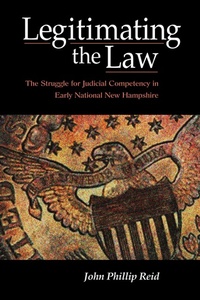
Legitimating the Law
The Struggle for Judicial Competency in Early National New Hampshire
Published on 15. June 2012
252 pages
978-1-60909-054-8 (ISBN)
Description

John Phillip Reid is one of the most highly regarded historians of law as it was practiced on the state level in the nascent United States. He is not just the recipient of numerous honors for his scholarship but the type of historian after whom such accolades are named: the John Phillip Reid Award is given annually by the American Society for Legal History to the author of the best book by a mid-career or senior scholar. Legitimating the Law is the third installment in a trilogy of books by Reid that seek to extend our knowledge about the judicial history of the early republic by recounting the development of courts, laws, and legal theory in New Hampshire.
Here Reid turns his eye toward the professionalization of law and the legitimization of legal practices in the Granite State-customs and codes of professional conduct that would form the basis of judiciaries in other states and that remain the cornerstone of our legal system to this day throughout the US. Legitimating the Law chronicles the struggle by which lawyers and torchbearers of strong, centralized government sought to bring standards of competence to New Hampshire through the professionalization of the bench and the bar-ambitions that were fought vigorously by both Jeffersonian legislators and anti-Federalists in the private sector alike, but ultimately to no avail.
Here Reid turns his eye toward the professionalization of law and the legitimization of legal practices in the Granite State-customs and codes of professional conduct that would form the basis of judiciaries in other states and that remain the cornerstone of our legal system to this day throughout the US. Legitimating the Law chronicles the struggle by which lawyers and torchbearers of strong, centralized government sought to bring standards of competence to New Hampshire through the professionalization of the bench and the bar-ambitions that were fought vigorously by both Jeffersonian legislators and anti-Federalists in the private sector alike, but ultimately to no avail.
More details
Language
English
Place of publication
Ithaca
United States
Publishing group
Cornell University Press
Product notice
Reflowable
ISBN-13
978-1-60909-054-8 (9781609090548)
Copyright in bibliographic data and cover images is held by Nielsen Book Services Limited or by the publishers or by their respective licensors: all rights reserved.
Schweitzer Classification
Other editions
Additional editions
John Phillip Reid
Legitimating the Law
The Struggle for Judicial Competency in Early National New Hampshire
Book
06/2012
Northern Illinois University Press
€68.28
Shipment within 3-4 weeks
Person
John Phillip Reid is the Russell D. Niles Professor of Law Emeritus at New York University School of Law. He is the author of numerous works, among them Controlling the Law and Legislating the Courts.
Content
- Intro
- Contents
- One-The Arena of the Giants
- Two-An Unschooled Judge
- Three-Federalist Indian Summer
- Four-Federalist Apostate
- Five-A "Law" Governor
- Six-In Judicial Depths
- Seven-Legislative Hegemony
- Eight-Dependent Court, Reluctant Chief
- Nine-Contesting Courts
- Ten-Judicial Interregnum
- Eleven-Addressing Out the Judges
- Twelve-A Receptionist Court
- Thirteen-Judicial Legacy
- Notes
- Short Titles
- Acknowledgments
- Index
