

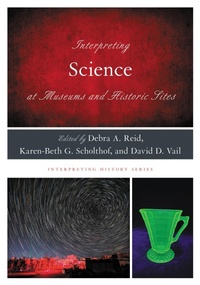
Interpreting Science at Museums and Historic Sites
1st Edition
Published on 11. September 2023
177 pages
979-8-216-25689-2 (ISBN)
Description

Ask not what science can do for you, but what public history can do for science!
Interpreting Science in Museums and Historic Sites stresses the untapped potential of historical artifacts to inform our understanding of scientific topics. It argues that science gains ground when contextualized in museums and historic sites. Engaging audiences in conversations about hot topics such as health and medical sciences or climate change and responses to it, mediated by a history museum, can emphasize scientific rigor and the time lag between discovery and confirmation of societal benefit. Interpreting Science emphasizes the urgency of this work, provides a toolkit to start and sustain the work, shares case studies that model best practice, and resources useful to facilitate and sustain a science-infused public history.
Interpreting Science in Museums and Historic Sites stresses the untapped potential of historical artifacts to inform our understanding of scientific topics. It argues that science gains ground when contextualized in museums and historic sites. Engaging audiences in conversations about hot topics such as health and medical sciences or climate change and responses to it, mediated by a history museum, can emphasize scientific rigor and the time lag between discovery and confirmation of societal benefit. Interpreting Science emphasizes the urgency of this work, provides a toolkit to start and sustain the work, shares case studies that model best practice, and resources useful to facilitate and sustain a science-infused public history.
More details
Series
Edition
1. Auflage
Language
English
Place of publication
United States
Publishing group
Bloomsbury Publishing Plc
Target group
Professional and scholarly
Illustrations
36 b/w photos; 1 table
ISBN-13
979-8-216-25689-2 (9798216256892)
Copyright in bibliographic data and cover images is held by Nielsen Book Services Limited or by the publishers or by their respective licensors: all rights reserved.
Schweitzer Classification
Other editions
Additional editions
Debra A. Reid | Karen-Beth G. Scholthof | David D. Vail
Interpreting Science at Museums and Historic Sites
Book
09/2023
Rowman & Littlefield Publishers
€59.90
Shipment within 3-4 weeks
Persons
Debra A. Reid,PhD, is curator of agriculture and the environment at The Henry Ford (THF). She has experience with AASLH's "Interpreting History" series, as author of Interpreting Agriculture at Museums and Historic Sites (2017) and co-author with David D. Vail of Interpreting the Environment at Museums and Historic Sites (2019). She is a fellow of the Agricultural History Society, and has received numerous additional awards for her teaching, research, and service. Her books include Reaping a Greater Harvest: African Americans, Rural Reform and the Texas Extension Service (2007), Beyond Forty Acres and a Mule: African American Landowning Families since Reconstruction (co-edited with Evan P. Bennett, 2012), and essays in anthologies including Companion to U.S. Agricultural History (forthcoming 2022), Science as Service: Establishing and Reformulating American Land-Grant Universities, 1865-1930 (2015), the Routledge History of Rural America (2016), and Arkansas Women: Their Lives and Times (2018).
Karen-Beth G. Scholthof, PhD, is professor of plant pathology and microbiology at Texas A&M University. She earned her undergraduate B.S. in Botany (and a minor in philosophy) at Montana State University, an M.S. in plant pathology (virology) from the University of Nebraska-Lincoln, and a PhD in plant pathology (virology) at the University of Kentucky. Her course "Pathogens, the Environment and Society" reflects her keen interest in bringing plant pathology, public health, environmental sciences and the humanities to students in science majors. She has published more than 100 peer-reviewed manuscripts and book chapters on molecular plant virology and host-virus interactions. She is an elected fellow of the American Phytopathological Society, the American Society for Microbiology and the American Association for the Advancement of Science.
David D. Vail, PhD, has training in environmental history, science and technology, earning a PhD at Kansas State University. He is associate professor in the Department of History at the University of Nebraska at Kearney. Vail has worked with universities and humanities councils to spread the word about the intersection of policy, science, and agricultural production. He serves as book reviews editor for The Public Historian (National Council on Public History), conference selection committee for the American Society for Environmental History, and the editorial committee of Agricultural History. His award-winning book, Chemical Lands: Pesticides, Aerial Spraying, and Health in North America's Grasslands since 1945 (2018), is part of the University of Alabama Press' NEXUS Series: New Histories of Science, Technology, the Environment, Agriculture, and Medicine.
Karen-Beth G. Scholthof, PhD, is professor of plant pathology and microbiology at Texas A&M University. She earned her undergraduate B.S. in Botany (and a minor in philosophy) at Montana State University, an M.S. in plant pathology (virology) from the University of Nebraska-Lincoln, and a PhD in plant pathology (virology) at the University of Kentucky. Her course "Pathogens, the Environment and Society" reflects her keen interest in bringing plant pathology, public health, environmental sciences and the humanities to students in science majors. She has published more than 100 peer-reviewed manuscripts and book chapters on molecular plant virology and host-virus interactions. She is an elected fellow of the American Phytopathological Society, the American Society for Microbiology and the American Association for the Advancement of Science.
David D. Vail, PhD, has training in environmental history, science and technology, earning a PhD at Kansas State University. He is associate professor in the Department of History at the University of Nebraska at Kearney. Vail has worked with universities and humanities councils to spread the word about the intersection of policy, science, and agricultural production. He serves as book reviews editor for The Public Historian (National Council on Public History), conference selection committee for the American Society for Environmental History, and the editorial committee of Agricultural History. His award-winning book, Chemical Lands: Pesticides, Aerial Spraying, and Health in North America's Grasslands since 1945 (2018), is part of the University of Alabama Press' NEXUS Series: New Histories of Science, Technology, the Environment, Agriculture, and Medicine.
Content
Contents
Foreword
Jill Tiefenthaler, Chief Executive Officer, National Geographic Society
Preface by Karen-Beth G. Scholthof
Acknowledgments
Part I - Science, the Public Historian and Museum Collections
Introduction
Chapter 1: Communicating Climate Change with Archives of Nature and Archives of
Societies by Sam White
Chapter 2: Creating Public Space for Complex Conversations by Melanie Armstrong
Chapter 3: (Re)constructing the Past: Research and Science Interpretation in Experimental
Archeological Open-Air Museums by Claus Kropp
Chapter 4: Local Weather, Distant Connections: Interpreting Meteorological
Instruments and Data by Roger Turner
Chapter 5: Medical Science Archives: Closer and More Accessible Than They Might
Appear by April White and David D. Vail
Part II - Science and the Human Experience
Introduction
Chapter 6: From Farm to Table: A One-Health Scenario by Karen-Beth G. Scholthof
Chapter 7: Seeing the Museum in the Garden: Using Living History Museums to
Teach the History of Plant Introductions by Emily Pawley
Chapter 8: The Outdoor Life: Seeking the "Cure" in New Mexico by Karen-Beth G.
Scholthof
Chapter 9: "...In the Interest of the Health Conservation of the American Negro":
National Negro Health Week, 1915-1951 by Cherisse Jones-Branch
Chapter 10: Irrigation History: Moving Water from Colorado Mountain Peaks to
Fruited Plain by Patricia Rettig
Chapter 11: Exporting the "Wonders of Modern Science": Thinking Scientifically
About Food Aid and Foreign Policy by Kristin Ahlberg
Part III - Science: A Culture of Doubt? A Culture of Questioning
Introduction
Chapter 12: Reflecting on Uncomfortable Science by Aimee Slaughter
Chapter 13: For Our Own Protection: On Black Gay Males and HIV/AIDS Activism by
Jajuan S. Johnson
Chapter 14: Becoming a Scientist: Untangling the Roles of Chemistry Sets
by Debra A. Reid
Chapter 15: The "Gene Gun" and Genetic Engineering: Unpacking the Science by Karen-
Beth G. Scholthof and Debra A. Reid
Chapter 16: Know your analyst, know your food? by Benjamin R. Cohen
Chapter 17: Science and Progress in the Kitchen: Forks, Eggbeaters, and Sporks by
Karen-Beth G. Scholthof and Debra A. Reid
Part IV - Science and History Museum Education
Introduction
Chapter 18: Integrating Art and Science to Effectively Share Knowledge by Bethann
Garramon Merkle
Chapter 19: School Gardens and Edible Education by Debra A. Reid
Chapter 20: A Yearbook of Science for the Public Good by David D. Vail
Chapter 21: Interpreting Scientists: An Interview with Storyteller Brian "Fox" Ellis
Chapter 22: Design, Science, and Driven to Win: A History Museum Addresses the
Innovation Opportunity Gap by Robert Oleary and Matt Anderson
Chapter 23: Exploring Science with Young Naturalists by Debra A. Reid
Conclusion
IDEAS: Inclusion, Diversity, Equity and Access to Science by Karen-Beth G. Scholthof
Selected Readings
Timeline
Contributors
Index
Foreword
Jill Tiefenthaler, Chief Executive Officer, National Geographic Society
Preface by Karen-Beth G. Scholthof
Acknowledgments
Part I - Science, the Public Historian and Museum Collections
Introduction
Chapter 1: Communicating Climate Change with Archives of Nature and Archives of
Societies by Sam White
Chapter 2: Creating Public Space for Complex Conversations by Melanie Armstrong
Chapter 3: (Re)constructing the Past: Research and Science Interpretation in Experimental
Archeological Open-Air Museums by Claus Kropp
Chapter 4: Local Weather, Distant Connections: Interpreting Meteorological
Instruments and Data by Roger Turner
Chapter 5: Medical Science Archives: Closer and More Accessible Than They Might
Appear by April White and David D. Vail
Part II - Science and the Human Experience
Introduction
Chapter 6: From Farm to Table: A One-Health Scenario by Karen-Beth G. Scholthof
Chapter 7: Seeing the Museum in the Garden: Using Living History Museums to
Teach the History of Plant Introductions by Emily Pawley
Chapter 8: The Outdoor Life: Seeking the "Cure" in New Mexico by Karen-Beth G.
Scholthof
Chapter 9: "...In the Interest of the Health Conservation of the American Negro":
National Negro Health Week, 1915-1951 by Cherisse Jones-Branch
Chapter 10: Irrigation History: Moving Water from Colorado Mountain Peaks to
Fruited Plain by Patricia Rettig
Chapter 11: Exporting the "Wonders of Modern Science": Thinking Scientifically
About Food Aid and Foreign Policy by Kristin Ahlberg
Part III - Science: A Culture of Doubt? A Culture of Questioning
Introduction
Chapter 12: Reflecting on Uncomfortable Science by Aimee Slaughter
Chapter 13: For Our Own Protection: On Black Gay Males and HIV/AIDS Activism by
Jajuan S. Johnson
Chapter 14: Becoming a Scientist: Untangling the Roles of Chemistry Sets
by Debra A. Reid
Chapter 15: The "Gene Gun" and Genetic Engineering: Unpacking the Science by Karen-
Beth G. Scholthof and Debra A. Reid
Chapter 16: Know your analyst, know your food? by Benjamin R. Cohen
Chapter 17: Science and Progress in the Kitchen: Forks, Eggbeaters, and Sporks by
Karen-Beth G. Scholthof and Debra A. Reid
Part IV - Science and History Museum Education
Introduction
Chapter 18: Integrating Art and Science to Effectively Share Knowledge by Bethann
Garramon Merkle
Chapter 19: School Gardens and Edible Education by Debra A. Reid
Chapter 20: A Yearbook of Science for the Public Good by David D. Vail
Chapter 21: Interpreting Scientists: An Interview with Storyteller Brian "Fox" Ellis
Chapter 22: Design, Science, and Driven to Win: A History Museum Addresses the
Innovation Opportunity Gap by Robert Oleary and Matt Anderson
Chapter 23: Exploring Science with Young Naturalists by Debra A. Reid
Conclusion
IDEAS: Inclusion, Diversity, Equity and Access to Science by Karen-Beth G. Scholthof
Selected Readings
Timeline
Contributors
Index
