

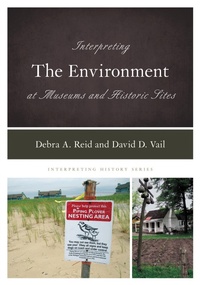
Interpreting the Environment at Museums and Historic Sites
1st Edition
Published on 19. September 2019
226 pages
979-8-216-25690-8 (ISBN)
Description

Interpreting the Environment at Museums and Historic Sites is for anyone who wants to better understand the environment that surrounds us and sustains us, who wants to become a better steward of that environment, and who wants to share lessons learned with others. The process starts by focusing attention on the environment - the physical space that constitutes the largest three-dimensional object in museum collections. It involves conceptualizing spaces and places of human influence; spaces that contain layer upon layer documenting human struggles to survive and thrive. This evidence exists in natural environments as well as city centers. The process continues by adopting an environment-centric view of the spaces destined to be interpreted. This mind-set forms the basis for devising research plans that document how humans have changed, destroyed, conserved and sustained spaces over time, and the ways that the environment reacts. Interpretation built on this evidence then becomes the basis for minds-on engagement with the places that humans inhabit and the spaces that they have changed and continue to manipulate.
Interpreting the Environment at Museums and Historic Sites provides a tool kit designed to help you research environmental history, document evidence of human influence on land and the environment over time, and tailor that knowledge to new public engagement. It proposes a multi-disciplinary approach that requires expertise in the humanities as well as the sciences and social sciences to best understand space and place over time. It incorporates case studies of the theory and method of environmental history to explore how human goals take lasting shape in the environment - creating working environments, getting water, generating and harnessing power, growing food, traveling and trading, building things, and preserving natural landscapes.
Features include the Interpreting the Environment Tool Kit to help you launch the good work of interpreting the environment:
Raw Materials (the evidence): landscape, ecosystems, artifacts, and the built environmentPreparation (methods): thinking like a naturalist/scientist; thinking like a historian; combining approachesPlanning (envisioning the goal): proactive message, stewardship, sustainabilityPartnerships (sharing work): strength in numbers; allying across disciplinary divides; united in efforts to inform the public about their individual and collective effects on the landscape and the environmentPotential: educating the public about people and places is part of a world-wide goal with the cumulative effect of saving the planet, one story at a time.A Timeline and Bibliographic essay round out the book's resources.
Interpreting the Environment at Museums and Historic Sites provides a tool kit designed to help you research environmental history, document evidence of human influence on land and the environment over time, and tailor that knowledge to new public engagement. It proposes a multi-disciplinary approach that requires expertise in the humanities as well as the sciences and social sciences to best understand space and place over time. It incorporates case studies of the theory and method of environmental history to explore how human goals take lasting shape in the environment - creating working environments, getting water, generating and harnessing power, growing food, traveling and trading, building things, and preserving natural landscapes.
Features include the Interpreting the Environment Tool Kit to help you launch the good work of interpreting the environment:
Raw Materials (the evidence): landscape, ecosystems, artifacts, and the built environmentPreparation (methods): thinking like a naturalist/scientist; thinking like a historian; combining approachesPlanning (envisioning the goal): proactive message, stewardship, sustainabilityPartnerships (sharing work): strength in numbers; allying across disciplinary divides; united in efforts to inform the public about their individual and collective effects on the landscape and the environmentPotential: educating the public about people and places is part of a world-wide goal with the cumulative effect of saving the planet, one story at a time.A Timeline and Bibliographic essay round out the book's resources.
More details
Other editions
Additional editions
Debra A. Reid | David D. Vail
Interpreting the Environment at Museums and Historic Sites
Book
09/2019
Rowman & Littlefield Publishers
€128.50
Shipment within 3-4 weeks
Persons
Debra A. Reid, PhD, is curator of agriculture and the environment at The Henry Ford. She saw the landscape through new eyes after earning a minor in Historical Geography at Southeast Missouri State University, studying with Michael Roark. She completed a minor field in Geography, studying with Peter Hugill, and her PhD in History at Texas A&M University. She taught in the Department of History at Eastern Illinois University from 1999 through 2016 before joining The Henry Ford. She is a Fellow of the Agricultural History Society (and current president) and is a past-president of the Association for Living History, Farm and Agricultural Museums (ALHFAM).
David D. Vail, PhD, has training in environmental history, agricultural history, and science and technology, earning a PhD at Kansas State University. He is assistant professor in the Department of History at the University of Nebraska at Kearney. His book, Chemical Lands: Pesticides, Aerial Spraying, and Health in North America's Grasslands since 1945 (University of Alabama Press, 2018) is part of the NEXUS Series: New Histories of Science, Technology, the Environment, Agriculture, and Medicine. He is book review editor for The Public Historian (National Council on Public History), and a member of the editorial committee for Agricultural History.
David D. Vail, PhD, has training in environmental history, agricultural history, and science and technology, earning a PhD at Kansas State University. He is assistant professor in the Department of History at the University of Nebraska at Kearney. His book, Chemical Lands: Pesticides, Aerial Spraying, and Health in North America's Grasslands since 1945 (University of Alabama Press, 2018) is part of the NEXUS Series: New Histories of Science, Technology, the Environment, Agriculture, and Medicine. He is book review editor for The Public Historian (National Council on Public History), and a member of the editorial committee for Agricultural History.
Content
Contents
Foreword by John C.F. Luzader
Preface
Acknowledgments
Part 1: A Primer on the Environment, Cultural Heritage, and History Interpretation
Chapter 1: Exploring Environmental History
Chapter 2: Thinking Historically about the Environment
Chapter 3: Constructing Stories about Humans and the Environment
Part 2: Telling Stories about Humans and Their Environments: Topics and Practice
Chapter 4: Creating Working Environments
Chapter 5: Getting Water
Chapter 6: Generating and Harnessing Power
Chapter 7: Growing Food
Chapter 8: Traveling and Trading
Chapter 9: Building Things
Chapter 10: Preserving and Conserving Natural Landscapes
Conclusion
Bibliographic Essay
Timeline of Environmental Ideas, Policies, and Legislation
About the Authors
Foreword by John C.F. Luzader
Preface
Acknowledgments
Part 1: A Primer on the Environment, Cultural Heritage, and History Interpretation
Chapter 1: Exploring Environmental History
Chapter 2: Thinking Historically about the Environment
Chapter 3: Constructing Stories about Humans and the Environment
Part 2: Telling Stories about Humans and Their Environments: Topics and Practice
Chapter 4: Creating Working Environments
Chapter 5: Getting Water
Chapter 6: Generating and Harnessing Power
Chapter 7: Growing Food
Chapter 8: Traveling and Trading
Chapter 9: Building Things
Chapter 10: Preserving and Conserving Natural Landscapes
Conclusion
Bibliographic Essay
Timeline of Environmental Ideas, Policies, and Legislation
About the Authors
