

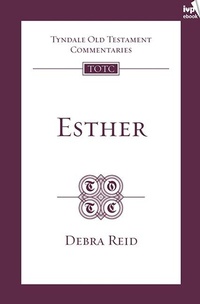
Esther
Tyndale Old Testament Commentary
Published on 1. January 2015
176 pages
978-1-78359-239-5 (ISBN)
Description

The place: Persia. The time: fifth century BC. The Jews were threatened with genocide. A decree ordered the extermination of young and old, women and children. The book of Esther describes how this crisis was averted through the bravery of Esther, the wisdom of her stepfather and the unity of the Jewish people. It also reveals the God who quietly - and sometimes unexpectedly - works behind the scenes to order the events of our lives.
More details
Series
Language
English
Place of publication
Nottingham
United Kingdom
Product notice
Reflowable
ISBN-13
978-1-78359-239-5 (9781783592395)
Copyright in bibliographic data and cover images is held by Nielsen Book Services Limited or by the publishers or by their respective licensors: all rights reserved.
Schweitzer Classification
Other editions
Additional editions
Book
02/2008
Inter-Varsity Press
€17.80
Shipment within 3-4 weeks
Person
Debra Reid has been a tutor at Spurgeon's College, London, since 1987. She has been involved with the publication of a variety of Bible editions, new translations, and other reference books. She is the author of theTyndale Old Testament Commentary on Esther.
Content
- Intro
- Tyndale Old Testament Commentaries
- Esther
- Contents
- General preface
- Author's preface
- Select bibliography
- Abbreviations
- Texts and versions
- INTRODUCTION
- 1. The nature of the book of Esther
- 2. Origin and date
- 3. Historical background and setting
- 4. Canonical status
- Position within the canon
- Relationship to the rest of the canon
- 5. Literary issues
- i. Genre
- ii. Structure
- iii. Style
- a. Characterization
- b. Language
- c. Mood
- d. Pace
- e. Tension
- f. Unity
- 6. Textual issues
- i. The Hebrew Masoretic Text
- ii. The Septuagint (LXX) or 'B-text'
- iii. The 'A-text' ('L' or Lucianic)
- iv. The version of Josephus
- 7. Theology and purpose
- i. God is working his purpose out
- ii. God is presently active in the world
- iii. God works with human behaviour and responses to him
- iv. God protects and saves his people
- v. God's people can celebrate
- vi. God calls his people to faith
- ANALYSIS
- 1. INTRODUCTION: THE REIGN OF XERXES (AHASUERUS) (Esther 1:1-9)
- 2. ESTHER BECOMES QUEEN (Esther 1:10-2:20)
- 3. A PLOT AGAINST XERXES: 'in those days' (Esther 2:21-23)
- 4. HAMAN'S PLOT AGAINST THE JEWISH EXILES: 'after these things' (Esther 3:1-15)
- 5. MORDECAI AND ESTHER RESPOND TO HAMAN'S PLOT: 'when Mordecai learned .' (Esther 4:1-5:8)
- 6. HAMAN'S PLOT AGAINST MORDECAI: 'filled with rage against Mordecai' (Esther 5:9-14)
- 7. XERXES HONOURS MORDECAI: 'the man the king delights to honour' (Esther 6:1-11)
- 8. PARTIAL SUCCESS: THE DEATH OF HAMAN (Esther 6:12-7:10)
- 9. FULL SUCCESS: THE JEWISH PEOPLE ARE SAVED (Esther 8:1-9:16)
- 10. THE JEWS CELEBRATE THEIR VICTORY (Esther 9:17-32)
- 11. CONCLUSION: MORDECAI'S HONOUR: 'he worked for the good of his people' (10:1-3)
- COMMENTARY
- 1. INTRODUCTION: THE REIGN OF XERXES (AHASUERUS) (Esther 1:1-9)
- A. The stage is set: 'in the days of Xerxes .' (1:1-2)
- B. The royal banquets (1:3-9)
- i. Xerxes' banquet for his officials (1:3-4)
- Additional note: Persia and Media
- ii. Xerxes' banquet for the people of Susa (1:5-8)
- iii. Vashti's banquet for the women of Xerxes' palace (1:9)
- Additional note: The Palace of Susa
- 2. ESTHER BECOMES QUEEN (Esther 1:10-2:20)
- A. The demise of Vashti: 'on the seventh day' (1:10-2:4)
- i. Vashti is summoned by Xerxes (1:10-11)
- ii. Vashti refuses to obey the summons (1:12)
- iii. Xerxes takes advice from his wise men, adding tension to the narrative (1:13-15)
- iv. Memucan's proposal (1:16-20)
- v. Xerxes accepts Memucan's advice (1:21-22)
- vi. Xerxes accepts the advice of his young men (2:1-4)
- Additional note: Feminist interpretations of Esther 1
- B. The emergence of Esther: 'now there was . a Jew' (2:5-20)
- i. Esther's family history (2:5-7)
- ii. Esther's rise to favour (2:8-9)
- iii. Esther's secret (2:10-11)
- iv. Explanation of the selection process (2:12-14)
- v. Esther is selected as queen (2:15-17)
- vi. Queen Esther's banquet (2:18)
- vii. Queen Esther's loyalty to Mordecai (2:19-20)
- 3. THE PLOT AGAINST XERXES: 'in those days' (Esther 2:21-23)
- A. The plot is discovered by Mordecai (2:21)
- B. The plot is foiled (2:22-23)
- 4. HAMAN'S PLOT AGAINST THE JEWISH EXILES: 'after these things .' (Esther 3:1-15)
- A. Haman's power (3:1-11)
- i. Haman's rise to power (3:1-2)
- ii. Haman's anger against Mordecai (3:3-5)
- iii. Haman plots the destruction of all the Jews (3:6-9)
- Additional note: the pûr
- iv. Haman is now in charge (3:10-11)
- B. The edict of genocide (3:12-15)
- i. The edict is written (3:12)
- ii. The edict is distributed (3:13-15)
- 5. MORDECAI AND ESTHER RESPOND TO HAMAN'S PLOT: 'when Mordecai learned .' (Esther 4:1-5:8)
- A. Esther discovers Haman's intentions (4:1-9)
- i. Mordecai weeps in sackcloth (4:1-4)
- ii. Esther investigates through Hathach (4:5-9)
- B. Mordecai enlists Esther's help (4:10-17)
- i. Esther's unenviable position (4:10-11)
- ii. Mordecai challenges Esther (4:12-14)
- iii. Esther accepts her role (4:15-17)
- C. Esther hosts a banquet (5:1-8)
- i. Esther issues the invitation (5:1-5a)
- ii. The banquet is held and a further invitation is issued (5:5-8)
- 6. HAMAN'S PLOT AGAINST MORDECAI: 'filled with rage against Mordecai' (Esther 5:9-14)
- A. Haman's emotional turmoil (5:9-13)
- B. Haman accepts his wife's (and friends') advice to hang Mordecai (5:14)
- 7. XERXES HONOURS MORDECAI: 'the man the king delights to honour' (Esther 6:1-11)
- A. Mordecai's loyalty is remembered (6:1-3)
- B. Xerxes takes advice from Haman (6:4-9)
- C. Mordecai is publicly honoured (6:10-11)
- 8. PARTIAL SUCCESS: THE DEATH OF HAMAN (Esther 6:12-7:10)
- A. Haman's demise: 'you will surely fall .' (6:12-7:6)
- i. Zeresh and advisers predict Haman's downfall (6:12-14)
- ii. Esther's second banquet takes place (7:1-2)
- iii. Esther exposes Haman and his plot (7:3-6)
- B. Haman's death (7:7-10)
- i. Xerxes' anger is roused (7:7-8)
- ii. Haman is put to death (7:9-10)
- 9. FULL SUCCESS: THE JEWISH PEOPLE ARE SAVED (Esther 8:1-9:16)
- A. Mordecai and Esther find favour before Xerxes (8:1-4)
- B. The issue of overturning Haman's edict is addressed (8:5-14)
- i. Esther asks for a new edict (8:5-6)
- ii. Xerxes hands the matter over to Esther and Mordecai (8:7-8)
- iii. Mordecai oversees the writing of a new edict (8:9-10a)
- iv. The new edict is distributed (8:10b-14)
- C. The Jews' mourning is replaced by joy (8:15-17)
- i. Mordecai's honour is complete (8:15)
- ii. The Jews' gladness is complete (8:16-17)
- D. The enemies of the Jews are destroyed (9:1-16)
- i. 'Now the tables were turned' (9:1-5)
- ii. The extent of the Jewish victory in Susa (9:6-12a)
- iii. Esther's further request on behalf of the Jews in Susa (9:12b-13)
- iv. Esther's request is granted (9:14-15)
- v. The extent of the Jewish victory in the provinces (9:16)
- 10. THE JEWS CELEBRATE THEIR VICTORY (Esther 9:17-32)
- A. Spontaneous days of feasting (9:17-19)
- B. Mordecai himself confirms the festival (9:20-22)
- C. The festival of Purim is established (9:23-32)
- i. A summary of the festival's historical roots (9:23-26a)
- ii. A summary of the commitment of the Jews to this festival (9:26b-28)
- iii. Esther confirms the festival (9:29-32)
- Additional note: Purim today
- 11. CONCLUSION: MORDECAI'S HONOUR: 'He worked for the good of his people'(Esther 10:1-3)
- APPENDIX: The Greek Additions
- the text of the GREEK ADDITIONS 1
- A.
- B.
- C.
- Mordecai's prayer
- Esther's prayer
- D.
- E.
- F.
- Colophon
