

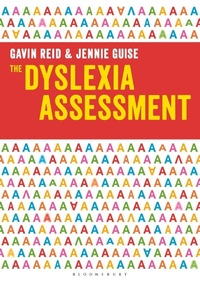
The Dyslexia Assessment
A Complete Assessment Tool for Investigating Reading, Writing and Spelling Difficulties
1st Edition
Published on 5. October 2017
208 pages
978-1-4729-4507-5 (ISBN)
Description

The Dyslexia Assessment is a complete assessment tool for investigating reading, writing and spelling difficulties in learners. Written by leading experts Gavin Reid and Jennie Guise, this practical guide aims to clarify the ambiguities and uncertainties that exist around the dyslexia assessment and is applicable to all education sectors, including early years, primary, secondary, further and higher education.
The book provides practical and comprehensive guidance on carrying out an assessment for dyslexia through informal and formal strategies, and interpreting and acting on results. It features assessment sheets, including questionnaires, forms and checklists that can be photocopied or downloaded from an accompanying website. The strategies explored focus on the whole learner, taking into consideration social, emotional and motivational factors, as well as the challenges of assessing learners with overlapping conditions or EAL.
This practical and invaluable guide will inform and empower all mainstream and specialist teachers, teaching assistants, SENCOs and psychologists to provide the best support possible for learners with reading, writing or spelling difficulties.
The book provides practical and comprehensive guidance on carrying out an assessment for dyslexia through informal and formal strategies, and interpreting and acting on results. It features assessment sheets, including questionnaires, forms and checklists that can be photocopied or downloaded from an accompanying website. The strategies explored focus on the whole learner, taking into consideration social, emotional and motivational factors, as well as the challenges of assessing learners with overlapping conditions or EAL.
This practical and invaluable guide will inform and empower all mainstream and specialist teachers, teaching assistants, SENCOs and psychologists to provide the best support possible for learners with reading, writing or spelling difficulties.
Reviews / Votes
The Dyslexia Assessment is accessible and informative, and suitable for both novice and expert. Its emphasis is that the assessment process is not a one-off event; it is fed into by a comprehensive gathering of information offering a variety of perspectives. The strengths-based approach the authors advocate is a positive one we all want for our dyslexic people in offering solutions for the future. Books abound on this subject but this is the one I prefer. * Bernadette McLean, Principal, Helen Arkell Dyslexia Centre * Anyone involved in supporting students with a specific learning disability to achieve their potential will find this book invaluable. Reid and Guise share their extensive knowledge of dyslexia in order to provide clear guidance for conducting and understanding dyslexia assessment and in developing appropriate intervention. A must read. * Rita Waddell, Head of School, Oak Hill, Centre of Excellence for Students with Dyslexia and/or Attention Deficit Disorder, Switzerland * This book provides a comprehensive overview of the dyslexia assessment process, including why and how we assess, and what we do with the findings. Importantly, it highlights the positive approach of diagnosis, the learner's strengths, and the responsibility to support a positive education outcome for our students. * Monica Gribben, Dyslexia Adviser, Edinburgh Napier University * This is a well-written, very clear and accessible guide to the whole complex area of the assessment of dyslexia, which can be readily, and profitably, used by teachers and lecturers in early years settings, schools and colleges. * Janice Wearmouth, Professor of Education, University of Bedfordshire * This is a useful resource to inform and empower teachers, and to clarify any of the ambiguities and uncertainties that exist around the dyslexia assessment. * Parents in Touch * This practical and invaluable guide will inform and empower all mainstream and specialist teachers, teaching assistants, SENCOs and psychologists to provide the best support possible for learners with reading, writing or spelling difficulties. * UKEdChat, @digicoled *More details
Edition
1. Auflage
Language
English
Place of publication
London
United Kingdom
Publishing group
Bloomsbury Publishing PLC (Digital)
Target group
College/higher education
Professional and scholarly
ISBN-13
978-1-4729-4507-5 (9781472945075)
Copyright in bibliographic data and cover images is held by Nielsen Book Services Limited or by the publishers or by their respective licensors: all rights reserved.
Schweitzer Classification
Other editions
Additional editions
Gavin Reid | Jennie Guise
The Dyslexia Assessment
A complete assessment tool for investigating reading, writing and spelling difficulties
Book
10/2017
Bloomsbury Education
€69.51
Shipment within 10-20 days
Persons
Dr Gavin Reid is an international Educational Psychologist with over 25 years' experience in assessment and in the field of dyslexia. Previously a classroom teacher and university lecturer, he has written a number of Masters courses on dyslexia, including modules on assessment. He is widely published in the field of dyslexia and learning, and currently lectures worldwide. He has regular assessment consultancies in seven countries. Dr Reid is Chair of the British Dyslexia Association, and has sat on government panels on assessment and dyslexia. He feels there is a real need for a practical book such as this, and he and Dr Guise welcome the opportunity to produce this book.
Dr Jennie Guise is a Practitioner Psychologist with extensive experience of assessing for dyslexia and other Specific Learning Difficulties. She is highly qualified in the areas of Psychology and Education, and has worked in research, and now in applied practice as Director of Dysguise Ltd. Dr Guise also has years of experience in teaching students of different ability levels, and of putting theory into practice. Her main interests are in identifying what will help individual learners, and working collaboratively with teachers and tutors to use that knowledge in the classroom.
Dr Jennie Guise is a Practitioner Psychologist with extensive experience of assessing for dyslexia and other Specific Learning Difficulties. She is highly qualified in the areas of Psychology and Education, and has worked in research, and now in applied practice as Director of Dysguise Ltd. Dr Guise also has years of experience in teaching students of different ability levels, and of putting theory into practice. Her main interests are in identifying what will help individual learners, and working collaboratively with teachers and tutors to use that knowledge in the classroom.
