

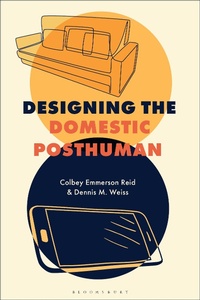
Designing the Domestic Posthuman
1st Edition
Published on 28. December 2023
208 pages
978-1-350-30122-1 (ISBN)
Description

Ever since TIME magazine's 1983 'Man of the Year' was the PC, we have been led to believe that our domestic spaces have been colonized by digital technology. Too little attention has been paid to the domestic spaces and inhabitants impacted by this, and critical posthumanism has been captured by a picture of humanity overly indebted to digital technologies and their largely male progenitors. By applying feminist theory to posthumanism, this work recovers the plethora of sophisticated human-technology mediations associated with the home and practiced primarily by women, the elderly, infants, the disabled and across cultures globally, challenging dominant, contemporary visions of a future humanity.
Authors Dennis M. Weiss and Colbey Emmerson Reid look at various iterations of the posthuman and assert the need for alternative, feminist readings that emphasize different standpoints from which to assess people, places, and products. Chapters address the impact of posthumanism on design theory and look at familiar domestic objects, with different attributes from those typically affiliated with technology and the future, such as clothing, textiles, ceramics, furniture and wallpaper. They reveal their unhomely, extra-human qualities and offer a much-needed perspective on domestic spaces and practices, revivifying the home as a site of species transformation and pushing beyond traditional understandings of person, mothering, families and care-giving to highlight a range of critically-overlooked mediated materialisms and embodiments affiliated with domestic space.
By focusing on the neglected intersection of the posthuman with the home and exploring domestic posthuman design, Designing the Domestic Posthuman offers a vision of a future humanity that retains identity, integrity and considers our relationship to others, to the world and things in it. This book widens the lens of critical focus in posthumanism, feminist philosophy and design and presents an alternative, inclusive design framework for the future.
Authors Dennis M. Weiss and Colbey Emmerson Reid look at various iterations of the posthuman and assert the need for alternative, feminist readings that emphasize different standpoints from which to assess people, places, and products. Chapters address the impact of posthumanism on design theory and look at familiar domestic objects, with different attributes from those typically affiliated with technology and the future, such as clothing, textiles, ceramics, furniture and wallpaper. They reveal their unhomely, extra-human qualities and offer a much-needed perspective on domestic spaces and practices, revivifying the home as a site of species transformation and pushing beyond traditional understandings of person, mothering, families and care-giving to highlight a range of critically-overlooked mediated materialisms and embodiments affiliated with domestic space.
By focusing on the neglected intersection of the posthuman with the home and exploring domestic posthuman design, Designing the Domestic Posthuman offers a vision of a future humanity that retains identity, integrity and considers our relationship to others, to the world and things in it. This book widens the lens of critical focus in posthumanism, feminist philosophy and design and presents an alternative, inclusive design framework for the future.
More details
Edition
1. Auflage
Language
English
Place of publication
London
United Kingdom
Publishing group
Bloomsbury Publishing PLC
Target group
Professional and scholarly
College/higher education
Illustrations
10 bw illus
ISBN-13
978-1-350-30122-1 (9781350301221)
Copyright in bibliographic data and cover images is held by Nielsen Book Services Limited or by the publishers or by their respective licensors: all rights reserved.
Schweitzer Classification
Other editions
Additional editions
Colbey Emmerson Reid | Dennis M. Weiss
Designing the Domestic Posthuman
Book
10/2025
Bloomsbury Visual Arts
€31.50
Shipment within 15-20 days
Persons
Dennis M. Weiss is Professor of Philosophy at York College of Pennsylvania, USA. He works at the intersection of philosophical anthropology, philosophy of technology, and philosophy of culture. He is the editor of Interpreting Man (2002) and co-editor of Design, Mediation, and the Posthuman (2016). He has published more than 30 articles in journals and anthologies on topics ranging from critical posthumanism to The Twilight Zone and the philosophy of Philip K. Dick.
Colbey Emmerson Reid is Professor and Chair of Fashion Studies at Columbia College Chicago, USA. She is also the Founder and Executive Director of the Fashion Lab, a Chicago-based organization for academic-corporate partnerships in co-creating and executing custom design research and product development projects. She studies the interface of fashion and interior design with technology and disability studies. She co-edited Design, Mediation, and the Posthuman (2016) and contributed to Emerging Genres in New Media Environments (2017). She has won awards for her essays on design flaws and statistical aesthetics as well as for a series of external outreach and engagement projects executed in the Research Triangle in North Carolina in 2013-2016.
Colbey Emmerson Reid is Professor and Chair of Fashion Studies at Columbia College Chicago, USA. She is also the Founder and Executive Director of the Fashion Lab, a Chicago-based organization for academic-corporate partnerships in co-creating and executing custom design research and product development projects. She studies the interface of fashion and interior design with technology and disability studies. She co-edited Design, Mediation, and the Posthuman (2016) and contributed to Emerging Genres in New Media Environments (2017). She has won awards for her essays on design flaws and statistical aesthetics as well as for a series of external outreach and engagement projects executed in the Research Triangle in North Carolina in 2013-2016.
Content
Acknowledgements
Introduction: Designing the Domestic Posthuman
Part 1: Posthuman Perons
1. Posthuman Parturition: An Origin Story
2. Domestic Posthuman Second Persons
3. Myths of Domestic Second Persons
Part 2: Poshuman Artifacts
4. Softwear
5. (Un)homely Techne
6. Myths of Domestic Posthuman Artifacts
Conclusion: A Design Sampler for the Domestic Posthuman
References
Introduction: Designing the Domestic Posthuman
Part 1: Posthuman Perons
1. Posthuman Parturition: An Origin Story
2. Domestic Posthuman Second Persons
3. Myths of Domestic Second Persons
Part 2: Poshuman Artifacts
4. Softwear
5. (Un)homely Techne
6. Myths of Domestic Posthuman Artifacts
Conclusion: A Design Sampler for the Domestic Posthuman
References
