

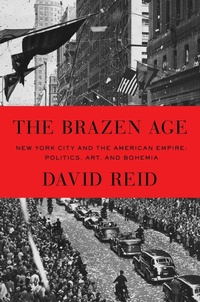
The Brazen Age
New York City and the American Empire: Politics, Art, and Bohemia
Published on 22. March 2016
544 pages
978-1-101-87066-2 (ISBN)
Description

A brilliant, sweeping, and unparalleled look at the extraordinarily rich culture and turbulent politics of New York City between the years 1945 and 1950, The Brazen Age opens with Franklin Delano Roosevelt's campaign tour through the city's boroughs in 1944. He would see little of what made New York the capital of modernity-though the aristocratic FDR was its paradoxical avatar-a city boasting an unprecedented and unique synthesis of genius, ambition, and the avant-garde. While concentrating on those five years, David Reid also reaches back to the turn of the twentieth century to explore the city's progressive politics, radical artistic experimentation, and burgeoning bohemia.
From 1900 to 1929, New York City was a dynamic metropolis on the rise, and it quickly became a cultural nexus of new architecture; the home of a thriving movie business; the glittering center of theater and radio; and a hub of book, magazine, and newspaper publishing. In the 1930s, the rise of Hitler and World War II would send some of Europe's most talented men and women to America's shores, vastly enriching the fields of science, architecture, film, and arts and letters-the list includes Albert Einstein, Erwin Panofsky, Walter Gropius, George Grosz, André Kertész, Robert Capa, Thomas Mann, Hannah Arendt, Vladimir Nabokov, and John Lukacs.
Reid draws a portrait of the frenzied, creative energy of a bohemian Greenwich Village, from the taverns to the salons. Revolutionaries, socialists, and intelligentsia in the 1910s were drawn to the highly provocative monthly magazine The Masses, which attracted the era's greatest talent, from John Reed to Sherwood Anderson, Djuna Barnes, John Sloan, and Stuart Davis. And summoned up is a chorus of witnesses to the ever-changing landscape of bohemia, from Malcolm Cowley to Anaïs Nin. Also present are the pioneering photographers who captured the city in black-and-white: Berenice Abbott's dizzying aerial views, Samuel Gottscho's photographs of the waterfront and the city's architectural splendor, and Weegee's masterful noir lowlife.
But the political tone would be set by the next president, and Reid looks closely at Thomas Dewey, Henry Wallace, and Harry Truman. James Forrestal, secretary of the navy under Roosevelt, would be influential in establishing a new position in the cabinet before ascending to it himself as secretary of defense under Truman, but not before helping to usher in the Cold War.
With The Brazen Age, David Reid has magnificently captured a complex and powerful moment in the history of New York City in the mid-twentieth century, a period of time that would ensure its place on the world stage for many generations.
From 1900 to 1929, New York City was a dynamic metropolis on the rise, and it quickly became a cultural nexus of new architecture; the home of a thriving movie business; the glittering center of theater and radio; and a hub of book, magazine, and newspaper publishing. In the 1930s, the rise of Hitler and World War II would send some of Europe's most talented men and women to America's shores, vastly enriching the fields of science, architecture, film, and arts and letters-the list includes Albert Einstein, Erwin Panofsky, Walter Gropius, George Grosz, André Kertész, Robert Capa, Thomas Mann, Hannah Arendt, Vladimir Nabokov, and John Lukacs.
Reid draws a portrait of the frenzied, creative energy of a bohemian Greenwich Village, from the taverns to the salons. Revolutionaries, socialists, and intelligentsia in the 1910s were drawn to the highly provocative monthly magazine The Masses, which attracted the era's greatest talent, from John Reed to Sherwood Anderson, Djuna Barnes, John Sloan, and Stuart Davis. And summoned up is a chorus of witnesses to the ever-changing landscape of bohemia, from Malcolm Cowley to Anaïs Nin. Also present are the pioneering photographers who captured the city in black-and-white: Berenice Abbott's dizzying aerial views, Samuel Gottscho's photographs of the waterfront and the city's architectural splendor, and Weegee's masterful noir lowlife.
But the political tone would be set by the next president, and Reid looks closely at Thomas Dewey, Henry Wallace, and Harry Truman. James Forrestal, secretary of the navy under Roosevelt, would be influential in establishing a new position in the cabinet before ascending to it himself as secretary of defense under Truman, but not before helping to usher in the Cold War.
With The Brazen Age, David Reid has magnificently captured a complex and powerful moment in the history of New York City in the mid-twentieth century, a period of time that would ensure its place on the world stage for many generations.
More details
Other editions
Additional editions
Book
03/2016
Random House Inc
€52.19
Article exhausted; check different version
Person
DAVID REID is the editor of Sex, Death and God in L.A. and coeditor of West of the West: Imagining California. His essays, articles, reviews, and inter- views have appeared in Vanity Fair, The Paris Review, The New York Times, The Washington Post, the Los Angeles Times Book Review, and in several anthologies, including The Pushcart Prize XII. He lives in Berkeley, California.
Content
- Intro
- Other Titles
- Title Page
- Copyright
- Dedication
- Epigraph
- Contents
- Introduction
- Prologue: The Last Hurrah of Franklin D. Roosevelt
- Part I: Empire and Communications
- 1: City Lights
- 2: Cultural Capital
- 3: The Greater City
- 4: Babylon Revisited
- 5: Wandering Rocks
- Part II: City of Refuge
- 1: Exiles and Émigrés
- 2: The City at War
- Part III: Words, Words, Words
- 1: Books Are Bullets
- 2: New York Discovers America
- 3: Limousines on Grub Street
- 4: Scenes of Writing
- Part IV: That Winter-and the Next
- 1: A Fractious Peace
- 2: New York Observed
- 3: Soldier's Home
- Part V: The City in Black and White
- 1: Berenice Abbott's Village in the City
- 2: Gottscho's Oz
- 3: Weegee's Dark Carnival
- Part VI: Greenwich Village: Ghosts, Goths, and Glimpses of the Moon
- 1: Bohemia Was Yesterday
- 2: Conciliating Nobody: The Masses and the Villagers
- 3: Brightness Falls
- 4: Another Part of the Forest
- 5: Culture and Anarchy: "The Sublime Is Now"
- Part VII: 1948: The End of Something
- 1: Verdict
- 2: Conference at the Waldorf
- Part VIII: Days Without End
- Acknowledgments
- Notes
- Selected Bibliography
- Illustration Credits
- A Note About the Author
- Illustrations
