

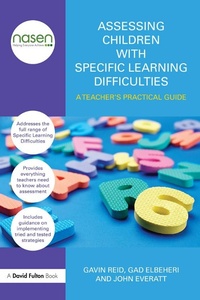
Assessing Children with Specific Learning Difficulties
A teacher's practical guide
Published on 16. July 2015
208 pages
978-1-317-43779-6 (ISBN)
Description

This comprehensive book provides all the information that practitioners need to know about assessment in relation to their pupils with Specific Learning Difficulties. The why, how and what of assessment is addressed, whilst the link between assessment and intervention is also a key focus.
Looking at the full range of Specific Learning Difficulties, this book provides practical guidance on implementing strategies that are tried and tested for use in any classroom, whilst also acknowledging that assessment is a process involving other professionals and parents. Addressing issues and topics common in inclusive classrooms around the world, key topics covered include:
Specific Learning Difficulties in context
Teacher Assessment in literacy, numeracy and movement
Motor development and co-ordination
Attention factors in learning
The key issues on learning differences
Self-esteem and emotional literacy
How to enhance skills and the self-sufficiency of teachers
Assessing Children with Specific Learning Difficulties will be an invaluable guide for classroom teachers, learning support departments, psychologists and other professionals.
Looking at the full range of Specific Learning Difficulties, this book provides practical guidance on implementing strategies that are tried and tested for use in any classroom, whilst also acknowledging that assessment is a process involving other professionals and parents. Addressing issues and topics common in inclusive classrooms around the world, key topics covered include:
Specific Learning Difficulties in context
Teacher Assessment in literacy, numeracy and movement
Motor development and co-ordination
Attention factors in learning
The key issues on learning differences
Self-esteem and emotional literacy
How to enhance skills and the self-sufficiency of teachers
Assessing Children with Specific Learning Difficulties will be an invaluable guide for classroom teachers, learning support departments, psychologists and other professionals.
Reviews / Votes
"This book is a thorough but readable guide on the theory and practice of assessing children with specific learning difference" - Graeme Whyte, Special Children"Overall this is an informative book, specialist teachers can recommend it to colleagues for a better understanding of SpLD and how interventions might work in an educational setting."- Jan Beechey, Dyslexia Review
"This book covers the full range of specific learning difficulties and provides practical guidance in terms of assessment and implementing strategies in the classroom. [...] This is a useful, timely and relevant publication" - SEN Magazine
More details
Series
Language
English
Place of publication
London
United Kingdom
Publishing group
Taylor & Francis Ltd
Target group
Professional and scholarly
Product notice
Reflowable
Illustrations
7 s/w Tabellen
7 Tables, black and white
File size
1,86 MB
ISBN-13
978-1-317-43779-6 (9781317437796)
Copyright in bibliographic data and cover images is held by Nielsen Book Services Limited or by the publishers or by their respective licensors: all rights reserved.
Schweitzer Classification
Other editions
Additional editions
Gavin Reid | Gad Elbeheri | John Everatt
Assessing Children with Specific Learning Difficulties
A teacher's practical guide
Book
07/2015
1st Edition
Routledge
€185.90
Shipment within 15-20 days
Gavin Reid | Gad Elbeheri | John Everatt
Assessing Children with Specific Learning Difficulties
A teacher's practical guide
Book
07/2015
1st Edition
Routledge
€58.30
Shipment within 15-20 days
Persons
Gavin Reid is a fully registered Psychologist with the Health and Care Professionals (HCPC) in the UK and the College of Psychologists in British Columbia, Canada.
Gad Elbeheri is the Dean of the Australian College of Kuwait; a university providing internationally recognized and accredited tertiary education to the Business and Engineering sectors.
John Everatt is a Professor of Education at the University of Canterbury, New Zealand.
Gad Elbeheri is the Dean of the Australian College of Kuwait; a university providing internationally recognized and accredited tertiary education to the Business and Engineering sectors.
John Everatt is a Professor of Education at the University of Canterbury, New Zealand.
Content
Introduction
Chapter 1: SpLD in Context -Pointers for practice
Chapter 2: Assessment Process
Chapter 3: Teacher Assessment: Literacy
Chapter 4: Teacher Assessment: Numeracy
Chapter 5: Teacher Assessment: Movement
Chapter 6: Behavioural problems Attention Deficit Hyperactivity Disorder and Emotional and Behavioural Disorders
Chapter 7: The Role of the Educational Psychologist and Teacher Assessments
Chapter 8: Recognising and dealing with Self-esteem, motivation and emotional needs
Chapter 9: Identifying and Utilising Learning Preferences and Styles
Chapter 10: Higher Education and the Workplace
Chapter 11: Developing an Assessment Framework
Chapter 12: Sources and resources - some guidance
References
Chapter 1: SpLD in Context -Pointers for practice
Chapter 2: Assessment Process
Chapter 3: Teacher Assessment: Literacy
Chapter 4: Teacher Assessment: Numeracy
Chapter 5: Teacher Assessment: Movement
Chapter 6: Behavioural problems Attention Deficit Hyperactivity Disorder and Emotional and Behavioural Disorders
Chapter 7: The Role of the Educational Psychologist and Teacher Assessments
Chapter 8: Recognising and dealing with Self-esteem, motivation and emotional needs
Chapter 9: Identifying and Utilising Learning Preferences and Styles
Chapter 10: Higher Education and the Workplace
Chapter 11: Developing an Assessment Framework
Chapter 12: Sources and resources - some guidance
References
