

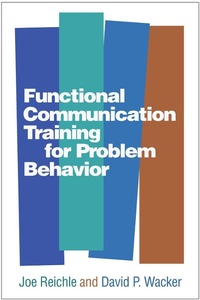
Functional Communication Training for Problem Behavior
Published on 26. April 2017
276 pages
978-1-4625-3023-6 (ISBN)
Description

Special educators, school and clinical psychologists, behavior analysts, speech-language pathologists, and others who use functional communication training. May serve as a supplemental text in graduate-level courses.
More details
Other editions
Additional editions
Joe Reichle | David P. Wacker
Functional Communication Training for Problem Behavior
Book
05/2017
1st Edition
Guilford Press
€47.50
Shipment within 15-20 days
Persons
Joe Reichle, PhD, is Professor of Speech-Language-Hearing Sciences and Research Director of the Leadership and Education in Neurodevelopmental Disabilities Training Program at the University of Minnesota. A Fellow of the American Speech-Language-Hearing Association, Dr. Reichle has expertise in augmentative communication, communication intervention for persons with significant developmental disabilities, and positive approaches to meet the needs of persons who engage in challenging behavior. He has published over 140 articles, chapters, and books, and served as an associate editor of the Journal of Speech, Language, and Hearing Research and Language, Speech, and Hearing Services in Schools. He has extensive experience delivering technical assistance to public schools and group homes.
David P. Wacker, PhD, is Professor Emeritus of Pediatric Psychology at The University of Iowa, where he directed biobehavioral outpatient services for children and adults with developmental disabilities who display severe problem behavior, such as self-injury. A Fellow of the Association for Behavior Analysis International and the American Psychological Association, Dr. Wacker is a past editor of the Journal of Applied Behavior Analysis. His work has focused on training parents to implement functional communication training (FCT) in their homes or in community settings. His current research investigates how to best implement functional analysis and FCT in homes via the use of telehealth.
Content
1. Introduction to Functional Communication Training
2. The Selection of Communicative Function(s) to Teach and How They Are Expressed
3. An Integrative Model to Establish Communicative Alternatives and Enhance Self-Regulatory Skills
4. Examples of Antecedent-Focused Intervention Strategies
5. Teaching Communicative Protesting as an Alternative to Avoidance-Maintained Problem Behavior, with Quannah Parker-McGowan and Jeff Sigafoos
6. Teaching Requesting Assistance
7. Requesting a Break
8. Teaching Communicative Requests as an Alternative to Problem Behavior Maintained by Attention
9. Teaching Communicative Requests as an Alternative to Problem Behavior Maintained by Tangibles
10. Describing Functional Communication Training as a Component of an Effective Behavior Support Plan: What We Know and What We Still Need to Know
Glossary
References
Index
2. The Selection of Communicative Function(s) to Teach and How They Are Expressed
3. An Integrative Model to Establish Communicative Alternatives and Enhance Self-Regulatory Skills
4. Examples of Antecedent-Focused Intervention Strategies
5. Teaching Communicative Protesting as an Alternative to Avoidance-Maintained Problem Behavior, with Quannah Parker-McGowan and Jeff Sigafoos
6. Teaching Requesting Assistance
7. Requesting a Break
8. Teaching Communicative Requests as an Alternative to Problem Behavior Maintained by Attention
9. Teaching Communicative Requests as an Alternative to Problem Behavior Maintained by Tangibles
10. Describing Functional Communication Training as a Component of an Effective Behavior Support Plan: What We Know and What We Still Need to Know
Glossary
References
Index
