

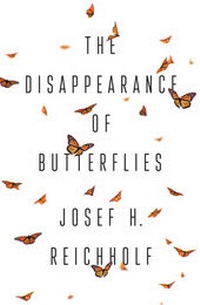
The Disappearance of Butterflies
Description

The eminent entomologist and award-winning author Josef H. Reichholf began studying butterflies in the late 1950s. He brings a lifetime of scientific experience and expertise to bear on one of the great environmental catastrophes of our time. He takes us on a journey into the wonderful world of butterflies - from the small nymphs that emerge from lakes in air bubbles to the trusting purple emperors drunk on toad poison - and immerses us in a world that we are in danger of losing forever. Step by step he explains the science behind this impending ecological disaster, and shows how it is linked to pesticides, over-fertilization and the intensive farming practices of the agribusiness.
His book is a passionate plea for biodiversity and the protection of butterflies.
More details
Other editions
Additional editions
Persons
Content
Acknowledgements
Introduction
Part I: The Biodiversity of Lepidoptera
A Review of 50 Years of Butterfly and Moth Research
Insects fly towards UV light
Urban Lepidoptera: more common than expected
Death's head hawk-moth: a guest that can barely live with us anymore
The Fascinating Life of Aquatic Moths
Evenings at the pond
The hidden lives of the little nymphs
How the caterpillar breathes under water
Up and away in an air balloon
The advantages of living in water
A place to live or an 'ecological niche'
The destruction of the biotopes of the little nymphs
The Benefits of Being Attracted to Light
Like moths to a flame
The red blindness of butterflies
The Strange Behaviour of the Purple Emperor
Butterflies on drugs
Psychedelics in the insect kingdom
The Nettle-feeding Lepidoptera: An Instructive Community
Nettles: indicators of overfertilization
Nettles escape defoliation
Maize: damaged beyond repair
Cabbage whites: parasites and protection
The mass flight of the map butterfly: singularities in the realm of the butterflies
Does climate change affect the seasonal morphs of the map butterfly?
Nature is too diverse for simple generalizations
The Great Migrations of the Butterflies
The migratory flights of the painted ladies
Small tortoiseshells as travellers
Butterfly invasions
Poisonous Butterflies and Moths: From the Cabbage White to the Six-spot Burnet
Cabbage whites on the Dalmatian coast
Whenever it rains in the desert ...
Which factors affect the reproduction of butterflies, and when?
Useful models
The need to go slow
Poison in the body
The Secret Life of Small Ermine Moths
The bird-cherry, a tree of the riparian woods
Toxins in bird-cherries
The life history of the caterpillars of the ermine moth
Helpful hungry caterpillars
Between parasitism and population explosion
Longer-term population cycles
Coppice management and its consequences
Generations and multiyear cycles of ermine moths
Parasitoids on other ermine moths
The lifecycles of butterflies and moths
Hardy Winter Moths
Life at the edge of winter
The mastery of seasonal niches
Why female winter moths do not need wings
Deforestation, poison and the decline of the codling moth and the winter moth
The common quaker moth in early spring
Brimstones: The First Spring Butterflies
Butterfly attacks
The problem with early flight
Müllerian mimicry
The critical factor of spring weather
'Balance' in nature
Part II: The Disappearance of Lepidoptera
Assessing the Abundance and Occurrence of Butterflies: A Major Challenge
Starting with 1,000 watts
How to successfully attract moths to light
Change and continuity
All praise to those who helped us with identification problems
Butterfly and Moth Names
The Decline of Moths and Butterflies
The village outskirts and the open fields
Findings in the riparian woods
The findings from Munich
The decline in species diversity
Warm summers and what they mean for the moths and butterflies
The Metropolis: The End of Nature or Salvation of Species Diversity?
The advantage of structure
Monocultures produce pests
Cities as islands of warmth
Overfertilized, poisoned land
Nature-friendly cities
The Inhospitality of the Countryside
From idyll to slurry
Monocultures and changes to the ground-level microclimate
The cooling of fields and forests
Increased growth reduces the abundance of moths and butterflies in the riparian woods
Boundary ridges in the fields and meadows: a supportive network
'Infilling' and 'compensating areas'
The 'nutritional condition' of the landscape
The disappearance of the cockchafers
The turning point for our farmers: the 1970s
The Krefeld Study
A subsidy system without an exit mechanism
Nature conservation and nature enthusiasts
The Devastating Effect of Communal Maintenance Measures
The End of the Night: The Role of Light Pollution
Summary: A Cluster of Factors
The Disappearance of Moths and Butterflies and Its Consequences
What We Can Do about the Disappearance of Moths and butterflies
The Beauty of Moths and Butterflies
Two Findings in Place of an Epilogue
Select Bibliography
Index
A Review of 50 Years of Butterfly and Moth Research
My records prevent me from creating rose-tinted memories of past conditions. I started keeping records on nature on 15 December 1958, and I therefore know, for example, that we did not have a 'white Christmas' in the Lower Bavarian Inn Valley 60 years ago, but it was, instead, two degrees above zero with light rain. On 2 January 1959, I noted that, outside on the River Inn, on the completely ice-free reservoir, I counted the following numbers of water birds: 800 mallards, 50 tufted ducks, 69 bean geese and 200 coots. Most of the numbers were rounded up, since I was not able to produce more accurate figures using my small binoculars from where I stood, half a kilometre away. I was not given a relatively powerful telescope until a few years later. As I pulled out and glanced through my old records in the course of preparing this book, I also came across a page with four butterflies that I had drawn myself. Astonished, I looked at it and read what I had written about the pictures 'drawn from my collection'. Next to a swallowtail and a pair of Adonis blues, Polyommatus bellargus, I had drawn a large and striking black and white butterfly, a great banded grayling, and labelled it with the scientific name that was customary at the time, Satyrus circe. This discovery surprised me, since the beautiful 'Circe' that flies in such an elegant manner has long vanished from my region. It is largely extinct in Southern Bavaria, just like numerous other species of butterfly that I knew and observed in my youth.
Some of the species that were considered ordinary in those days do still exist, but they have, in the meantime, become rare or very rare. I also found a fitting example of this in my records. A note dated 12 September 1962 contained an observation that would be considered remarkable today. An almost palm-sized moth flew into the local train when we stopped at a station on our early morning journey to school and landed on the red shirt of my classmate. It was a red underwing, Catocala nupta (see Photo 1). When it is resting, the grey-brown, washed bark-coloured forewings of this large noctuid moth cover the bright crimson hindwings that are bordered with an angled black strip, just inside the outer margin. Not yet aware that moths - like all insects - cannot see the colour red, I wrote: 'The red underwing was thus attracted by the red colour of the shirt.' In fact, the red shirt would actually have seemed dark to the moth. To its vision in the so-called 'grey-scale', it may well have corresponded to a dark tree bark and the grey scales of its forewings. In the wild, the spot would have been suitable as a resting place during the day for this noctuid moth, which is active at twilight. One may therefore assume that red underwings were so common 50 years ago that one of them got lost in a train, presumably startled from its resting place in the station.
If this type of note from my schooldays was a mere anecdote, then these records would offer nothing further. Indeed, one retains what seems unusual, while the ordinary goes unnoticed. And yet, interesting points can be gleaned from unsystematic memos. I can find plenty of examples in my diaries. For example, the nine-spotted moth (or yellow belted burnet), Syntomis phegea, which has long since vanished from the area, sighted on 1 August 1960, or the caterpillar of the wood tiger, Parasemia plantaginis, recorded on 28 July 1960. The latter is only seen very rarely now. However, all of these and the many other records only show that there used to be Lepidoptera* species that no longer exist there. The true scope of the decline in butterflies and moths and other insects cannot be deduced from the disappearance of individual species. It is quite possible that other species that were not there earlier have appeared during this period. Nature is dynamic: changes can and will always occur. My initial claim that we have lost 80 per cent of the butterflies in the last 50 years refers to their overall frequency and requires much more concrete evidence.
I have already achieved that with birds: my counts of the water birds on the reservoirs of the lower River Inn, which I carried out every two to three days for six years, resulted in my first specialist ornithological publication in 1966. However, a quantitative survey of butterflies and moths was a very different challenge from counting birds that were resting on the banks or swimming on the water. My attempts gradually took form during my zoology studies at the University of Munich. A scientific approach was required for my doctoral thesis on aquatic moths, so I quickly familiarized myself with the five different species of moth that make up the Crambidae family and learnt how to reliably distinguish them by recognizing their flight patterns in the field.
However, given their number, moth and butterfly species require far greater knowledge if one wants to record all of them. The training is far more difficult and time-consuming than getting to know bird life. In southeast Bavaria alone, there are more than 1,100 species of butterfly and moth; for the whole of Bavaria, 3,243 have been reported (as of 2016). Many of these are very small and can only be identified with the help of specialist literature. For birds, there were already very good identification guides in the 1960s, which were not prohibitively expensive. Consequently, my initial engagement was with the bird world rather than with the butterflies. The reason was proximity, in the literal sense of the word: the reservoirs and riparian woods along the lower River Inn, which I could reach on foot or by bicycle, are a bird paradise. They are among the wetlands with the largest numbers of species in inland central Europe. When I started my zoology studies in Munich in 1965, I had already gained professional recognition as an ornithologist, thanks to my native surroundings, and I was familiar with various methods that are employed in field research.
Insects fly towards UV light
During my studies, I became familiar with a method that is more suitable than any other to establishing the abundance of moths. It consists of attracting species that are active at night using UV light. This is no longer done with large mercury-vapour lamps of 1,000 watts, which are used to light up white sheets that have been stretched behind them, as was common practice in the past and as I have attempted myself, but instead by means of an ingenious construction using UV neon tubes of only 15 watts. The moths and other insects are drawn in by this UV light. When they approach, they enter a funnel under the light tubes, leading to a large sack, in which the insects land. In order to offer them a place to hide until the following morning, empty egg cartons or similar are placed in the sack. This collection method does not harm the moths in any way. In the sack they quickly settle down, since the stimulus of the light has been removed. Together with the other insects, the moths are counted the following morning, and identified species by species, to the extent that their species identification is possible. At that point, all the insects are released immediately. In this manner, readily analysable and statistically useable results are achieved, which can be compared, depending on the problem in question, with a similar assembly of the apparatus in another location. This method can even be used to establish frequency and species composition of moths in quite different habitats. This is exactly what I did, starting from 1969. Dr Hermann Petersen perfected the method. I am greatly indebted both to him, and also to Elsbeth Werner for allowing me to use her pesticide-free farm for research.
Unfortunately, this type of light attraction does not work with butterflies. In order to establish changes in frequency for them in a comparable manner, I started to count them in the 1970s, along specific, fixed routes that would not be changed over the years. For example, along forest tracks or dirt tracks across fields, or along embankments already specified as transects. With their signs indicating river kilometres, placed at intervals of exactly 200 metres, these riverside routes are perfectly suited to such transect counts. In the 1980s, I primarily used the findings that I had obtained in this way for my lectures on ecology and nature conservation at the Technical University of Munich and on ecological biogeography at the University of Munich. Over the years, it became clear that the light traps and the route counts (or 'transects') yielded fewer and fewer butterflies. As for the 'by-catch', as I referred to the other insects that flew into my lights, even the cockchafers disappeared, despite previously having been so numerous. On more than one occasion, their mass flight to the UV light caused the sack to become detached from the funnel and fall to the ground, since up to 1,000 cockchafers had crept in there in the gloaming. Since there were often hardly any moths in the cockchafer season at the beginning of May, such a mishap did not compromise the annual totals. But the rather sudden decrease in the cockchafers perplexed me. This was the first signal that my investigations were providing important data about the changes to nature. Yet in the 1980s, I still had no inkling of how sharply downhill things would go for the moths and the other insects, nor that my findings would result in an eco-nutritional basis for the decline of the birds in the meadows and the fields.
Urban Lepidoptera: more common than expected
In the early 1980s, I...
