

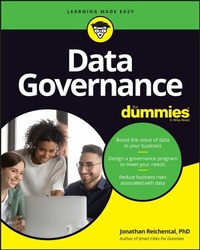
Data Governance For Dummies
Description

How to build and maintain strong data organizations—the Dummies way
Data Governance For Dummies offers an accessible first step for decision makers into understanding how data governance works and how to apply it to an organization in a way that improves results and doesn't disrupt. Prep your organization to handle the data explosion (if you know, you know) and learn how to manage this valuable asset. Take full control of your organization’s data with all the info and how-tos you need. This book walks you through making accurate data readily available and maintaining it in a secure environment. It serves as your step-by-step guide to extracting every ounce of value from your data.
- Identify the impact and value of data in your business
- Design governance programs that fit your organization
- Discover and adopt tools that measure performance and need
- Address data needs and build a more data-centric business culture
This is the perfect handbook for professionals in the world of data analysis and business intelligence, plus the people who interact with data on a daily basis. And, as always, Dummies explains things in terms anyone can understand, making it easy to learn everything you need to know.
More details
Other editions
Additional editions
Content
2 - Copyright Page [Seite 4]
3 - Table of Contents [Seite 7]
4 - Introduction [Seite 13]
4.1 - About This Book [Seite 13]
4.2 - Foolish Assumptions [Seite 15]
4.3 - Icons Used in This Book [Seite 15]
4.4 - Beyond the Book [Seite 16]
4.5 - Where to Go from Here [Seite 16]
5 - Part 1 Data Everywhere [Seite 17]
5.1 - Chapter 1 Defining Data Governance [Seite 19]
5.1.1 - Understanding Data Governance [Seite 20]
5.1.1.1 - What is meant by governance? [Seite 20]
5.1.1.2 - What is data governance? [Seite 22]
5.1.1.2.1 - Data governance versus data management [Seite 23]
5.1.1.2.2 - Data governance versus information governance [Seite 23]
5.1.1.2.3 - The value of data governance [Seite 23]
5.1.1.2.4 - Creating a data governance program [Seite 25]
5.1.2 - Developing a Data Governance Framework [Seite 26]
5.1.2.1 - Leadership and strategy [Seite 27]
5.1.2.2 - Roles and responsibilities [Seite 28]
5.1.2.3 - Policies, processes, and standards [Seite 28]
5.1.2.4 - Metrics [Seite 28]
5.1.2.5 - Tools [Seite 29]
5.1.2.6 - Communications and collaboration [Seite 29]
5.1.3 - Preparing for Data Governance [Seite 29]
5.1.3.1 - What is data culture? [Seite 30]
5.1.3.1.1 - Assessing the data culture [Seite 30]
5.1.3.1.2 - Maturing the data culture [Seite 31]
5.1.3.2 - Assessing data governance readiness [Seite 32]
5.2 - Chapter 2 Exploring a World Awash in Data [Seite 35]
5.2.1 - Defining Data [Seite 36]
5.2.1.1 - What's all the fuss about data? [Seite 36]
5.2.1.2 - Welcome to the zettabyte era [Seite 37]
5.2.1.3 - From data to insight [Seite 39]
5.2.2 - The Role of Data in the 21st Century [Seite 41]
5.2.2.1 - Data-driven decision-making [Seite 42]
5.2.2.2 - Data as the new oil [Seite 43]
5.2.2.3 - Data ownership [Seite 43]
5.2.2.4 - Data architecture [Seite 44]
5.2.2.5 - The lifecycle of data [Seite 45]
5.2.2.6 - Data quality matters [Seite 46]
5.2.3 - Understanding the Impact of Big Data [Seite 47]
5.2.3.1 - Defining big data [Seite 48]
5.2.3.2 - The drivers of big data [Seite 49]
5.2.3.3 - Consequences of big data [Seite 50]
5.2.3.4 - What about small data? [Seite 50]
5.2.3.5 - Here comes smart data [Seite 51]
5.3 - Chapter 3 Driving Value through Data [Seite 53]
5.3.1 - Identifying the Roles of Data [Seite 53]
5.3.1.1 - Operations [Seite 54]
5.3.1.2 - Strategy [Seite 55]
5.3.1.3 - Decision-making [Seite 56]
5.3.1.4 - Measuring [Seite 56]
5.3.1.5 - Monitoring [Seite 57]
5.3.1.6 - Insight management [Seite 58]
5.3.1.7 - Reporting [Seite 59]
5.3.1.8 - Other roles for data [Seite 60]
5.3.2 - Improving Outcomes with Data [Seite 61]
5.3.2.1 - Approaching data as an asset [Seite 61]
5.3.2.2 - Data analytics [Seite 63]
5.3.2.3 - Data management [Seite 64]
5.3.2.4 - Governing data [Seite 65]
5.4 - Chapter 4 Transforming through Data [Seite 67]
5.4.1 - Examining the Broader Value of Data [Seite 68]
5.4.1.1 - Data catalogs [Seite 69]
5.4.1.2 - From data to insights [Seite 73]
5.4.1.3 - Data analytics [Seite 74]
5.4.1.4 - Data monetization [Seite 76]
5.4.1.5 - Data-driven decision making [Seite 77]
5.4.2 - Developing a Data Strategy for Improved Results [Seite 80]
5.4.2.1 - Why every organization needs a data strategy [Seite 80]
5.4.2.2 - Creating a data strategy [Seite 82]
5.4.2.3 - Managing and monitoring your data strategy [Seite 85]
6 - Part 2 Delivering Data Governance [Seite 87]
6.1 - Chapter 5 Building the Business Case for Data Governance [Seite 89]
6.1.1 - Identifying the Business Case for Data Governance [Seite 90]
6.1.1.1 - Drivers of change [Seite 91]
6.1.1.2 - Supporting governance, compliance, and risk [Seite 92]
6.1.1.3 - Improving the financial bottom line [Seite 95]
6.1.1.4 - Other arguments for supporting a data governance program [Seite 96]
6.1.2 - Creating a Data Governance Strategy Proposal [Seite 96]
6.1.2.1 - Involving the right stakeholders [Seite 96]
6.1.2.2 - Documenting and delivering the business case [Seite 98]
6.1.2.3 - Considering and presenting costs [Seite 100]
6.2 - Chapter 6 Focusing on the Fundamentals of Data Governance [Seite 103]
6.2.1 - Establishing Basic Approaches to Data Governance [Seite 104]
6.2.1.1 - Transparency [Seite 104]
6.2.1.2 - Accountability [Seite 105]
6.2.1.3 - Standardization [Seite 106]
6.2.1.4 - Change management [Seite 108]
6.2.2 - Examining Where Data Governance Brings Value [Seite 109]
6.2.2.1 - Privacy [Seite 110]
6.2.2.2 - Availability [Seite 110]
6.2.2.3 - Usability [Seite 111]
6.2.2.4 - Consistency [Seite 112]
6.2.2.5 - Compliance [Seite 112]
6.2.2.6 - Security [Seite 112]
6.2.2.7 - Integrity [Seite 114]
6.2.2.8 - Business intelligence [Seite 115]
6.2.2.9 - Quality [Seite 115]
7 - Part 3 Developing Data Governance [Seite 117]
7.1 - Chapter 7 Establishing Data Governance Objectives [Seite 119]
7.1.1 - Defining an Organization's Priorities [Seite 120]
7.1.1.1 - Alignment with organizational needs [Seite 120]
7.1.1.2 - Ensuring inclusiveness [Seite 123]
7.1.2 - Determining the Desired Outcomes [Seite 124]
7.1.2.1 - Understanding and achieving program success [Seite 124]
7.1.2.2 - Agreeing on a desired maturity level [Seite 128]
7.1.2.2.1 - Level 1: Initial [Seite 130]
7.1.2.2.2 - Level 2: Aware [Seite 130]
7.1.2.2.3 - Level 3: Defined [Seite 130]
7.1.2.2.4 - Level 4: Proactive [Seite 130]
7.1.2.2.5 - Level 5: Optimized [Seite 131]
7.2 - Chapter 8 Identifying Data Governance Roles and Responsibilities [Seite 133]
7.2.1 - Exploring Roles and Responsibilities in Data Governance [Seite 134]
7.2.1.1 - Data governance manager [Seite 135]
7.2.1.2 - Data owner [Seite 137]
7.2.1.3 - Data steward [Seite 138]
7.2.1.4 - Data custodian [Seite 139]
7.2.1.5 - Roles of the chiefs in data governance [Seite 140]
7.2.1.5.1 - Chief Executive Officer (CEO) [Seite 141]
7.2.1.5.2 - Chief Data Officer (CDO) [Seite 142]
7.2.1.5.3 - Chief Compliance Officer (CCO) [Seite 143]
7.2.1.5.4 - Chief Information Officer (CIO) [Seite 144]
7.2.1.5.5 - Chief Information Security Officer (CISO) [Seite 145]
7.2.2 - Creating Data Governance Leadership Groups [Seite 146]
7.2.2.1 - Data Stewardship Council (DSC) [Seite 146]
7.2.2.2 - Data Governance Council (DGC) [Seite 148]
7.2.2.3 - Data Governance Program Office (DGPO) [Seite 149]
7.3 - Chapter 9 Designing a Data Governance Program [Seite 151]
7.3.1 - Analyzing Stakeholder Needs [Seite 152]
7.3.1.1 - Identifying data governance stakeholders [Seite 152]
7.3.1.2 - Analysis techniques for data governance programs [Seite 153]
7.3.1.2.1 - Understand the business strategy [Seite 154]
7.3.1.2.2 - Identify data assets [Seite 154]
7.3.1.2.3 - Conduct a risk analysis [Seite 155]
7.3.1.2.4 - Collect stakeholder requirements [Seite 156]
7.3.1.3 - Tips for requirements gathering [Seite 157]
7.3.1.4 - The role of data modeling [Seite 158]
7.3.1.5 - Knowledge graphs [Seite 160]
7.3.2 - Developing Policies and Procedures [Seite 162]
7.3.2.1 - Designing policies and procedures [Seite 163]
7.3.2.2 - Creating policies and procedures [Seite 164]
7.3.2.3 - Designing a policy document [Seite 165]
7.4 - Chapter 10 Deploying a Data Governance Program [Seite 169]
7.4.1 - Implementing a Data Governance Program [Seite 170]
7.4.1.1 - Change management [Seite 171]
7.4.1.2 - Change management for data changes [Seite 173]
7.4.1.3 - Announcing the program [Seite 175]
7.4.1.3.1 - Formalize the communications function [Seite 177]
7.4.1.3.2 - Preview the program [Seite 178]
7.4.1.3.3 - Use a variety of channels [Seite 178]
7.4.1.3.4 - Utilize many voices [Seite 178]
7.4.1.3.5 - Provide examples of benefits [Seite 179]
7.4.1.3.6 - Use clear language [Seite 179]
7.4.1.4 - Quick communication tips [Seite 179]
7.4.1.4.1 - Clarity and simplicity [Seite 179]
7.4.1.4.2 - Positivity and relevancy [Seite 180]
7.4.1.4.3 - Consistency and repetition [Seite 180]
7.4.1.4.4 - Creativity and playfulness [Seite 180]
7.4.1.5 - Providing training [Seite 180]
7.4.2 - Using Data Governance Across the Enterprise [Seite 183]
7.4.2.1 - The role of data governance in organizational functions [Seite 183]
7.4.2.1.1 - Executive suite and general management [Seite 184]
7.4.2.1.2 - Sales [Seite 184]
7.4.2.1.3 - Marketing [Seite 185]
7.4.2.1.4 - Human resources [Seite 186]
7.4.2.1.5 - Information technology [Seite 187]
7.4.2.1.6 - Finance [Seite 188]
7.4.2.1.7 - Other departments [Seite 188]
7.4.2.2 - Data governance in emerging technologies [Seite 189]
7.4.2.2.1 - Digital transformation [Seite 189]
7.4.2.2.2 - Artificial intelligence [Seite 190]
7.4.2.2.3 - Internet of Things (IoT) [Seite 191]
7.4.2.2.4 - Blockchain [Seite 192]
8 - Part 4 Democratizing Data [Seite 195]
8.1 - Chapter 11 Running a Successful Data Governance Program [Seite 197]
8.1.1 - Managing the Day-to-Day of a Data Governance Program [Seite 198]
8.1.1.1 - Ongoing program communications [Seite 199]
8.1.1.2 - Reporting on status [Seite 201]
8.1.1.3 - Continuous improvement [Seite 203]
8.1.1.4 - The PDCA framework [Seite 204]
8.1.1.5 - Resolving data definition disputes [Seite 205]
8.1.1.6 - Master data management [Seite 207]
8.1.1.7 - Reference data [Seite 208]
8.1.2 - Automating a Data Governance Program [Seite 210]
8.1.2.1 - Software tools for data governance [Seite 211]
8.1.2.2 - Selecting data governance tools [Seite 211]
8.1.2.3 - DataOps [Seite 213]
8.1.2.4 - DataGovOps [Seite 215]
8.1.2.5 - Cloud data governance [Seite 218]
8.2 - Chapter 12 Measuring and Monitoring a Data Governance Program [Seite 221]
8.2.1 - Identifying Ways to Measure Program Success [Seite 222]
8.2.1.1 - Determining the right performance indicators [Seite 222]
8.2.1.1.1 - Data quality [Seite 224]
8.2.1.1.2 - Strategic alignment [Seite 225]
8.2.1.1.3 - Governance [Seite 225]
8.2.1.1.4 - People [Seite 226]
8.2.1.1.5 - Technology [Seite 226]
8.2.1.2 - Building a management dashboard [Seite 227]
8.2.1.2.1 - Management dashboard best practices [Seite 228]
8.2.1.2.2 - Using a management dashboard [Seite 228]
8.2.1.3 - Using a data governance balanced scorecard [Seite 229]
8.2.2 - Deploying Monitoring Processes [Seite 230]
8.2.2.1 - The role of monitoring in data governance [Seite 230]
8.2.2.2 - Deciding what to monitor [Seite 231]
8.2.2.2.1 - Data quality [Seite 231]
8.2.2.2.2 - Compliance [Seite 232]
8.2.2.2.3 - Data governance program [Seite 232]
8.2.2.2.4 - Data lineage [Seite 232]
8.2.2.2.5 - Cybersecurity [Seite 233]
8.2.2.3 - Automating monitoring [Seite 233]
8.2.2.4 - Enforcing data governance [Seite 234]
8.2.2.5 - Garnering support for the program [Seite 235]
8.2.2.5.1 - Communication [Seite 235]
8.2.2.5.2 - Documentation [Seite 236]
8.2.2.5.3 - Metrics [Seite 236]
8.2.2.5.4 - Continuous improvement [Seite 237]
8.3 - Chapter 13 Responding to Data Governance Challenges and Risks [Seite 239]
8.3.1 - Exploring the Complexities of Data Governance [Seite 240]
8.3.1.1 - Data governance is hard [Seite 240]
8.3.1.1.1 - Insufficient leadership and organizational support [Seite 241]
8.3.1.1.2 - Too much (or too little ambition) at the start [Seite 242]
8.3.1.1.3 - Poor communications and change management [Seite 242]
8.3.1.1.4 - Data challenges [Seite 243]
8.3.1.2 - Data governance is easy [Seite 244]
8.3.1.2.1 - Data governance is already happening [Seite 244]
8.3.1.2.2 - Big returns for low investment [Seite 245]
8.3.1.2.3 - Even small steps can produce results [Seite 246]
8.3.1.2.4 - Leaders and teams are more motivated than they appear [Seite 246]
8.3.2 - Anticipating Ongoing Program Risks and Challenges [Seite 247]
8.3.2.1 - Areas of data governance maintenance [Seite 247]
8.3.2.1.1 - Staffing [Seite 248]
8.3.2.1.2 - Ongoing communications [Seite 248]
8.3.2.1.3 - Aligning data strategy with data governance [Seite 248]
8.3.2.1.4 - Current regulations and policies [Seite 249]
8.3.2.1.5 - Problem management [Seite 249]
8.3.2.1.6 - Periodic program reviews [Seite 250]
8.3.2.2 - The evolving data landscape [Seite 250]
8.3.2.2.1 - People [Seite 251]
8.3.2.2.2 - Process [Seite 252]
8.3.2.2.3 - Technology [Seite 252]
9 - Part 5 The Part of Tens [Seite 255]
9.1 - Chapter 14 Ten Data Governance Best Practices [Seite 257]
9.1.1 - Start Small and Progressively Build Your Program [Seite 258]
9.1.2 - Ensure the Program Is Aligned with the Interests of the Organization [Seite 259]
9.1.3 - Get Your Leaders to Advocate for the Program's Success [Seite 259]
9.1.4 - Begin the Change Management Process Early [Seite 260]
9.1.5 - Establish Meaningful Metrics [Seite 261]
9.1.6 - Create Abundant Learning Opportunities for Team Members [Seite 262]
9.1.7 - Communicate Early and Often [Seite 263]
9.1.8 - Remind Stakeholders This Is a Program, Not a Project [Seite 264]
9.1.9 - Focus on People and Behaviors [Seite 265]
9.1.10 - Understand What Data Matters to the Organization [Seite 266]
9.2 - Chapter 15 Ten Essential Data Governance Stakeholders [Seite 267]
9.2.1 - Data Owner [Seite 268]
9.2.2 - Data Steward [Seite 268]
9.2.3 - Data Custodian [Seite 269]
9.2.4 - Data User [Seite 269]
9.2.5 - Data Governance Manager [Seite 270]
9.2.6 - Chief Data Officer (CDO) [Seite 271]
9.2.7 - Chief Information Officer (CIO) [Seite 271]
9.2.8 - Chief Executive Officer (CEO) [Seite 272]
9.2.9 - Data Governance Council (DGC) [Seite 272]
9.2.10 - Data Governance Program Office (DGPO) [Seite 273]
10 - Index [Seite 275]
11 - EULA [Seite 291]
