

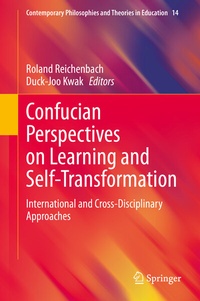
Confucian Perspectives on Learning and Self-Transformation
Description

This book bridges the regions of East Asia and the West by offering a detailed and critical inquiry of educational concepts of the East Asian tradition. It provides educational thinkers and practitioners with alternative resources and perspectives for their educational thinking, to enrich their educational languages and to promote the recognition of educational thoughts from different cultures and traditions across a global world.
The key notions of Confucian and Neo-Confucian philosophy directly concern the ideals, processes and challenges of learning, education and self-transformation, which can be seen as the western equivalences of liberal education, including the German concept of Bildung. All the topics in the book are of fundamental interest across diverse cultures, giving a voice to a set of long-lasting and yet differentiated cultural traditions of learning and education, and thereby creating a common space for critical philosophical reflection of one's own educational tradition and practice.
More details
Other editions
Additional editions
Persons
Duck-Joo Kwak is a professor of Philosophy of Education at Seoul National University, Korea. Her recent research interests are in arts-education, philosophy of teacher education, and comparative philosophy of education on the humanistic traditions between the East and West. She also has written numerous articles on Stanley Cavell, especially his existential interpretation of later Wittgenstein, and civic and moral education in the post-liberal Confucian culture.
Content
The Pleasure of Learning: An Introduction; Roland Reichenbach and Duck-Joo Kwak.- 1. Confucian Education as Life Education and its Modern Relevance; Chung Yi Cheng.- 2. Educational Relationship in the Analects of Confucius; Jeong-Gil Woo.- 3. Ritual, Virtue, and Education: An interpretation of Xunzi's philosophy of ritual; Morimichi Kato.- 4. Ogyû Sorai on the Content and Intent of Learning; Paulus Kaufmann.- 5. Enlightenment and Freedom in a Confucian Way ???? (wanwu yiti) - A Philosophical Concept and its Educational relevance; Niklaus Schefer.- 6. "When the Heart/Mind is lost." The Metaphysics of Educational Theory; Roland Reichenbach.- 7. A Vietnamese Reading of the Master's Classic: Ph?m Nguy?n Du's Humble Comments on The Analects - An Example of Transformative Learning; Nguyen Nam.- 8. Self-Cultivation with Brushes: From the Perspective of Graphocentrism; Ruyu Hung.- 9. Zhu Xi's Ethics of Reading;Duck-Joo Kwak.
