

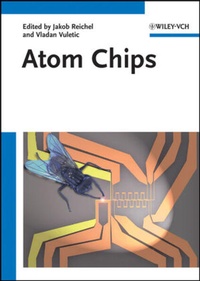
Atom Chips
1st Edition
Published on 30. November 2010
XX, 425 pages
978-3-527-63336-4 (ISBN)
Description

This stimulating discussion of a rapidly developing field is divided into two parts. The first features tutorials in textbook style providing self-contained introductions to the various areas relevant to atom chip research.
Part II contains research reviews that provide an integrated account of the current state in an active area of research where atom chips are employed, and explore possible routes of future progress. Depending on the subject, the length of the review and the relative weight of the 'review' and 'outlook' parts vary, since the authors include their own personal view and style in their accounts.
Part II contains research reviews that provide an integrated account of the current state in an active area of research where atom chips are employed, and explore possible routes of future progress. Depending on the subject, the length of the review and the relative weight of the 'review' and 'outlook' parts vary, since the authors include their own personal view and style in their accounts.
More details
Other editions
Additional editions
Jakob Reichel | Vladan Vuletic
Atom Chips
Book
02/2011
1st Edition
Wiley-VCH
€145.00
Article exhausted; check different version
Persons
Jakob Reichel is a member of the Laboratoire Kastler Brossel of the Ecole Normale Supérieure (E.N.S.)
and professor of physics at the Université Pierre et Marie Curie in Paris. After studies in Bonn and Munich, he entered the field of ultracold atoms with a PhD at the E.N.S. in Paris. He then joined the team of T. W. Hänsch in Munich and started developing what is now known as atom chips. Having obtained a European Young Investigator Award (EURYI) and a Chaire d'Excellence of the French Government, he crossed borders once again and took up his current position in Paris in 2004. His group currently explores the applications of atom chips in quantum information and precision metrology.
Vladan Vuletic received his Ph.D. degree in physics from the Ludwig-Maximilians-Universität Munich. While a postdoctoral researcher with the Max-Planck Institute for Quantum Optics in Garching, Germany, Professor Vuletic accepted a Lynen Fellowship at Stanford University in 1997. In 2000, he was appointed an Assistant Professor in the Department of Physics at Stanford and in 2003 accepted an Assistant Professorship in Physics at MIT. He was promoted to Associate Professor in 2004. Recent awards include a 2003 to 2004 Alfred P. Sloan Research Fellowship and the Lester Wolfe Career Development Chair at MIT.
and professor of physics at the Université Pierre et Marie Curie in Paris. After studies in Bonn and Munich, he entered the field of ultracold atoms with a PhD at the E.N.S. in Paris. He then joined the team of T. W. Hänsch in Munich and started developing what is now known as atom chips. Having obtained a European Young Investigator Award (EURYI) and a Chaire d'Excellence of the French Government, he crossed borders once again and took up his current position in Paris in 2004. His group currently explores the applications of atom chips in quantum information and precision metrology.
Vladan Vuletic received his Ph.D. degree in physics from the Ludwig-Maximilians-Universität Munich. While a postdoctoral researcher with the Max-Planck Institute for Quantum Optics in Garching, Germany, Professor Vuletic accepted a Lynen Fellowship at Stanford University in 1997. In 2000, he was appointed an Assistant Professor in the Department of Physics at Stanford and in 2003 accepted an Assistant Professorship in Physics at MIT. He was promoted to Associate Professor in 2004. Recent awards include a 2003 to 2004 Alfred P. Sloan Research Fellowship and the Lester Wolfe Career Development Chair at MIT.
Content
I. Tutorials
1. Producing Bose-Einstein Condensates with Atom Chips
2. Atom Chip Fabrication
3. Atom-Surface Interactions
4. Atom Interferometry (Cold Atom Metrology)
5 Neutral-Atom Quantum Information Technology
II. Research Reviews
1. 1D Quantum Gases
2. Cavity QED
3. Rydberg Atom Chips
4. Electronics for Atom Chips Experiments
5. Portable Cold Atom Devices
6. Chip Traps for Fermions, Ions, Molecules
7. RF Potentials
8. Atom-Nanodevice Interaction
1. Producing Bose-Einstein Condensates with Atom Chips
2. Atom Chip Fabrication
3. Atom-Surface Interactions
4. Atom Interferometry (Cold Atom Metrology)
5 Neutral-Atom Quantum Information Technology
II. Research Reviews
1. 1D Quantum Gases
2. Cavity QED
3. Rydberg Atom Chips
4. Electronics for Atom Chips Experiments
5. Portable Cold Atom Devices
6. Chip Traps for Fermions, Ions, Molecules
7. RF Potentials
8. Atom-Nanodevice Interaction
