

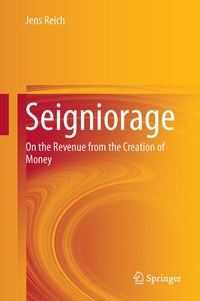
Seigniorage
Description

This book analyzes the revenues from the creation of currency by a central government. Adopting an institutional perspective, it develops a general theory of seigniorage by identifying three monetary regimes in economic history and the history of economic thought: a commodity currency, a fiat currency and a credit currency regime. As such it provides a modern analytical framework to analyze the nature of revenues from the creation of currency and their optimal height, whether currency is issued by means of minting coins, by printing and spending paper notes, by crediting private entities, or combinations thereof.
The results of this analysis stretch beyond the immediate topic. The book establishes a relationship between the theory of seigniorage and government debt, the theory of the interest rate, the optimal rate of inflation, or the effectiveness and inflationary limits of outright monetary transactions.
Reviews / Votes
"Reich has performed a valuable service in surveying and categorizing the extensive literature on seigniorage. Anglophone readers, in particular, will benefit from exposure to a wide range of sources that might not otherwise come to their attention." (David Glasner, Journal of the History of Economic Thought, June 2, 2020)
More details
Other editions
Additional editions
Person
Jens Reich studied economics and social sciences at Frankfurt University and at the New School for Social Research in New York. He received his PhD from Frankfurt University and has thaught at several Universities. He was, among others, Visiting Assistant Professor at Université Lumiere Lyon 2 (Minerve Program) and holds a lectureship at Frankfurt University. He published in several Journals and edited volumes, among others with Claudia M. Buch, Vice-President of the Deutsche Bundesbank. In 2014, he left the division for Financial Market and Financial Economics at the German Federal Financial Supervisory Authority (BaFin) and joined the German Central Bank (Bundesbank) where he is currently Senior Economist in the Division for General Policy on Macroprudential Policy Issues in the Department for Financial Stability.
He is founder and organizer of the sole PhD and Post-Doc colloquium for the history of economic thought in the German speaking area, which from 2017 onward is officially part of the Verein für Socialpolitik. His research focusses on monetary theory.
Content
Preface.- 1 Seigniorage in Institutional Perspective.- 2 Seigniorage in the History of Economic Thought.- 3 Seigniorage from Fiat Currency: Presents State of Economics.- 4 Seigniorage from Commodity Currency.- 5 Seigniorage from Credit Currency.- 6 Seigniorage in Mixed Currency Systems.- 7 Extended Seignorage.- 8 General Theory of Seigniorage.
