

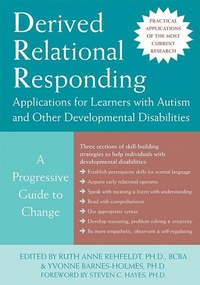
Derived Relational Responding Applications for Learners with Autism and Other Developmental Disabilities
Description

Copublished with Context Press
Derived Relational Responding offers a series of revolutionary intervention programs for applied work in human language and cognition targeted at students with autism and other developmental disabilities. It presents a program drawn from derived stimulus relations that you can use to help students of all ages acquire foundational and advanced verbal, social, and cognitive skills.
The first part of Derived Relational Responding provides step-by-step instructions for helping students learn relationally, acquire rudimentary verbal operants, and develop other basic language skills. In the second section of this book, you'll find ways to enhance students' receptive and expressive repertoires by developing their ability to read, spell, construct sentences, and use grammar. Finally, you'll find out how to teach students to apply the skills they've learned to higher order cognitive and social functions,...
More details
Other editions
Additional editions
Content
- Intro
- Introduction and Acknowledgments
- PART 1
- Establishing the Prerequisites for Normal Language
- Chapter 1
- Reinforcer Identification Strategies and Teaching Learner Readiness Skills
- Thomas S. HigbeeUtah State University
- Chapter 2
- The Assessment of Basic Learning Abilities (ABLA) and Its Relation to the Development of Stimulus Relations in Persons with Autism and Other Intellectual Disabilities
- W. Larry Williams and Marianne L. JacksonUniversity of Nevada, Reno
- 3
- Observing Responses: Foundations of Higher Order Verbal Operants
- Dolleen-Day Keohane and Jo Ann Pereira DelgadoColumbia University Teachers College and CABASR. Douglas GreerColumbia University Graduate School of Arts and Science Teachers College
- Chapter 4
- Joint Attention and Social Referencing in Infancy as Precursors of Derived Relational Responding
- Martha Peláez, Ph.D.Florida International University
- Chapter 5
- Establishing Mand and Tact Repertoires
- Linda A. LeBlanc and Courtney M. Dillon, Western Michigan University, and Rachael A. Sautter Y.A.L.E. School
- Part 2
- Chapter 6
- Nonrelational and Relational Instructional Control
- Chapter 7
- Naming and Frames of Coordination
- Caio F. Miguel, California State University, Sacramento, and Anna I. Petursdottir, Texas Christian University
- APPENDIX
- Chapter 8
- Acquiring the Earliest Relational Operants: Coordination, Difference, Opposition, Comparison, and Hierarchy
- Chapter 9
- Applying Relational Operants to Reading and Spelling
- Deisy G. de Souza, Julio C. de Rose, and Camila Domeniconi, Universidade Federal de São Carlos, Brazil
- Chapter 10
- Syntax, Grammatical Transformation, and Productivity: A Synthesis of Stimulus Sequences, Equivalence Classes, and Contextual Control
- Harry A. Mackay, Northeastern University and Praxis Inc. and Lanny Fields, Queens College and the Graduate School of the City University of New York
- Chapter 11
- Extending Functional Communication Through Relational Framing
- Rocio Rosales and Ruth Anne Rehfeldt, Southern Illinois University
- Part 3
- Chapter 12
- Training Analogical Reasoning as Relational Responding
- Ian Stewart, National University of Ireland, Galway, Dermot Barnes-Holmes, National University of Ireland, Maynooth, and Tim Weil, University of Nevada, Reno
- Chapter 13
- Understanding and Training Perspective-taking as Relational Responding
- Louise McHugh, University of Wales, Swansea, and Yvonne Barnes-Holmes and Dermot Barnes-Holmes, National University of Ireland, Maynooth
- Chapter 14
- Establishing Empathy
- Chapter 15
- Mathematical Reasoning
- Chris Ninness, James Holland, Glen McCuller, Robin Rumph, Sharon Ninness, and Jennifer McGinty, Stephen F. Austin State University, and Mark Dixon, Southern Illinois University
- Chapter 16
- Developing Self-Directed Rules
- Chapter 17
- Teaching Flexible, Intelligent, and Creative Behavior
