

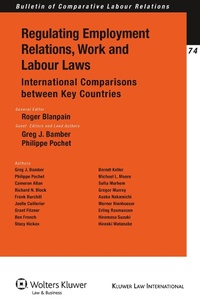
Regulating Employment Relations, Work and Labour Laws
International Comparisons between Key Countries
Kluwer Law International (Publisher)
Published on 28. May 2010
224 pages
978-90-411-5511-5 (ISBN)
Description

The complexity of employment arrangements in various countries tends to make it difficult to understand them. Nevertheless, it is important to 'take stock' periodically, particularly from an internationally comparative perspective. This remarkable book is a giant step in that direction. It is especially valuable in the context of increasing globalisation.
For each of nine key jurisdictions - the European Union, Germany, Sweden, United Kingdom, United States of America, Canada, New Zealand, Australia and Japan - experts present detailed information and analysis on key issues, shedding valuable light on trends in such specific areas of employment relations as the following:
atypical work and flexible work arrangements;
dispute settlement procedures such as negotiation, conciliation, mediation, arbitration and other forms of governmental or judicial intervention;
job security, anti-discrimination and gender equality;
recognition of unions and employers' associations and forms of employee representation;
how collective bargaining is regulated, whom the collective agreements cover and what they contain;
parental leave and childcare policy;
the capacity of individual agreements to override or not override collective agreements;
minimum wage levels;
overtime and shift work; and
paid leave entitlements.
As a general framework, Part 1 offers an insightful summary of the underpinnings of current analysis of globalization, including discussion of the varieties of capitalism thesis, the divergence/convergence debate (with its models of bipolarization, clustering and hybridization), and elements of historical and political-economic path dependency in various cultures.
The information gathered here furthers understanding of the increasing 'disconnect' between the prevailing institutional framework for employment relations and the sweeping changes that are taking place in the world of work. With this book's analysis, practitioners and policymakers will be able to overcome their dated assumptions and more effectively accommodate each others' interests in the face of the complex mix of continuity and change that they are confronting.
The team of authors are experts in these countries. They are active in policy or legal analysis, business and/or scholarship.
For each of nine key jurisdictions - the European Union, Germany, Sweden, United Kingdom, United States of America, Canada, New Zealand, Australia and Japan - experts present detailed information and analysis on key issues, shedding valuable light on trends in such specific areas of employment relations as the following:
atypical work and flexible work arrangements;
dispute settlement procedures such as negotiation, conciliation, mediation, arbitration and other forms of governmental or judicial intervention;
job security, anti-discrimination and gender equality;
recognition of unions and employers' associations and forms of employee representation;
how collective bargaining is regulated, whom the collective agreements cover and what they contain;
parental leave and childcare policy;
the capacity of individual agreements to override or not override collective agreements;
minimum wage levels;
overtime and shift work; and
paid leave entitlements.
As a general framework, Part 1 offers an insightful summary of the underpinnings of current analysis of globalization, including discussion of the varieties of capitalism thesis, the divergence/convergence debate (with its models of bipolarization, clustering and hybridization), and elements of historical and political-economic path dependency in various cultures.
The information gathered here furthers understanding of the increasing 'disconnect' between the prevailing institutional framework for employment relations and the sweeping changes that are taking place in the world of work. With this book's analysis, practitioners and policymakers will be able to overcome their dated assumptions and more effectively accommodate each others' interests in the face of the complex mix of continuity and change that they are confronting.
The team of authors are experts in these countries. They are active in policy or legal analysis, business and/or scholarship.
More details
Other editions
Additional editions
Regulating Employment Relations, Work and Labour Laws
International Comparisons between Key Countries
Book
04/2010
Kluwer Law International
€123.50
Shipment within 10-20 days
Persons
Content
- Cover
- Half Title Page
- Title Page
- Copyright Page
- Summary of Contents
- Table of Contents
- Notes on Guest Editors and Lead Authors
- Notes on Other Authors
- Acknowledgements
- List of Abbreviations
- Preface
- Part I Frameworks for Internationally Comparative Analysis
- 1. DEBATES ABOUT CONVERGENCE AND DIVERGENCE
- 1.1. CONVERGENCE
- 1.2. DIVERGENCE
- 2. VARIETIES OF CAPITALISM
- 2.1. CLUSTERING
- 2.2. HYBRIDITY AND INTERNAL DIVERSITY
- 3. FUTURE CHALLENGES
- Part II An International Review of Key Jurisdictions
- 1. EUROPEAN UNION
- 1.1. MAJOR POLITICAL AND ECONOMIC DEVELOPMENTS
- 1.2. THE MAIN ACTORS
- 1.2.1. EU Institutions
- 1.2.2. Unions
- 1.2.3. Employers
- 1.3. STRUCTURE OF COLLECTIVE BARGAINING
- 1.4. CHANGES AND FUTURE TRENDS
- 2. GERMANY
- 2.1. MAJOR POLITICAL AND ECONOMIC DEVELOPMENTS
- 2.2. THE MAIN ACTORS
- 2.2.1. Government
- 2.2.2. Unions
- 2.2.3. Employers
- 2.3. STRUCTURE OF COLLECTIVE BARGAINING
- 2.4. CHANGES AND FUTURE TRENDS
- 3. SWEDEN
- 3.1. MAJOR POLITICAL AND ECONOMIC DEVELOPMENTS
- 3.2. THE MAIN ACTORS
- 3.3. STRUCTURE OF COLLECTIVE BARGAINING
- 3.4. RECENT CHANGES AND FUTURE TRENDS
- 4. UNITED KINGDOM
- 4.1. MAJOR POLITICAL AND ECONOMIC DEVELOPMENTS
- 4.2. THE MAIN ACTORS
- 4.2.1. Government
- 4.2.2. Unions
- 4.2.3. Employers
- 4.3. STRUCTURE OF COLLECTIVE BARGAINING
- 4.4. RECENT CHANGES AND FUTURE TRENDS
- 5. UNITED STATES OF AMERICA
- 5.1. MAJOR POLITICAL AND ECONOMIC DEVELOPMENTS
- 5.2. THE MAIN ACTORS
- 5.2.1. Government
- 5.2.2. Unions
- 5.2.3. Employers
- 5.3. STRUCTURE OF COLLECTIVE BARGAINING
- 5.4. RECENT CHANGES AND FUTURE TRENDS
- 6. CANADA
- 6.1. MAJOR POLITICAL AND ECONOMIC DEVELOPMENTS
- 6.2. THE MAIN ACTORS
- 6.2.1. Government
- 6.2.2. Unions
- 6.2.3. Employers
- 6.3. STRUCTURE OF COLLECTIVE BARGAINING
- 6.4. RECENT CHANGES AND FUTURE TRENDS
- 7. NEW ZEALAND
- 7.1. MAJOR POLITICAL AND ECONOMIC DEVELOPMENTS
- 7.2. THE MAIN ACTORS
- 7.2.1. Government
- 7.2.2. Unions
- 7.2.3. Employers
- 7.3. STRUCTURE OF COLLECTIVE BARGAINING
- 7.4. RECENT CHANGES AND FUTURE TRENDS
- 8. AUSTRALIA
- 8.1. MAJOR POLITICAL AND ECONOMIC DEVELOPMENTS
- 8.2. THE MAIN ACTORS
- 8.2.1. Government
- 8.2.2. Unions
- 8.2.3. Employers
- 8.3. STRUCTURE OF COLLECTIVE BARGAINING
- 8.4. RECENT CHANGES AND FUTURE TRENDS
- 9. JAPAN
- 9.1. MAJOR POLITICAL AND ECONOMIC DEVELOPMENTS
- 9.2. THE MAIN ACTORS
- 9.2.1. Government
- 9.2.2. Unions
- 9.2.3. Employers
- 9.3. STRUCTURE OF COLLECTIVE BARGAINING
- 9.4. RECENT CHANGES AND FUTURE TRENDS
- Part III An International Review of Key Issues
- Chapter 1 Work and Family
- 1.1. EUROPEAN UNION
- 1.2. GERMANY
- 1.3. SWEDEN
- 1.4. UNITED KINGDOM
- 1.5. UNITED STATES OF AMERICA
- 1.6. CANADA
- 1.7. NEW ZEALAND
- 1.8. AUSTRALIA
- 1.9. JAPAN
- Chapter 2 Individual Agreements
- 2.1. EUROPEAN UNION
- 2.2. GERMANY
- 2.3. SWEDEN
- 2.4. UNITED KINGDOM
- 2.5. UNITED STATES OF AMERICA
- 2.6. CANADA
- 2.7. NEW ZEALAND
- 2.8. AUSTRALIA
- 2.9. JAPAN
- Chapter 3 Non-standard Employment
- 3.1. EUROPEAN UNION
- 3.2. GERMANY
- 3.3. SWEDEN
- 3.4. UNITED KINGDOM
- 3.5. UNITED STATES OF AMERICA
- 3.6. CANADA
- 3.7. NEW ZEALAND
- 3.8. AUSTRALIA
- 3.9. JAPAN
- Chapter 4 Minimum Wage Levels
- 4.1. EUROPEAN UNION
- 4.2. GERMANY
- 4.3. SWEDEN
- 4.4. UNITED KINGDOM
- 4.5. UNITED STATES OF AMERICA
- 4.6. CANADA
- 4.7. NEW ZEALAND
- 4.8. AUSTRALIA
- 4.9. JAPAN
- Chapter 5 Working Time
- 5.1. EUROPEAN UNION
- 5.2. GERMANY
- 5.3. SWEDEN
- 5.4. UNITED KINGDOM
- 5.5. UNITED STATES OF AMERICA
- 5.6. CANADA
- 5.7. NEW ZEALAND
- 5.8. AUSTRALIA
- 5.9. JAPAN
- Chapter 6 Paid Leave Entitlements
- 6.1. EUROPEAN UNION
- 6.2. GERMANY
- 6.3. SWEDEN
- 6.4. UNITED KINGDOM
- 6.5. UNITED STATES OF AMERICA
- 6.6. CANADA
- 6.7. NEW ZEALAND
- 6.8. AUSTRALIA
- 6.9. JAPAN
- Chapter 7 Employment Protection
- 7.1. WHAT ARE FAIR AND UNFAIR INDIVIDUAL DISMISSALS?
- 7.1.1. EUROPEAN UNION
- 7.1.2. GERMANY
- 7.1.3. SWEDEN
- 7.1.4. UNITED KINGDOM
- 7.1.5. UNITED STATES OF AMERICA
- 7.1.6. CANADA
- 7.1.7. NEW ZEALAND
- 7.1.8. AUSTRALIA
- 7.1.9. JAPAN
- 7.2. COLLECTIVE REDUNDANCIES
- 7.2.1. EUROPEAN UNION
- 7.2.2. GERMANY
- 7.2.3. SWEDEN
- 7.2.4. UNITED KINGDOM
- 7.2.5. UNITED STATES OF AMERICA
- 7.2.6. CANADA
- 7.2.7. NEW ZEALAND
- 7.2.8. AUSTRALIA
- 7.2.9. JAPAN
- 7.3. ANTI-DISCRIMINATION
- 7.3.1. EUROPEAN UNION
- 7.3.2. GERMANY
- 7.3.3. SWEDEN
- 7.3.4. UNITED KINGDOM
- 7.3.5. UNITED STATES OF AMERICA
- 7.3.6. CANADA
- 7.3.7. NEW ZEALAND
- 7.3.8. AUSTRALIA
- 7.3.9. JAPAN
- Chapter 8 Dispute Settlement Procedures
- 8.1. EUROPEAN UNION
- 8.2. GERMANY
- 8.3. SWEDEN
- 8.4. UNITED KINGDOM
- 8.5. UNITED STATES OF AMERICA
- 8.6. CANADA
- 8.7. NEW ZEALAND
- 8.8. AUSTRALIA
- 8.9. JAPAN
- Chapter 9 Freedom of Association and Representative Organizations
- 9.1. EUROPEAN UNION
- 9.2. GERMANY
- 9.3. SWEDEN
- 9.4. UNITED KINGDOM
- 9.5. UNITED STATES OF AMERICA
- 9.6. CANADA
- 9.7. NEW ZEALAND
- 9.8. AUSTRALIA
- 9.9. JAPAN
- Chapter 10 Collective Bargaining and Collective Industrial Action: Coverage and Legal Framework
- 10.1. EUROPEAN UNION
- 10.2. GERMANY
- 10.3. SWEDEN
- 10.4. UNITED KINGDOM
- 10.5. UNITED STATES OF AMERICA
- 10.6. CANADA
- 10.7. NEW ZEALAND
- 10.8. AUSTRALIA
- 10.9. JAPAN
- References
- Back Cover
