

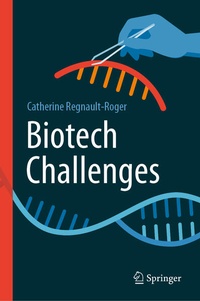
Biotech Challenges
Description

The evolution of genome's modification by genetic engineering was characterized by a major technological breakthrough with the discovery of CRISPR in 2012. A distinction is now made between first-generation biotechnologies developed in the 20th century and current second-generation biotechnologies, NGT or New Genomic Techniques, including genome editing. How do we consider these genomic modifications compared to those that occur spontaneously in nature? What are the applications of these techniques in the fields of plants, animals, and human health? What prospects in terms of development and independence for countries and at least what regulations are in force on the different continents?
The book questions what GMOs are, genome editing products and the place of genomic transformations today and tomorrow in our societies. It tries to give some geostrategic and regulatory benchmarks on biotech products in order to better understand the current issues.
Reviews / Votes
"Biotech Challenges, Catherine Regnault Roger's latest book, reviews these fast-changing innovations, as New Genomic Techniques (NGTs) such as CRISPR gene editing are being deployed in countries around the world. It is thoughtfully constructed and easily digestible, even for a lay readership; it runs 17 chapters and a concise 150 pages, making it widely accessible to a lay readership. It also includes invaluable bibliographic references." (Michel Thibier, Genetic Literacy Project, geneticliteracyproject.org, June 14, 2024)
"If you want to know more about biotechnology and the perspectives on gene-editing, make sure to check out this new book, called 'Biotech challenges'. It is a key book to understand and follow the ongoing EU debate and the issues surrounding it. The book provides global perspectives of biotech challenges in the world ... ." (seedworld.com, January 31, 2024)
More details
Other editions
Additional editions
Person
Graduated of Faculty of Pharmacy (René Descartes University-Paris V, now University of Paris), PhD in Natural Sciences from Pierre and Marie Curie University-Paris VI, now Paris Sorbonne, she has had an academic career in France (University Denis Diderot-Paris VII, CNAM Paris and University of Pau and Pays de l'Adour [UPPA]) and abroad (French cooperation at the University of Constantine in Algeria and at the Faculty of Pharmacy and Dentistry of Monastir in Tunisia), beginning from assistant professor to reach exceptional class professor. She is now professor emeritus at the University of Pau and Pays de l'Adour (E2S). She has created several university degrees at the UPPA, at the Master's level in biotechnology and plant bioprotection, at the second cycle level to encourage student mobility abroad (university degree in "International Studies") or in companies (degree University "Applied Science and Technology Training"). In terms of research, her works are recognized in the field of the bioprotection of agrosystems and the environment through a chemical ecology approach and the sanitary quality of crops (mycotoxins) ; then for transdisciplinary research on biotechnology, biocontrol and agricultural revolutions. She has served on numerous university committees, from the National Council of Universities (2003-2013), the Territorial Biological Monitoring Committee (2010-2015) of the Ministry of Agriculture and the National Commission for Engineering and Expertise (CGRA1) of the Institute for Research and Development (IRD) (2003-2007) as Vice-President in both bodies. Member of the Scientific Committee of the Haut Conseil des Biotechnologies for its entire duration (2009-2021) as an expert in ecotoxicology and regulatory issues on the post-marketing surveillance of transgenic crops, she is also a member emeritus of the National Academy of Pharmacy (Environmental Health section) and full member of the French Academy of Agriculture in which, after having been secretary of the Plant Production section, she is the director for the Academy's Books Committee and also director of the collection "Academies d'agriculture de France" published by Presses des Mines. She is also a member of the Editorial Board of Phytoma - la Santé du Végetal (Groupe de la France Agricole). She has written and coordinated several scientific reference works (in French, English, Spanish) which have been distinguished, as well as book chapters and numerous scientific and technical articles. The French Plant Protection Association (now Végéphyl) awarded her its Medal of Excellence in 2015. She is also a Knight in the Order of the French Legion of Honor and an Officer in the French Order of Agricultural Merit.
Content
See attached
