

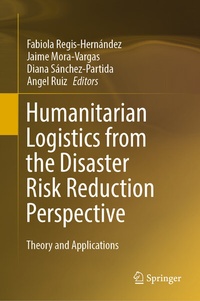
Humanitarian Logistics from the Disaster Risk Reduction Perspective
Description

The target audience of the book includes professionals who work in Linear Programming, Logistics, Optimization (Mathematical, Robust, Stochastic), Management Science, Mathematical Programming, Networks, Scheduling, Simulation, SupplyChain Management, Sustainability, and similar areas. It can be useful for researchers, academics, graduate students, and anyone else doing research in the field
More details
Other editions
Additional editions
Persons
Fabiola Regis Hernández Ph.D., is a professor in the Industrial Engineering Department of the Engineering and Sciences School of Tecnologico de Monterrey (San Luis Potosi, Mexico). Her research interests are on network flow problems, discrete optimization, multi-objective programming, approximation techniques, and heuristic approaches. Her research is focused on real-life applications, such as humanitarian logistics, healthcare, and emergency management systems. Her research has been developed in collaboration with Université Laval, HEC Montreal, and Istituto di Matematica Applicata e Tecnologie Informatiche (IMATI).
Jaime Mora-Vargas, Ph.D., is a professor-researcher in Tecnologico de Monterrey (Estado de Mexico, Mexico). His research area includes the development and implementation of algorithms for the solution of combinatorial problems, based on hybridizations between algorithms exact and advanced artificial intelligence methods. His work has been developed in collaborationwith renowned groups of institutions such as MIT, HEC Montreal, Université Laval, Eindhoven University of Technology, Naval School of Cadets Almirante Padilla, among others. Diana Sánchez-Partida is Professor-Researcher and Academic Director of the Postgraduate in Logistics and Supply Chain Management at Universidad Popular Autonoma del Estado de Puebla (UPAEP) in Mexico. She is the leader of the Humanitarian Logistics Group in the same institution. She received a Ph.D. in Logistics and Supply Chain Management. She has been granted a doctorate and post-doctorate scholarship by CONACyT. Since 2018, she has been a member of the National Council of Researchers (SNI level 1) in Mexico. Her research areas of interest are Disaster Risk Reduction, Humanitarian Logistics, Resilience in Economic Activities and Logistics Operations, among others.Angel Ruiz, Ph.D, is a professor at Université Laval in Canada. He is member of the Interuniversity Research Center on Entreprise Networks, Logistics and Transportation (CIRRELT) and of the FOR@C research consortium. His main research interests are operations research applied to healthcare systems and emergency logistics management. He has published more than 50 scientific articles in international journals related to these disciplines, and he regularly presents his research works in focused international conferences, such as ORAHS or HCSE.
