

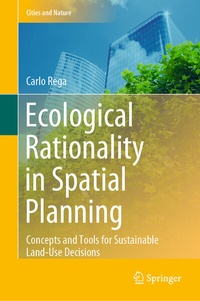
Ecological Rationality in Spatial Planning
Description

Spatial planning defines how men use one of the most important and scarce resources on Earth: land. Planners therefore play a key role in countering or deepening the current ecological crisis. To foster ecological transitions, planning scholars and practitioners need to be equipped with sound theories and practical tools. To this end, this book advocates a re-foundation of spatial planning under the paradigm of "ecological rationality", based on the revaluation of early pioneers of ecological planning and mutual fertilization with different disciplines, including decision-making science, ecology, (eco)system theory, land use science and political ecology.
The key principles of ecological rationality and its application to spatial planning are discussed and this conceptual framework is used to explain the main underlying drivers of ecological degradation and their spatial manifestations at the local level. Current policy instruments in the European context, which can be used tounderpin ecological planning, such as Green Infrastructure and the Mapping and Assessment of Ecosystem Service (MAES) initiative, are also examined.
More details
Other editions
Additional editions
Person
Dr. Carlo Rega has a M.Sc. in environmental engineering and a PhD in spatial planning. His research interests include spatial and land-use planning, sustainable agriculture and rural development, mapping and assessment of ecosystem services; strategic environmental assessment; spatial analysis and ecological/environmental modelling. He has been involved in different international research projects on these topics and has published several papers in peer-reviewed journals. He has also advised public and private bodies in this field. Dr. Rega is currently a researcher at the European Commission Joint Research Centre in Ispra, Italy.
Content
Chapter 1. Standing on the shoulders of giants - reviving ecological approaches in planning traditions.- Chapter 2. The concept of Ecological Rationality and its application to spatial planning.- Chapter 3. Bridging the gaps: connecting Spatial Planning with Land Use Science and Political Ecology.- Chapter 4. Towards a conceptual framework for ecological rationality in spatial planning.- Chapter 5. A closer look to processes of territorial transformations in Europe: urbanisation, agricultural intensification and land abandonment.- Chapter 6. Policies and regulatory frames in the EU and the needed link with spatial planning.- Chapter 7. Conclusions and ways forward: five propositions for bringing back ecological rationality in spatial planning.
