

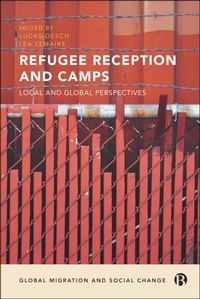
Refugee Reception and Camps
Local and Global Perspectives
Bristol University Press
1st Edition
Published on 14. October 2025
318 pages
978-1-5292-2284-5 (ISBN)
Description

Available open access digitally under CC-BY-NC-ND licence.
This edited collection provides new insights into refugee reception and camps by focusing on the overlap between local and global dynamics in the governance of camps.
Contributors examine how camps are (re)placed within their local contexts across regions including Africa, America, Asia, Europe and Oceania. They explore how local environments both influence, and are influenced by, global flows, networks and connections in the governance of refugee camps.
By highlighting these interconnections, this volume provides valuable insights for scholars, policy makers and practitioners seeking to understand the complex realities of refugee camps around the world.
This edited collection provides new insights into refugee reception and camps by focusing on the overlap between local and global dynamics in the governance of camps.
Contributors examine how camps are (re)placed within their local contexts across regions including Africa, America, Asia, Europe and Oceania. They explore how local environments both influence, and are influenced by, global flows, networks and connections in the governance of refugee camps.
By highlighting these interconnections, this volume provides valuable insights for scholars, policy makers and practitioners seeking to understand the complex realities of refugee camps around the world.
Reviews / Votes
'This vital collection offers rare, incisive insights into the entangled local and global dynamics shaping refugee camps within a uniquely global frame.' Paolo Novak, School of Oriental and African Studies (SOAS), LondonMore details
Series
Edition
First Edition
Language
English
Place of publication
Bristol
United Kingdom
Target group
Professional and scholarly
Illustrations
16 s/w Abbildungen
16 Illustrations, black and white
File size
2,56 MB
ISBN-13
978-1-5292-2284-5 (9781529222845)
Copyright in bibliographic data and cover images is held by Nielsen Book Services Limited or by the publishers or by their respective licensors: all rights reserved.
Schweitzer Classification
Other editions
Additional editions
Refugee Reception and Camps
Local and Global Perspectives
Book
10/2025
1st Edition
Bristol University Press
€41.00
Shipment within 3-4 weeks
Persons
Lucas Oesch is Scientific Officer at the University of Neuchatel. He was previously based at the University of Luxembourg where he directed the REFUGOV research project on refugee reception in Luxembourg and Jordan.
Lea Lemaire is Associate Researcher at Mesopolhis, Aix-Marseille University and at REPI, Universite libre de Bruxelles. Previously, she worked as a postdoctoral researcher at the University of Luxembourg where she managed the REFUGOV research project on refugee reception in Luxembourg and Jordan.
Lea Lemaire is Associate Researcher at Mesopolhis, Aix-Marseille University and at REPI, Universite libre de Bruxelles. Previously, she worked as a postdoctoral researcher at the University of Luxembourg where she managed the REFUGOV research project on refugee reception in Luxembourg and Jordan.
Contributions
Durham University
Radboud University
South Asian University
University of Victoria
Johannes Gutenberg- Universitaet
Erasmus University Rotterdam (International Institute of Social Studies (ISS))
Macquarie University
University of Bologna
University of Wisconsin Law School
Macquarie University
Content
1. Introduction: A Local and Global Perspective on Refugee Reception and Camps - Lucas Oesch and Le?a Lemaire
2. Setting the Scene: Refugee Reception and the Challenge of 'the Local' - Jonathan Darling
Part 1: Camps and Their Relations with Cities
3. Local Governance of/through Informal Refugee Camps: Revisiting Lebanon's Palestinian and Syrian 'Gatherings' - Nora Stel
4. Unrelated spaces? Camps and cities in Jordan and Luxembourg - Lea Lemaire and Lucas Oesch
5. Between the Exceptional and the Ordinary: The Local Turn and the Camp in South Asia - Ankur Datta
6. Welcome to the Bubble: Governing the Parisian 'Migration Crisis' from the Street to the Centre de premier accueil - Melora Koepke
Part 2: Camps and the Provision of Care
7. The Governance of Migrant Reception and More-Than-Local Stories in Southern Costa Rica - Elena Reichl and Nanneke Winters
8. Camps and Safe Houses: Serbia's Local Geographies of Reception and Care for Unaccompanied Refugee Children - Jessica Collins-Bojovic and Claudio Minca
9. An Unlikely Host in Humanitarian Reception: Fort McCoy during Operation Allies Welcome in the US - Erin Barbato
10. Non-Care in the Detention Hotel: 20 Years of Australia's use of 'Alternative Places of Detention' - Andrew Burridge
Part 3: Camps as Economic Resources
11. How Do Camps Affect Cities? The Political Economy of Refugee Camps and Arua, Uganda - Evan Easton-Calabria
12. Refugee Accommodation Industries: Migration Governance, Profit and City Making - Rene Kreichauf
13. Humanitarian Governance as Development: Protracted Refugee Camps as Drivers of Investment and Innovation in Refugee-Hosting Regions - Bram J. Jansen
14. Providing Hospitality to Asylum Seekers: Exploring the Tension between Tourism and Refugee Accommodation in Austria's Migration System through Visual Research - Nina Valerie Kolowratnik and Johannes Pointl
2. Setting the Scene: Refugee Reception and the Challenge of 'the Local' - Jonathan Darling
Part 1: Camps and Their Relations with Cities
3. Local Governance of/through Informal Refugee Camps: Revisiting Lebanon's Palestinian and Syrian 'Gatherings' - Nora Stel
4. Unrelated spaces? Camps and cities in Jordan and Luxembourg - Lea Lemaire and Lucas Oesch
5. Between the Exceptional and the Ordinary: The Local Turn and the Camp in South Asia - Ankur Datta
6. Welcome to the Bubble: Governing the Parisian 'Migration Crisis' from the Street to the Centre de premier accueil - Melora Koepke
Part 2: Camps and the Provision of Care
7. The Governance of Migrant Reception and More-Than-Local Stories in Southern Costa Rica - Elena Reichl and Nanneke Winters
8. Camps and Safe Houses: Serbia's Local Geographies of Reception and Care for Unaccompanied Refugee Children - Jessica Collins-Bojovic and Claudio Minca
9. An Unlikely Host in Humanitarian Reception: Fort McCoy during Operation Allies Welcome in the US - Erin Barbato
10. Non-Care in the Detention Hotel: 20 Years of Australia's use of 'Alternative Places of Detention' - Andrew Burridge
Part 3: Camps as Economic Resources
11. How Do Camps Affect Cities? The Political Economy of Refugee Camps and Arua, Uganda - Evan Easton-Calabria
12. Refugee Accommodation Industries: Migration Governance, Profit and City Making - Rene Kreichauf
13. Humanitarian Governance as Development: Protracted Refugee Camps as Drivers of Investment and Innovation in Refugee-Hosting Regions - Bram J. Jansen
14. Providing Hospitality to Asylum Seekers: Exploring the Tension between Tourism and Refugee Accommodation in Austria's Migration System through Visual Research - Nina Valerie Kolowratnik and Johannes Pointl
