

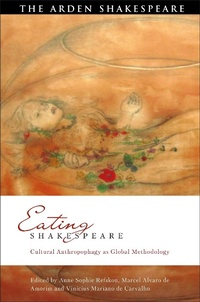
Eating Shakespeare
Cultural Anthropophagy as Global Methodology
1st Edition
Published on 16. May 2019
328 pages
978-1-350-03571-3 (ISBN)
Description

Eating Shakespeare provides a constructive critical analysis of the issue of Shakespeare and globalization and revisits understandings of interculturalism, otherness, hybridity and cultural (in)authenticity. Featuring scholarly essays as well as interviews and conversation pieces with creatives - including Geraldo Carneiro, Fernando Yamamoto, Diana Henderson, Mark Thornton Burnett, Samir Bhamra, Tajpal Rathore, Samran Rathore and Paul Heritage - it offers a timely and fruitful discourse between global Shakespearean theory and practice.
The volume uniquely establishes and implements a conceptual model inspired by non-European thought, thereby confronting a central concern in the field of Global Shakespeare: the issue of Europe operating as a geographical and cultural 'centre' that still dominates the study of Shakespearean translations and adaptations from a 'periphery' of world-wide localities. With its origins in 20th-century Brazilian modernism, the concept of 'Cultural Anthropophagy' is advanced by the authors as an original methodology within the field currently understood as 'Global Shakespeare'. Through a broad range of examples drawn from theatre, film and education, and from both within Brazil and beyond, the volume offers illuminating perspectives on what Global Shakespeare may mean today.
The volume uniquely establishes and implements a conceptual model inspired by non-European thought, thereby confronting a central concern in the field of Global Shakespeare: the issue of Europe operating as a geographical and cultural 'centre' that still dominates the study of Shakespearean translations and adaptations from a 'periphery' of world-wide localities. With its origins in 20th-century Brazilian modernism, the concept of 'Cultural Anthropophagy' is advanced by the authors as an original methodology within the field currently understood as 'Global Shakespeare'. Through a broad range of examples drawn from theatre, film and education, and from both within Brazil and beyond, the volume offers illuminating perspectives on what Global Shakespeare may mean today.
More details
Series
Edition
1. Auflage
Language
English
Place of publication
London
United Kingdom
Publishing group
Bloomsbury Publishing PLC
Target group
College/higher education
Illustrations
6 bw illus
ISBN-13
978-1-350-03571-3 (9781350035713)
Copyright in bibliographic data and cover images is held by Nielsen Book Services Limited or by the publishers or by their respective licensors: all rights reserved.
Schweitzer Classification
Other editions
Additional editions
Anne Sophie Refskou | Marcel Alvaro de Amorim | Vinicius Mariano de Carvalho
Eating Shakespeare
Cultural Anthropophagy as Global Methodology
Book
02/2021
The Arden Shakespeare
€49.70
Shipment within 15-20 days
Persons
Anne Sophie Refskou, Research and Education Consultant at HamletScenen, Elsinore, Denmark; Marcel Alvaro de Amorim, Federal Institute of Rio de Janeiro, Brazil and Vinicius Mariano de Carvalho, King's College London, UK.
Content
List of Illustrations
Notes on Contributors
Acknowledgements
Foreword, David Schalkwyk
Anne Sophie Refskou, Marcel Amorim and Vinicius Mariano de Carvalho, Introduction
Dialogue I: Shakespeare and Cultural Anthropophagy in Practice
Geraldo Carneiro and Vinicius de Carvalho, 'We are all Cannibals: Reflections on Translating Shakespeare'
Víctor Huertas Martín, 'Miguel Del Arco's Las Furias (2016): Cultural Anthropophagy as Adaptation Practice and as Metafiction'
'Devouring Shakespeare in North-Eastern Brazil': Clowns de Shakespeare director Fernando Yamamoto in Conversation with Paulo da Silva Gregório
Cristiane Busato Smith, 'Cannibalizing Hamlet in Brazil: Ophelia meets Oxum'
Dialogue II: Global Conversations and Intricate Intersections
'De-centring Shakespeare, incorporating Otherness': Diana Henderson in conversation with Koel Chatterjee
Marcel Alvaro de Amorim, 'Transconstructing Shakespeare'
'Past and Present Trajectories for Global Shakespeare': Mark Thornton Burnett in Conversation with Anne Sophie Refskou
Dialogue III: Insiders and Outsiders
Varsha Panjwani, 'Tupi or not Tupi': Conversations with Brasian Shakespeare Directors'
Anne Sophie Refskou, '"Not where he eats, but where he is eaten": Rethinking Otherness in (British) Global Shakespeare'
Eleine Ng, Rojak Shakespeare, 'Devouring the Self and Digesting Otherness on the Singaporean Stage'
Dialogue IV: Re-cultivating and Re-Disseminating Shakespeare Beyond the Institution
Aimara Resende, 'Engrafting Him New: Educating for Citizenship via Shakespeare in a Rural Area in Brazil'
'Cultural Anthropophagy and the De-institutionalization of Shakespeare': Paul Heritage in conversation with Vinicius de Carvalho
Afterword: Alfredo Michel Modenessi
Notes
References
Index
Notes on Contributors
Acknowledgements
Foreword, David Schalkwyk
Anne Sophie Refskou, Marcel Amorim and Vinicius Mariano de Carvalho, Introduction
Dialogue I: Shakespeare and Cultural Anthropophagy in Practice
Geraldo Carneiro and Vinicius de Carvalho, 'We are all Cannibals: Reflections on Translating Shakespeare'
Víctor Huertas Martín, 'Miguel Del Arco's Las Furias (2016): Cultural Anthropophagy as Adaptation Practice and as Metafiction'
'Devouring Shakespeare in North-Eastern Brazil': Clowns de Shakespeare director Fernando Yamamoto in Conversation with Paulo da Silva Gregório
Cristiane Busato Smith, 'Cannibalizing Hamlet in Brazil: Ophelia meets Oxum'
Dialogue II: Global Conversations and Intricate Intersections
'De-centring Shakespeare, incorporating Otherness': Diana Henderson in conversation with Koel Chatterjee
Marcel Alvaro de Amorim, 'Transconstructing Shakespeare'
'Past and Present Trajectories for Global Shakespeare': Mark Thornton Burnett in Conversation with Anne Sophie Refskou
Dialogue III: Insiders and Outsiders
Varsha Panjwani, 'Tupi or not Tupi': Conversations with Brasian Shakespeare Directors'
Anne Sophie Refskou, '"Not where he eats, but where he is eaten": Rethinking Otherness in (British) Global Shakespeare'
Eleine Ng, Rojak Shakespeare, 'Devouring the Self and Digesting Otherness on the Singaporean Stage'
Dialogue IV: Re-cultivating and Re-Disseminating Shakespeare Beyond the Institution
Aimara Resende, 'Engrafting Him New: Educating for Citizenship via Shakespeare in a Rural Area in Brazil'
'Cultural Anthropophagy and the De-institutionalization of Shakespeare': Paul Heritage in conversation with Vinicius de Carvalho
Afterword: Alfredo Michel Modenessi
Notes
References
Index
